



On 10th October 1807 Joseph Huntley is born in Sibford Ferris, a village close to Banbury in Oxfordshire. He is the son of Joseph & Mary Huntley; they are a Quaker family and at this time his father is a schoolmaster, but latterly the family move to Reading and he opens a shop on London Street selling biscuits and confectionery. His father, along with his brother, will go on to be the founders of Huntley & Palmers – the great biscuit manufacturers.
The younger Joseph is believed to have been apprenticed to Edwin Fardon, the husband of his father’s niece by marriage, who had an ironworks in London Street. After his apprenticeship he becomes a journeyman ironmonger in Worcestershire and then in 1832 returns to Reading and rents no. 68 London Street and sets up as an ironmonger opposite his family’s shop and next to Crown Inn, which was one of only two posting inns in Reading and a halt for traffic from London to West country. The 1875 map below shows the location of the by-then much larger tin works. The original shop was facing London Street. Also shown in the smaller circle is Huntley’s father’s original bakery shop. The picture is of Joseph Huntley junior.
In the 1841 census we see him recorded as an ironmonger in London Street.
1875 Ordnance Survey Map – reproduced with permission of the National Library of Scotland
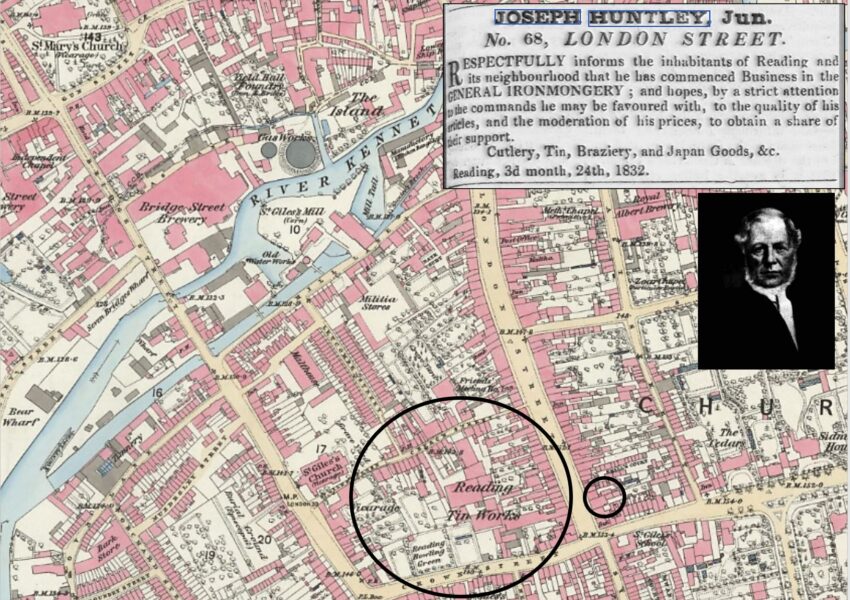
Huntley is producing domestic ironware goods such as kitchen ranges, fireplaces and garden implements. He places an announcement in the Berkshire Chronicle of 31st March 1832 stating “Joseph Huntley Jun. No 68 London Street. Respectfully informs the inhabitants of Reading and its neighbourhood that he has commenced business in the general ironmongery, and hopes by a strict attention to the commands he may be favoured with, to the quality of his articles, and the moderation of his prices, to obtain a share of their support. Cutlery, Tin, Braziery and Japan Goods etc”. He also advertises undertakings described as “the tinning and all sorts of repairs connected with the tin and brazing business”.
The early years of his enterprise are focussed on the domestic trade. However, they are greatly supplemented by an order for the supply of tools to support the construction of the Great Western Railway, which is being built through Reading between 1837 and 1840. The railway enterprise tries to keep costs low by using local suppliers where possible. Most of the larger ironware requirements are supplied by Reading’s Barrett & Exall’s Katesgrove foundry, while Huntley is supplying the tools and smaller iron objects.
Since 1822 his father and brother have been operating their biscuit making enterprise from no. 72 London Street and as we have seen it is conveniently situated by the Crown Inn, one of Reading’s posting Inns serving travellers between London and the West Country, the Huntleys start selling biscuits to these travellers as they wait for their coaches. The reputation of these biscuits grows and they need a means of packaging their goods to keep them fresh. Joseph senior engages his son, Joseph junior, to provide tins to hold the biscuits. Surviving accounts for 1837-1839 show that grocers were charged for the tins and were then refunded when they returned them; it isn’t clear if they were also charged a transaction fee. The extra work that the production of these tins brings for the ironmongery business means that the younger Huntley has to enlarge his premises; he builds two square rooms to the rear of the shop and installs around twenty small furnaces. At this time, the equipment that he had would have used would allow a practiced ironmonger to make around 100 tins per day.
The partnering of the family firms continues. However, by 1846 the biscuit side of the family, now called Huntley & Palmers, has opened their large King’s Road site and their increasing mechanisation drives a demand for tins that is stretching the capabilities of Joseph Huntley’s tin works. In the same year Huntley junior goes into partnership with James Boorne, an accountant, who buys £2,600 worth of funds (this would be around £200,000 today) in the business; this input of money allows for the expansion required. On 5th September 1846 Huntley announces the partnership in the Reading Mercury saying “Joseph Huntley respectfully informs his valued connections and the public generally that he has taken his friend James Boorne Jun into partnership, who, he feels assured, will by attention and diligence merit the support and confidence which have been hitherto bestowed upon himself”. In the same paper the company, now entitled Huntley & Boorne, announces that they are enlarging the business and “making a considerable addition to their stock, particularly in the articles of register stove grates, kitchen ranges, fenders, etc.” The second article describes the company as one of “Furnishings and General Ironmongers, Tin Plate Workers, etc.”
James Boorne (1824 – 1910)
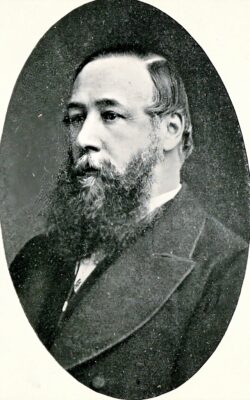
James Boorne is born in Reading in 1824, the son of a Quaker family who lived in Mill Lane. His parents are of independent means, as indicated in the 1841 census records. He will go on to marry Ellen Whiting in 1850 and together they have five children.
At this time the company is still a small concern employing only six men and two apprentices on the ironmongery side and two men and two boys as tin makers. The company continued to focus on the ironmongery side of the business along with a few ventures into making and selling other products; in 1846 there are a number of adverts from them for the Stapleton’s Patent Wind Guard which they manufactured and claimed cured smoking chimneys, and in 1849 they are acting as agents for gutta percha, a vegetable latex material, that is made into various products including bands to drive machinery, window blinds, riding whips and biscuit baskets.
In the 1851 census we find Joseph Huntley described as an ironmonger living at Speen Villa in St Giles Parish, Reading; later that year he marries Mary Lamb of Banbury. In the same census James Boorne is described as an ironmonger and tinplate worker who is employing six tinsmiths and two apprentices. He is also described as a ‘whitesmith’; a whitesmith focuses on manipulating lighter metals such as tin and adding finishing touches through filing, polishing, and other processes, this opposed to blacksmithing which uses raw iron to make larger products. James, and his wife Ellen, are living in the tin works at no. 68 London Street. One of the apprentices living with them is Samuel Stevens, aged 18 and from Newbury, we will hear more of him later.
By this time Joseph Huntley is becoming heavily engaged in his Quaker ministry while James Boorne is following his many outside interests which culminate in his becoming Mayor of Reading for 1860-61. All of these distractions take their focus away from the tin making operation and the company begins to miss their contractual targets to supply Huntley & Palmers with biscuit tins.
By 1858 Huntley & Palmers biscuit production had increased seventeen-fold, while at the same time Huntley & Boorne’s tin production had risen only seven-fold and this is causing delays to biscuit delivery. Attempts to rectify the problem lead to repatched tins being provided to customers which are felt to impact on Huntley & Palmers’ reputation. It takes a long while for the company to look into rectifying this situation, and even by 1864 tin production was still significantly behind biscuit manufacture. In the late 1860s Joseph Huntley acquired the freehold to no. 68 London Street which gives him the opportunity to improvement the business premises, but at the same time Huntley & Palmers are about to extend their site King’s Road northwards making them the largest biscuits enterprise in the World and meaning that significant change would be needed at Huntley & Boorne to keep up.
Samuel Stevens (1833 – 1927)
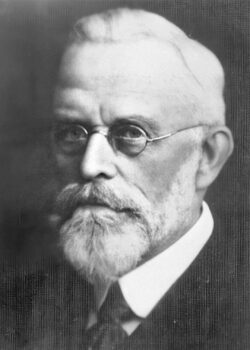
In 1847 Samuel Beaven Stevens had joined the company as a fourteen-year-old apprentice, and as we saw above was living on the premises in 1851. He was born in Newbury in 1833. By 1869 Stevens had become the manager of Huntley & Boorne, and as such he introduced steam powered machinery and then in 1871 brought in more machinery from France. In 1872 he is made a partner in the business with a third-share; he is also paid £300 as a salary on the condition that Huntley and Boorne could be free to pursue their interests outside of the business. The company becomes Huntley, Boorne & Stevens.
Advert for Huntley, Boorne & Stevens showing the London Street Ironmongery Shop Front
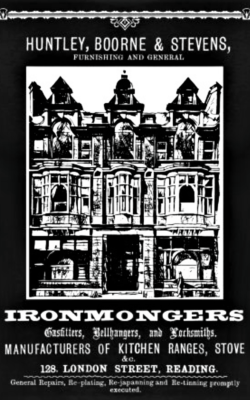
Stevens’ mechanisation of the London Street site completes in 1873 and in March of that year the company is employing 100 men, 72 women and 149 boys. At this time, the biscuit tins were made of metal covered with paper labels, but the technology was evolving to directly print onto the tins.
Early metal tin covered with paper labels

This new process was technically difficult, so a method was developed using designs printed onto very thin paper which was then stuck onto the tin’s surface, but it was time-consuming as the tin had to be varnished and then baked after the transfer process. Barclay & Fry of London developed the offset-lithography process which solved the problem there had been of poor contact between the hard ‘print stone’ and the solid tin; it used a rubber-covered canvas sheet. This new technology had been sold to Bryant & May, the match manufacturers. Bryant & May were already using Huntley, Boorne & Stevens to manufacture some of their matchboxes and in 1877 Huntley, Boorne & Stevens acquires the agreement to use, and later the exclusive rights to use, offset lithographic printing onto metal.
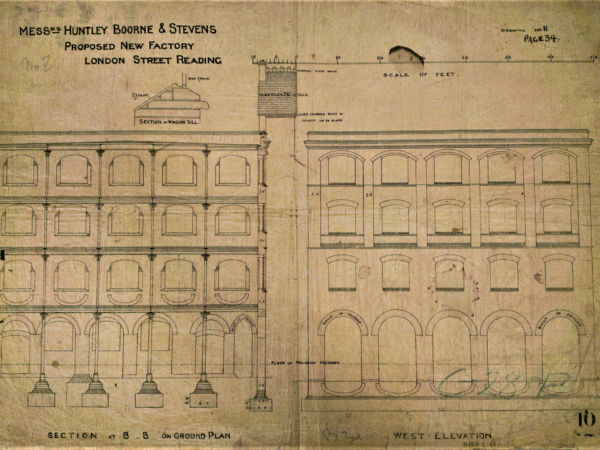
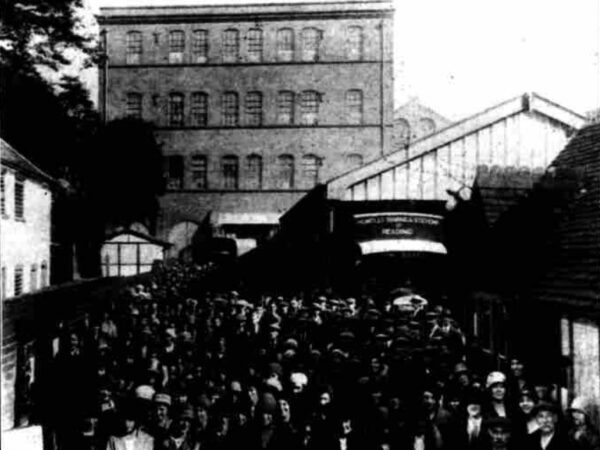
Huntley, Boorne & Stevens become the first company in Britain to combine tin box manufacture with tin printing. Under their agreement Bryant & May advance Huntley, Boorne & Stevens £5,000 to finance the rebuilding of the London Street factory, to meet the cost of the printing machines and metal plates. The funds also include a contribution to the overheads of running the factory. To accommodate the nine new flat-bed tinplating printing machines, costing around £3,000, a new four-storey factory is built and the adjacent Wesleyan chapel is furnished with long tables to allow the women employees to pack the tins; the forewoman sat in the pulpit to supervise the production line. Huntley & Palmers purchases the exclusive rights to have their tins made with this new process.
Plan for new four-storey factory, which became known as No 1 factory
No 1 Factory behind the Southampton Street Entrance (from Reading Standard 25 Oct 1930)
As time moves forward the relationship with Bryant & May becomes difficult, mainly due to the companies’ differing business approaches: Huntley, Boorne & Stevens and Huntley & Palmers are conservative in their actions and follow their Quaker principals. Bryant & May are more dynamic and consider Huntley, Boorne & Stevens in particular to be lacking enterprise. The situation comes to a head when it is claimed that Bryant & May have been reneging on their exclusive deal by selling the offset-lithograph technology to firms in the USA and then Bryant & May counter-claim that Huntley, Boorne & Stevens need to do more to sell their products. The second is not an unfair claim as Huntley, Boorne & Stevens still do not use advertising or have a salesforce. In 1884 the relationship finally ends when Huntley, Boorne & Stevens purchase the tin-plating plant on site at cost price, repay the outstanding load of £5,000 and agree to a contract whereby Bryant & May levy a royalty on each tin made. However, operational contact between the companies still continues as the production of tin boxes for Bryant & May still accounts for 30% of Huntley, Boorne & Stevens’s business and Bryant & May still provide the salesforce for them.
What may seen strange to us is that in the Victorian era it was not unusual for visitors to come to manufacturing premises to see the operations. With respect to Huntley, Boorne & Stevens the influx was such that in late 1878 they were compelled to close the London Street site to such visitors. A report in the Reading Mercury of 14th December puts the closure down less to the inconvenience of having strangers in the tin works than to the wish to avoid ‘industrial espionage’ whereby their inventive machinery is stolen by competitors.
In 1887 Huntley, Boorne & Stevens recruit George W Brown, who had previously worked for Barrett, Exall & Andrewes’ Reading Ironworks in Katesgrove as their chief draughtsman, to be chief engineer and to start increasing the number of technically-qualified staff. Brown was born in Bristol in 1850 and had served his apprenticeship at the Avonside Engine Works in the city. Despite what had been improving business figures the company now begins to see a decline in both turnover and profit. Despite the business situation in the same year we also see them living up to their Quaker principles and signing up to the Reading Early Closing Association which is a group of employers who pledge to close their establishments at four pm on each Wednesday from 7th September 1887.
The situation does not improve and the business partnership is dissolved in 1893, when Samuel Stevens buys out Joseph Huntley and James Boorne. The business is valued at £138,000 meaning that Stevens has to find £92,000 to complete the buy-out; this comes from £21,000 that Huntley and Boorne leave in the business, a £15,000 loan from Simonds Bank and the remainder from Huntley & Palmers who offered at a low rate of interest along with the option to take over the business on the death of Stevens. This change of ownership is not reflected in a new company name, which remained as Huntley, Boorne & Stevens.
Joseph Huntley dies on 24th July 1895, two years after he has ended his working relationship with the company. He dies at his home Earlham Villa (7 Kendrick Road) leaving no family, his wife having died seven years prior and without issue. He is buried at the Quaker Friends Meeting House, Church Street, Reading. While not having been widely involved in local affairs, he was associated with many charitable institutions and left monies to the Royal Berkshire Hospital, The Reading Temperance Society, The British School in Reading and the Reading Female Home in Redlands Villa, Reading.
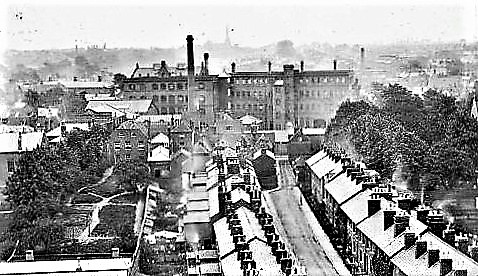
1900 - Factory in London Street taken from Mill Lane Water Tower (Reading Library)
The change in the leadership saw Huntley & Palmers taking a much larger interest in how the company was run. As profits continued to fall Stevens proposed in February 1902 that George Brown, the company’s chief engineer, and his own son Ewart Stevens be taken into a partnership. Huntley & Palmers insisted instead that Huntley, Boorne & Stevens becomes a limited liability company and this is what happened. The new Board of Directors comprises Samuel Stevens, Ewart Stevens, George Brown and a representative from Huntley & Palmers called Clement Williams.
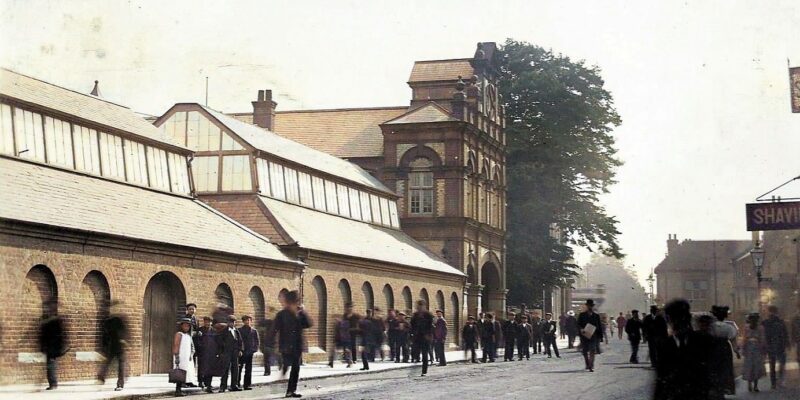
1905 - Factory showing Crown Street side (Reading Library)
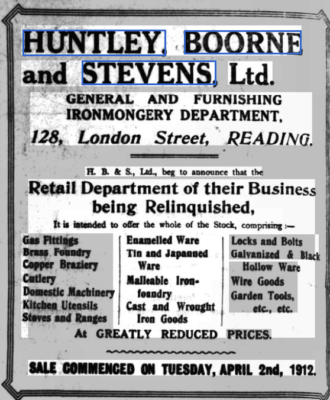
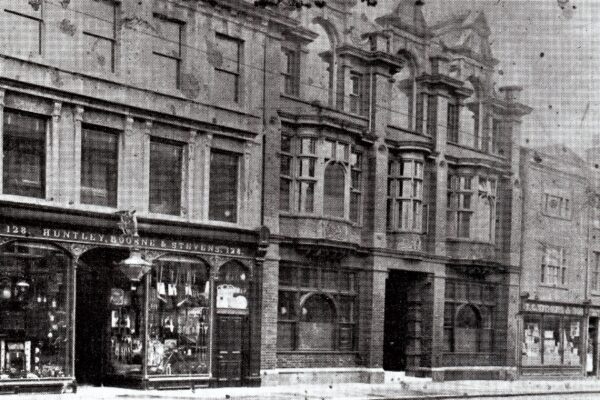
In the following decade a number of technical changes are made; the original Hopkinson & Cope printing machines are replaced with new models from Schmiers, Verner & Stein and from George Mann & Co of Leeds. When George Brown dies in 1909, his son, W Lindahl Brown, takes over the role of Chief Engineer. Along with the personnel changes, extensions are made to the factory and the initial ironmongery shop is finally closed in 1912 having become uneconomical. The ironmongery shop area actually remains in situ until the company moves to new premises in the late 1960s. Note that the premises are now cited as 128 London Street, this is due to the renumbering that took place in the 1870s.
1912 Advert – Reading Observer 20th April
1912 – Ironmongery shop in London Street (Reading Library)
From newspaper reports on James Boorne death in 1910 we see that the company is by now employing nearly 1,000 people. Boorne dies on 2nd February 1910 in Cheltenham, where he had retired after he left the company. During his life he had remained a Quaker and became a minister, he was also President of the Reading Literary, Scientific and Mechanics’ Institute, President of the Reading Liberal Association and Mayor in 1861. He was a personal friend of the authors Charles Dickens, William Makepeace Thackeray and Charles Kingsley, and renowned as a public orator. At 6’ 3” he was an imposing character, but had spent the last seventeen years of his life physically infirm. He died with his family while doing his morning correspondence. His funeral takes place in the Quaker Meeting House in Reading which required his body to be carried by rail from Cheltenham via Birmingham, and afterwards his ashes are buried in his wife’s grave in the Quaker graveyard. In his Will he leaves properties in Reading; nos. 306 and 308 King’s Road and Blenheim House which fronted London Road and King’s Road. Blenheim House had been the premises of the Blenheim House Ladies school and later housed the Abbey School before the school moved to its current position in Kendrick Road. After Boorne’s death Blenheim House became the Gladstone Club and latterly the Sardar Palace Curry House close to the Cemetery Junction end of the road.
As World War I broke out Samuel Stevens, now approaching 81 years old, was finding the business onerous and his Quaker ethics of peace were in conflict with his patriotism. On the second issue he compromises by having the company manufacture non-lethal items for the war effort. Over the period of the war, they produced:
- 436,000 water bottles
- Prototype anti-shrapnel helmets (the bulk production was done elsewhere)
- Over 6 million detonators and fuse tins
- Surgical boxes
- Rocket distress tubes
- Tin containers for kite balloons
- Buoyancy tanks for use in minesweepers
- Tobacco and chocolate ration tins
At the start of the War, the Reading Mercury reported on the number of serving men being provided by each of Reading’s larger industries; 184 men had enlisted from Huntley, Boorne & Stevens out of the total number of 728 men employed. By the end of the War over 300 of their employees had enlisted, 54 of losing their lives.
The impact of the War sees a reduction in biscuit consumption and an even greater decline in the sales of decorative tins; these factors lead to falling profits and a financial crisis for the company. As a result, in 1918, Ewart Stevens approaches Huntley & Palmers, who agreed to take over the company. The ‘amalgamation of the two companies’ is how the change is reported in a notice placed by them in the Reading Observer of 23rd February. It goes on to say that the name of Huntley, Boorne & Stevens will continue and the company will carry on in the same style as it had been, excepting that there will be a new Board of Directors comprising Eustace E Palmer as Chairman, Cecil N Palmer as deputy and Ewart Stevens as the Managing Director. The new arrangement comes into force on 1st March 1918. Samuel Stevens only agreed to this change with reluctance and as a result of it he retires. Ewart Stevens, who was already suffering with ill health, retires from the company in 1921, and L Victor Smith takes over as Managing Director; he stays for the next forty years.
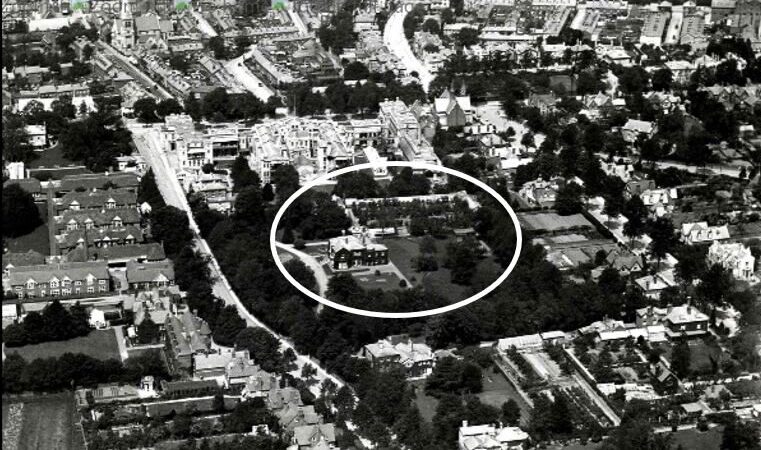
Samuel Stevens dies on 13th November 1927, aged ninety-four, at his home of Greenlands, no. 1 Redlands Road. He leaves £144,600 (this would be around £9.5m today) and, as well as his own house, he leaves a property at 40 Alexandra Road. Greenlands was sited behind the Royal Berkshire Hospital with the location now being subsumed into the hospitals grounds after the building was demolished.
1920 – Greenlands (centre) in front of Royal Berkshire Hospital (Reading Library)
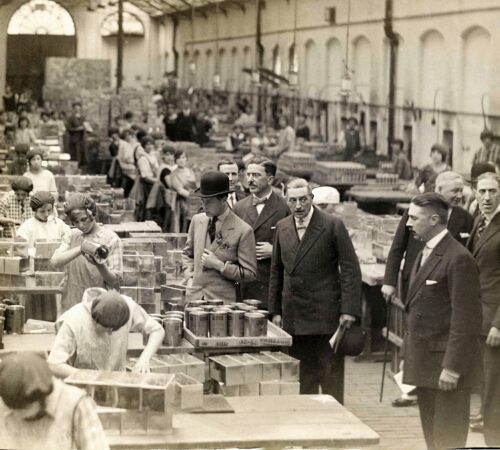
The company’s financial position remains concerning throughout the 1920s despite their implementing proper costing systems and other managerial reforms. One of the positive highlights of this time is the visit, on 26th June 1926, of HRH The Prince of Wales. He was well received, but no-one had informed him of the no-smoking policy in the factory; his discarded cigarette butts are collected and were to remain in a small glass jar in the Board Room for over forty years.
1926 – Visit of HRH The Price of Wales to London Street Factory (Reading Library)
Huntley, Boorne & Stevens was a typical company of its time and operated with many of the same conditions, although their Quaker inheritance did have some positive impacts. Below is an illustration of the working conditions in 1926:
- Working Hours: 8 am to 6 pm Monday-Friday, with 1 ¼ lunch break, 8 am to 12.30 pm on Saturday
- Adult males were paid 48 shillings per week while adult females were paid 29 shillings per week – Paid on Friday afternoon with cash in a cloth bag which had to be brought back on Saturday
- Bell rang at 3 minutes to 8 am and another at 3 minutes past, in between you passed a window at the Time Office in Southampton Street and called your work number. If you were later than the second bell you lost ¼ hours pay for each 15 minutes late
- Benefits, if the appropriate subscriptions were paid from wages:
- Sick club with subs of 6d which provided 10 shillings per week sick pay
- Burial club at 1d per week
- Holiday fund club with subs in multiples of 6d and paid out just before August Bank Holiday with interest
- Could join Huntley & Palmers Recreation Club for 2d per week (or 3d for playing members)
- Company had own fire brigade under leadership of Lindahl Brown and were loaned a fire engine by the Government
1920s Workers leaving by the Southampton Street Exit (Reading Library)
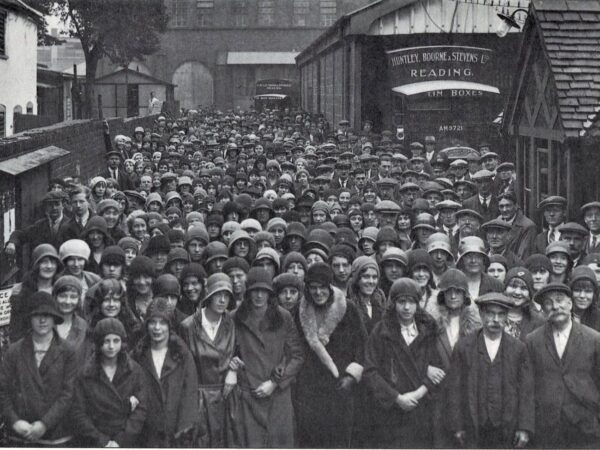
1920s Workers leaving by the Southampton Street Exit (Reading Library)
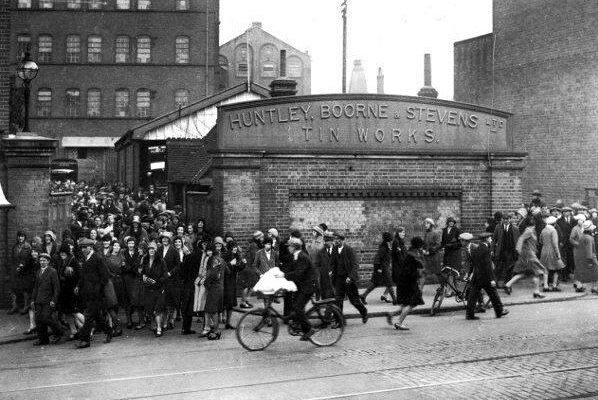
At the 1928 Reading Industries Exhibition, Huntley, Boorne & Stevens had a stand and a report of the event in the Reading Standard of 29th September described the factory as occupying an area of 250,000 square feet tucked between London Street and Southampton Street and employing nearly 1,000 employees. Meaning that numbers had changed little since 1910.
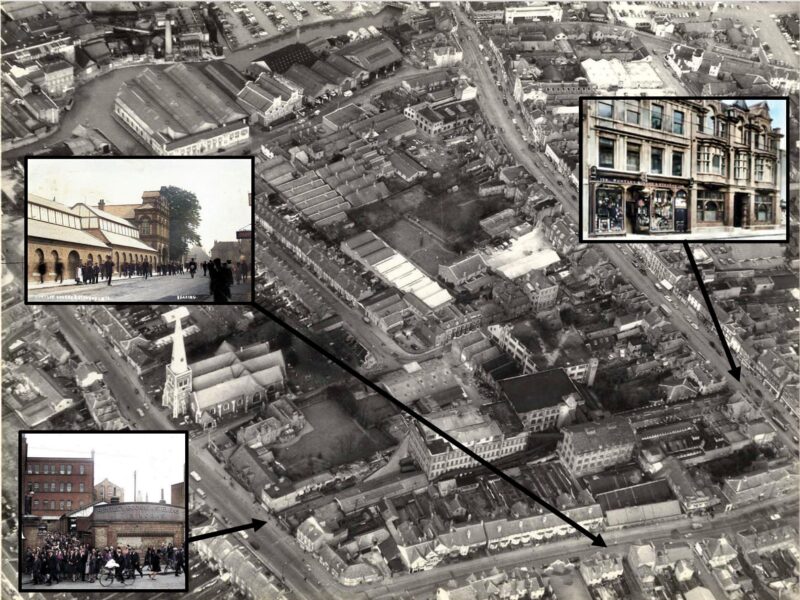
Below is an aerial view of the factory, highlighting the shop front on London Street, the factory on Crown Street and the workers entrance on Southampton Street.
Aerial view of London Street site
In October 1930 the company celebrates its centenary; it is not explained anywhere why this occurred at this date when they had only been operating for ninety-eight years and nine months. As part of the celebration employees are given a week’s wages. In the reports of the centenary, the newspapers listed the products then being made by the company which includes film tins for the cinema, artist paint boxes, mechanical toys and containers for many forms of food products.
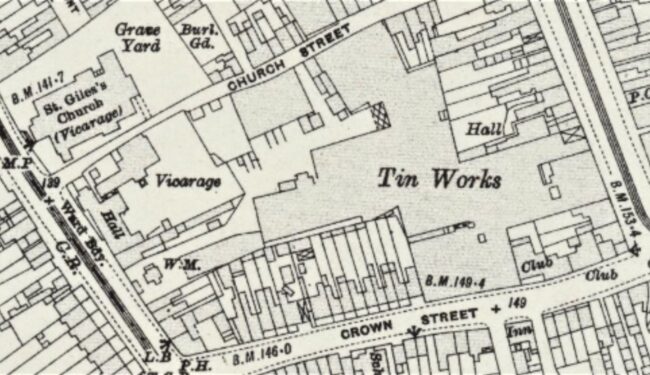
1931 Ordnance Survey Map – reproduced with permission of the National Library of Scotland
Sadly, profits are still not improving and aided by a depressed tin plate industry worldwide and out-dated machinery at the plant Huntley & Palmers looks to sell the company to The Metal Box Company in 1934. However, the offer mode of £135,000 is considered inadequate, and along with Metal Box’s desire to include the Huntley & Palmers’ tin trade in the deal, it is rejected.
By now the company’s management is closely controlled by Huntley & Palmers, with the local management only being allowed to make minor decisions. Within the Huntley, Boorne & Stevens’s own management structure control is rigid and rather arcane, with all incoming letters being opened personally by either the Managing Director, Sales Director or Company Secretary. The factory manager, A E Vickers, is described as an authoritarian controlling all production, recruitment and safety issues himself. The workers remain non-unionised.
By the mid to late 1930s suitable labour is becoming hard to find locally and the company begins to advertise in the areas of Britain that have been hardest hit by unemployment, such as the South Wales valleys and the North-East.
1930s – London Street Factory interior (Reading Library)
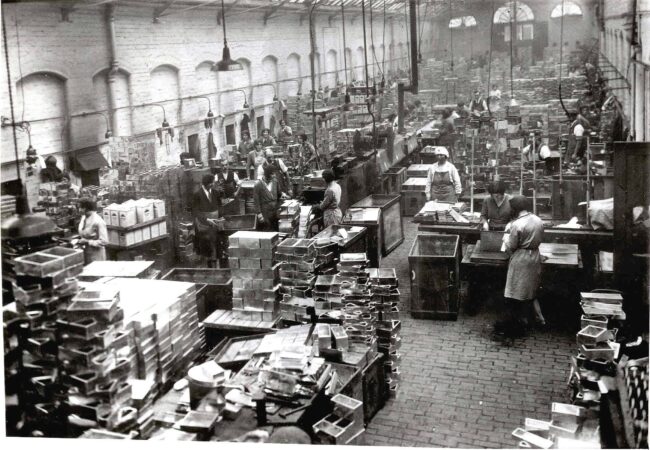
As World War II approaches employment issues increased, and while many of the company’s employees are classed as having reserved occupations, others are lost to the war. In November 1939 the Reading Standard has an advert stating ‘Huntley, Boorne & Stevens Ltd Tinworks, Reading, are short of employees to help with urgent Government contracts. An opportunity for married women who have previously worked with the firm as well as other men or women seeking such employment’. A number of their younger male employees who were deemed to be in reserved occupations joined the Huntley & Palmers Territorial Unit and others formed a Home Guard, which appears to have focussed on bomb disposal and to have trained with the Royal Engineers. As in World War I the company provides goods for the war effort, but by now they are less troubled by Quaker principles, producing items such as incendiary bomb cases. The workers are expected to undertake a compulsory hour of overtime, but the efforts of some not drafted to the front line are rewarded, for example factory operator, Vera Wicks, and chair of the works committee, Joe Peasnell, are awarded the British Empire Medal.
Post War, the company looks once more to improve production, introducing a Planning Department, a group not always appreciated by the highly-skilled craftsmen who objected to ‘clerical’ interference. As previously, the 1940s sees labour shortages with female operatives being recruited from Middlesbrough, then staff being taken on from the post-War arrivals from eastern European, mainly Poland, and later into the 1950s those coming from the West Indies.
1947 sees the introduction of a staff pension, but only for male employees (females only become eligible after 1968). The following year Geoffrey C Palmer becomes chairman of the company and Raymond C Palmer his deputy.
In 1952 tinplate is still rationed following the War, but an additional allowance is made available for items linked to the coronation of Queen Elizabeth II. The already noted arcane approach of the company can be seen in their appointing their first ever sales representative at this time and, when in 1956 a deal is made with Irish Biscuits, it was described as a worldwide venture.
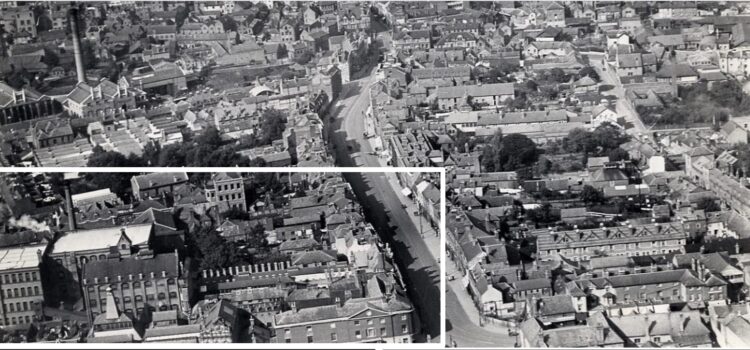
As with many companies of the time Huntley, Boorne & Stevens employees tended to remain with the company for long periods, often throughout their working lives. In 1950 long-service awards are presented to ninety-five employees who, in total, have contributed 3000 years of service; one man has been employed for seventy-two years.
1922 - View of London Street Site looking north along London Street (Reading Library)
1946 - View of London Street Site looking north-east along Crown Street (Historic England)
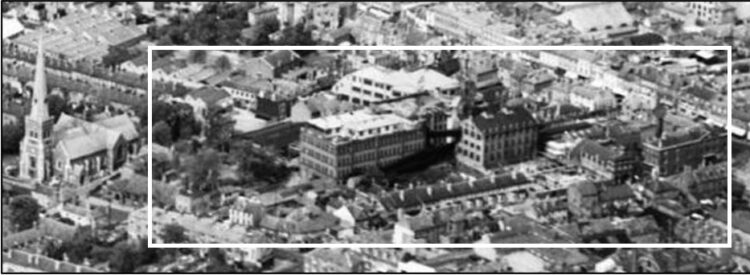
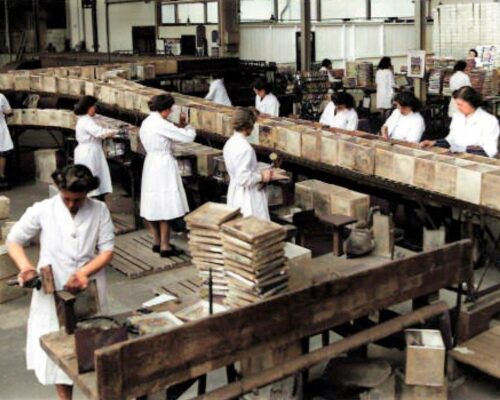
By the 1950s Huntley & Palmers’ tins are accounting for less than a third of the output from Huntley, Boorne & Stevens, and the factory layout is becoming crowded and space to expand is limited. In 1967 a site is set up at Aintree in Liverpool to supply the three big biscuit makers of Jacobs, Huntley & Palmers and United biscuits, all of whom had factories in the north-west. However, this means that printed tinplate has to be transported from Reading to be made into tins at this new site. While the operational setup of this site in Aintree was not perfect, it oddly provided the reason why Huntley, Boorne & Stevens could relocate from London Street to Woodley in the later 1960s. At the time of closing London Street, the Government was restricting company relocation to areas of high unemployment and this did not include Berkshire. However, the ownership of the Aintree site allowed the management to argue that they were already providing jobs in these areas and the move to Woodley was approved.
1950s – Production line and removing bumps from the tins (Reading Library)
In 1967 a decision is made to set up a new 240 ft laminating line to keep up with the industry trends of using Lamiplate technology, which is laminated plastics bonded to a metal base. This new equipment cannot be accommodated at the London Street site. Having dismissed a premises on Battle Farm Estate in West Reading, a large hangar on the former airfield at Woodley on Headley Road East is chosen. The new site is officially opened on 4th July 1968. While preparing the Woodley site an adjoining building is vacated by Racal Electronics and a decision is made to fully close out the London Street site.
1970s – Woodley site (Reading Library)

The larger site is ready in 1969 and the transfer of London Street operation takes place while production continues. Throughout the move output is maintained by a production line closing on a Friday night, machinery being deinstalled and reinstalled and the line being ready to run by 7.30 on Monday morning. While much of the London Street equipment is transferred to the new site, the opportunity is taken to purchase new coating and varnishing machines and two 60 ft curing ovens. The cost of the move, at £365,000 (this would be around £6.4m today), results in the company posting a loss for 1969. Around 700 staff move out of the London Street site, which had been operational for 136 years. The buildings remained in London Street in to the 1980s.
1970s - Ironmongery Shop Site in London Street (Reading Library)
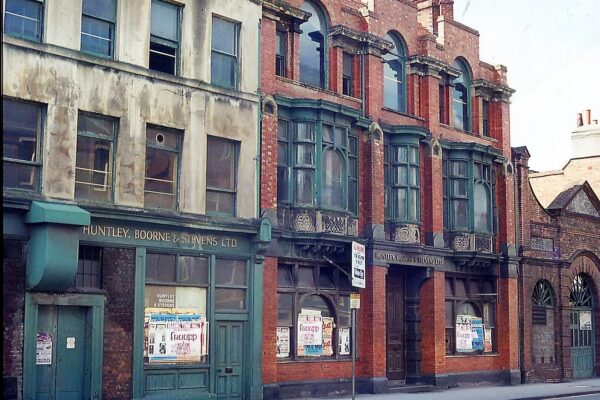
Worker entrance in Southampton Street (Reading Library)
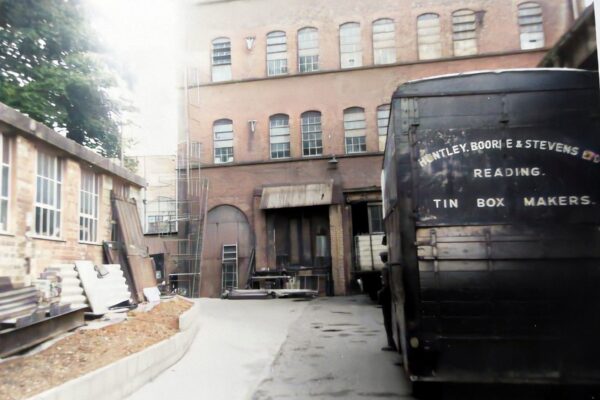
1970 sees the decision to close the Aintree site along with a vacuum-forming site that had been set up in King’s Road, Reading. Despite all of the changes, trading losses still persist, being £243,000 in 1970. The Lamiplate production is successful and is beginning to challenge the tin box side of the business. Printing techniques are improved with the introduction of ultra-violet radiation to cure the inks. One problem that persist until a new 50,000 sq ft finished goods warehouse is built in February 1971 is the lack of storage space, with items having to be stored in every available cupboard and corner.
As noted, fortunes are not revived by the move to Woodley and when Huntley & Palmers join with Peek Freans to form Associated Biscuit Manufacturers the special bond between the parent and subsidiary is broken. Now, being expected to take more responsibility, Huntley, Boorne & Stevens increases its marketing and moves into other areas of manufacture and plating. One new line is the product brand ‘Giftcharm’ which comprises houseware goods such as trays, canisters, coasters and similar. The output proves so attractive that it is made in ‘the cage’, an area specifically protected to avoid theft. 1970 also sees the company stop light engineering production, the manufacture of items such as motor components, electrical trade goods and all Government contracts which are labour-intensive and needed significant administration. Only a few valued customer contracts are maintained in the light engineering sphere and these are sub-contracted to Precision Engineering, a small unit located in Bucklebury in West Berkshire.
1974 sees an ambitious plan to get into aerosol can manufacture. The production of the required seam-soldered can proves technically difficult and requires specialist machinery and labour, but by the early 1980s Huntley, Boorne & Stevens are producing around 50 million cans per annum. At the same time the ‘Giftcharm’ business is growing and bought-in items, such as pans, aprons and gloves, are boosting the range.
The steel strike of 1980 causes considerable difficulties for the company, with tin plate becoming unavailable. Huntley, Boorne & Stevens are bringing in raw products from Europe and this causes there to be ‘flying pickets’ and considerable issues with the unions. When the strike ends after thirteen weeks the raw products are still hard to obtain and the company benefits from premium pricing on their output from European sources, making the profits for 1980 over £364,000.
To produce their biscuit tins Huntley, Boorne & Stevens had always employed a team of artists, at times as many as ten. These artists would design and paste up around sixty tins annually for review by the Design Committee, and around half of these would be put into production. One famous tin, known as the ‘Kate Greenaway Rude Garden Party’ tin, is produced in 1980 and the artist adds a few unexpected items in the background hedging. It was originally thought to be the work of a disgruntled employee, but was actually a freelance artist who did it out of devilment.
1980 - Kate Greenaway Rude Biscuit Tin – whole and close up

By 1985 the overall management, now Nabisco Foods Ltd, decide that Huntley, Boorne & Stevens does not fit in with their planned portfolio, so from 1st April of that year the company becomes part of the Metal Packaging Division of The Linpac Group, which was a privately-owned organisation. This change results in the closure of the Lamiplate department and a focus on tin box and aerosol manufacture.
The economic downturn in the late 1990 leads to many jobs at the plant being cut and work being relocated to Linpac’s Welsh plant. In a newspaper report of 25th September 1998 Linpac’s Managing Director states ‘the Reading operation is simply not viable in its present form’ and the report confirms the loss of 135 jobs. In the consolidated financial statements of Linpac Metal Packaging Limited for the year ending 31st December 1999 it notes that a decision was made to close the General Line manufacturing operation at Reading and Cwmbran on 29th September 2000. Thus ends the lineage of Huntley, Boorne and Stevens, Tin Makers of Reading.
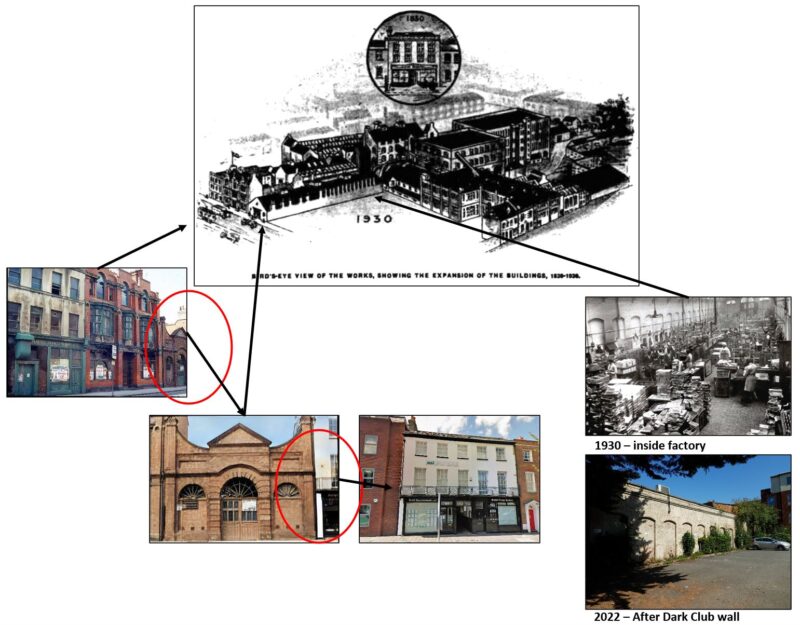
Little remains of the London Street site, but with detective work a few pieces can be spotted. Below is a drawing of the site in 1930 taken from the newspapers’ reports on the company’s centenary. From this and old photographs the ironmonger shop and the next-door gateway on London Street can be traced to an ironwork railing feature on a premises still extant. It may also have been that Huntley, Boorne & Stevens made the railings. The few photographs that show the factory’s interior have a distinctive arched wall and this can be seen on the drawing. The same wall forms the outside of the After Dark club and can be seen from the car park in St Giles Close.
What is left of the London Street Site
References
- Huntley, Boorne & Stevens of Reading and Woodley: a tradition in tins. Trustees of the Stevens Benevolent Fund (1993)
- Huntley, Boorne & Stevens and Tin Box Manufacturing in Berkshire 1832-1985; T A B Corley; Berkshire Archaeological Journal 72 (1983-1985)
- Mayors of Reading Fourteenth to Twentieth Century. C F Slade (1970)
- Reading Mercury: Stapleton’s Patent Wind Guard (26 Dec 1846)
- Reading Mercury: Huntley & Boorne, Wholesale and Retail Agents for the sale of the Patent Gutta Percha (21 Apr 1849)
- Reading Mercury: James Boorne partnership and business expansion (5 Sep 1846)
- Reading Standard: The Late Mr James Boorne JP – Special Memoir and Portrait (12 Feb 1910)
- Reading Standard: Death of Mr James Boorne JP, Former Mayor of Reading (5 Feb 1910)
- Gloucester Chronicle: Death of Mr James Boorne- A former mayor of Reading and many years resident in Cheltenham (5 Feb 1910)
- Gloucester Citizen: The Late Mr James Boorne (4 Feb 1910)
- Reading Standard: Order of Execution of the late Mr James Boorne (27 Apr 1910)
- Reading Mercury: Loss of Teeth (7 Apr 1838)
- Sunderland Daily Echo and Shipping Gazette: Employment (16 Jun 1936)
- Reading Standard: Situations Vacant – Huntley, Boorne & Stevens (3 Nov 1939)
- Berkshire Chronicle: Joseph Huntley Jun. (31 Mar 1832)
- Reading Mercury: Death of Mr Joseph Huntley (3 Aug 1895)
- Reading Mercury: Mr Huntley’s Charitable Bequests (14 Sep 1895)
- Reading Mercury: Messrs Huntley, Boorne & Stevens (3 Jun 1916)
- Reading Observer: Huntley, Boorne & Stevens and Huntley & Palmers – Important Amalgamation (23 Feb 1918)
- Reading Standard: Huntley, Boorne & Stevens (29 Sep 1928)
- Reading Standard: One Hundred Years of Progress (25 Oct 1930)
- Reading Mercury: Reading Early Closing Association (3 Sep 1887)
- Reading Evening Post: Woodley Firm Cuts 135 Jobs (25 Sep 1998)
- Consolidated financial statements of Linpac Metal Packaging Limited for the year ending 31 Dec 1999 (filed 31 Oct 2000)
- 1875 Ordnance Survey Map – reproduced with permission of the National Library of Scotland
- Non-Conformist and Non-Parochial Registers 1567-1936
- London Street Described: A Reading Historical Record 1800 – 1900 – London Street Research Group 2007
- Reading Mercury: Latest Intelligence (14 Dec 1878)
- Grace’s Guide to British Industrial History