


Reading is synonymous with the ‘3Bs’ – Biscuits, Bulbs and Beer, and if asked most would say that the biscuit element is Huntley & Palmers. However, Huntley & Palmers weren’t the only biscuit manufacturers in town. Reading had other significant biscuit making operations and this is their history.
The biscuit makers we are talking about are Meaby & Co. Ltd and H. O. Serpell and Co. Ltd, more commonly called just Serpells, who bought their operation. As with so many Victorian businesses there are a number of company names used along the way.
Albert Meaby started a bakery business in Albert Road, Reading, as small terraced road that ran parallel to the Kennet and Avon canal by Blake’s Lock. In much later advertisements in the Reading Standard 46, he claims an establishment date of 1840, but Albert was only born in Baughurst, Hampshire in 1846 and the earliest record of his bakery found in directories is in Webster’s 1874 edition 47 that lists ‘Meaby, Albert – baker and mealman, 49 Albert Road.’ A mealman is a dealer in the edible part of any grain as in oatmeal, but in this case, it is most likely to be flour from corn. In the 1871 census Albert is listed as a ‘bread and biscuit baker’ living in Albert Road. 48
By the 14th century the word biscuit had appeared in the English language, although small baked products often based on bread had been around for a long time. These medieval biscuits would be sweet or savoury and were often eaten at the end of a meal. As travel grew, especially on ships, the biscuit would be a staple food as it could be kept for a long time without spoiling. In the 17th century the increasing availability of sugar from the slave trade increased the production of sweet biscuit varieties. At the same time cooking technologies were changing and the breakdown of the old guild structure meant that the Baker’s Guild could no longer stop people baking biscuits at home. By the 19th century biscuits were very popular especially amongst the middle and upper classes, this was helped by Queen Victoria being a big fan. In 1874 Britain removed the import duty on sugar and this coincided with the increasing use of steam-powered machinery and electricity in manufacturing. In a factory setting biscuit manufacturers used powered mixers and cutters to make and shape the biscuit dough and large ovens for baking. These changes made biscuits available to all classes or society.
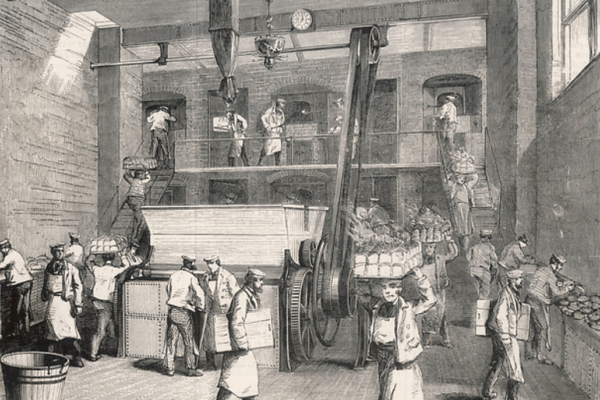
In 1885 Meaby opened the ‘Queens Road Steam Bakery’, taking over the business of Mr J Shepherd. Shepherd’s bakery had already been established for about forty years at this time 9, 63 and it must be the Shepherd heritage that Meaby refers to when he quotes the 1840 establishment date. His notices about his new enterprise state that they will supply “every variety of plain and fancy bread of reliable purity and quality, untouched by the hand in the process of making” and that the steam bakery is the “only establishment of its kind in the town”. 8 While Meaby may not have had a premises as large as the steam bakery shown below, he would have employed a lot of the new technologies.
A Steam Bakery
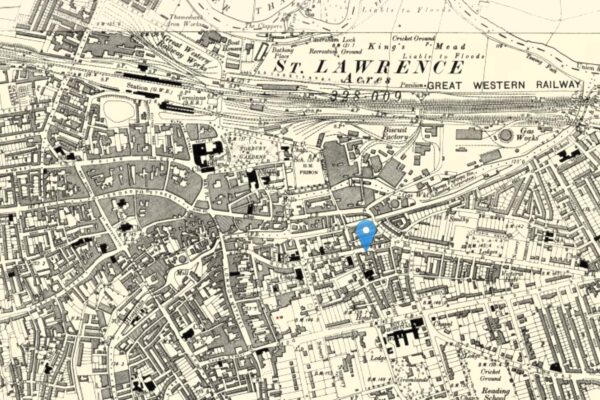
In the 1887 Kelly’s Directory of Berkshire, Meaby is listed as a baker at 82 Queens Road and 52 Beauvoir Road. 49
Location of Meaby’s bakery and flour mill in Queens Road (1900 Ordnance Survey Map – reproduced with permission of the National Library of Scotland)
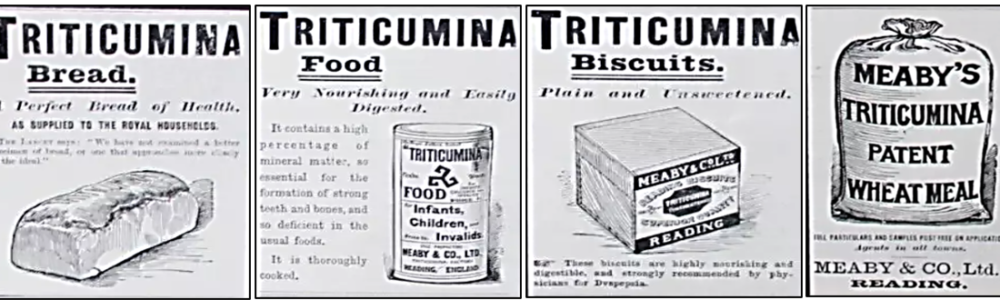
In 1891, in conjunction with a Mr Lester, Meaby forms ‘Meaby’s Triticumina Company’ which produces and sells an ‘improved’ flour that they name Triticumina. This flour, made from malted grain, was considered easily digestible and particularly suitable for children and invalids. The name, Triticumina comes from the Latin word “Triticum”, meaning wheat. Such ‘fancy’ naming was common for the time and one of Serpell’s rivals, Hovis, was named from the Latin, “hominis vis” or “the strength of man.” 6, 7, 10
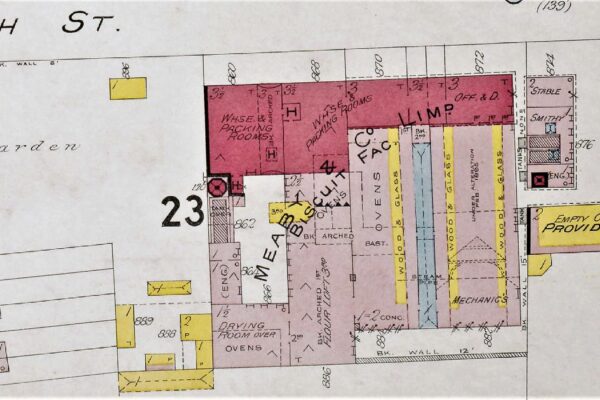
While Meaby’s operation would not rival the size of Huntley & Palmers or even Serpells, the Goad insurance map below shows that it was still a significant concern much larger than the original bakery.
Meaby’s Factory (Fire Insurance Plans - Charles E Goad 1895: Reading Sheet 5-23)
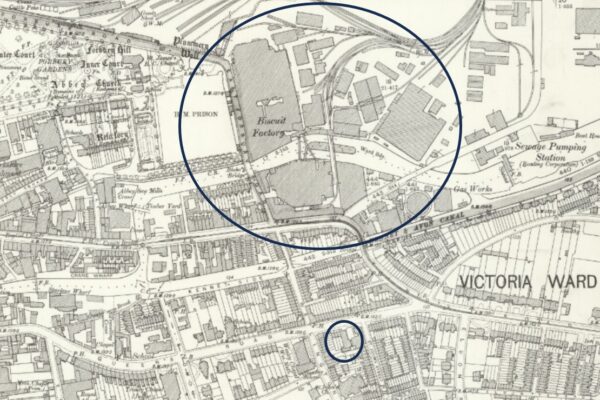
In early 1893 Meaby and Lester also formed ‘The Reading Biscuit Company’. The company name led to a trademark dispute with Huntley & Palmers who objected to the word ‘Reading’ in the company’s name and took them to court in May 1893 to request a restraining order to prevent the company’s name being used on any biscuit and cake packaging as it could impact Huntley & Palmers’ reputation. Huntley & Palmers won the case. 10 The map below shows the closeness of the two biscuit companies and also gives an indication of their relative scale of operations.
Location of Meaby and Huntley & Palmers sites (1900 Ordnance Survey Map – reproduced with permission of the National Library of Scotland)
In the same year, 1893, Meaby invested in new plant and buildings at a site in South Street, Reading. South Street is only a short distance from Queens Road. The South Street site had previously been ‘South Street Ladies’ and Gentlemen’s Swimming Baths’. The Reading Mercury gives the price for the whole site as £3,800. 59 It appears that the baths were incorporated into the biscuit factory that was built on the site. We know this from a report on bathing accommodation in Reading in the Reading Observer of 5th August 1893. 60 This report notes that the reconstruction of the King’s Meadow Bathing Place had been delayed and that The Reading Biscuit Company Limited had already generously placed two of their smaller baths in South Street at the discretion of the Corporation for the use of women and girls and had extended the use to men and boys on Tuesdays and Thursdays.
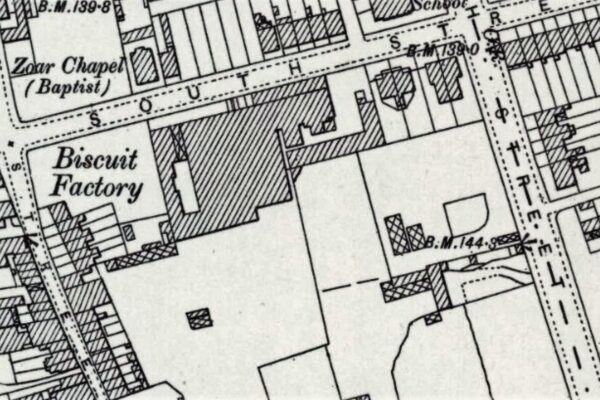
In October 1897 Meaby & Co. Ltd, as The Reading Biscuit Company was renamed, is wound-up having been declared bankrupt following a court case when it had failed to prevent the use of the term Triticum or its derivatives from being used by other flour manufacturers on the basis that Triticum is the Latin term for wheat. 13 Sadly, the notice of the legal outcome in the Reading Observer of 20th November 1897 is followed by the announcement of Albert Meaby death from cancer five days beforehand. He died at his residence at 82 Queens Road, Reading – the site of his original biscuit factory. In the death notice it says that the business in Queens Road, now known as Meaby’s Machine Bakery, is to be taken on by Albert Meaby’s son Harry Meaby. How much of a business he had left at this point is in questionable. 12 Probate details show that Albert Meaby left just over £5648 (around a million pounds in today’s money) and his Will is said to have included a legacy of five pounds for every one of his employees with over twelve months of service. 6, 11, 54
Within a year, in late 1898, the Meaby’s biscuit factory and all of the machinery is being auctioned; it comprised a building of almost an acre and plant capable of outputting ninety tons of product each week. There was a roller flour mill, four 24” biscuit-making machines, five dough kneaders, fourteen ovens of various description and associated steam engines, boilers and loose tools. The auction included the patents for Triticumina and the ‘goodwill’ of Meaby & Co. Ltd. 14, 15 Harry Meaby continued as a baker at 82 Queens Road, with his adverts offering fancy bread, biscuits and cake all from ‘The Machine Bakery’ and still claiming to have been established in 1840. 55
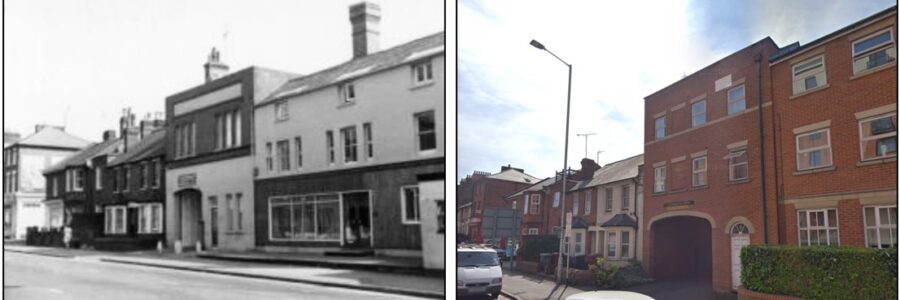
The Meaby’s mill, situated at 94, 98 and 100 Queens Road, was sold at auction in November 1916. According to Fred Padley in his book ‘A Village in the Town’ 45 Christopher Hansen took over the factory and used it to produce rennet, and when he moved to a more convenient location for his business in about 1960, it was taken over by S M Bryde & Co. Ltd. as a wallpaper and paint factory. A fire destroyed the interior in December 1965. The site now holds a private housing development called Barkham Mews. From the photographs below we can see that the replacement flats definitely give a nod to the heritage of the site with the corresponding archway.
Left is Meaby’s factory in Queens Road in 1972 (Reading Library) and right its replacement Barkham Mews
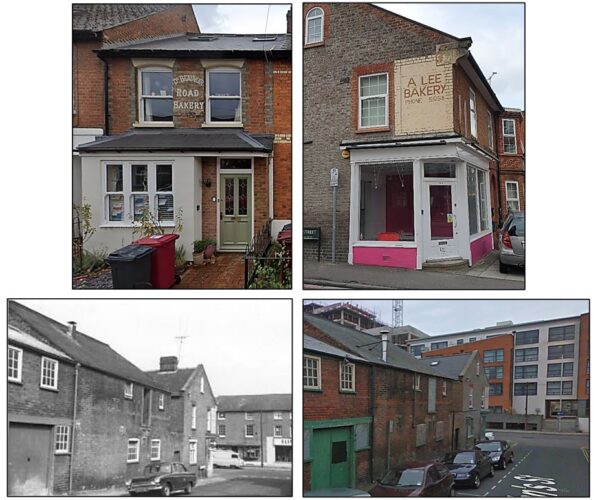
Fred Padley also writes about the bakeries in the Queens Road area. The oldest established premises he states was Harry Meaby’s and Fred says that the bakery and stabling ran from Queens Road through to St John’s Street. He recalls his mother having a fruit cake baked there every Friday – in the early part of the 20th century it was common for local bakers to bake privately made cakes – and Meaby’s charged one penny for this service taking in the cakes through a small window in the bakehouse. A Mr Huggins had his bakery on the corner of Queens Road and St John’s Hill with the premises having a flour store on the upper storey. Huggins closed in the early 1930s. On the corner of St John’s Road and St John’s Street was H J Deane, who besides being a baker also operated as a general store and held a beer licence. On the north side of Queens Road there was another confectioner, so the area was well served for baked goods. While Padley speaks of Harry Meaby’s, Harry had died in his seventies in 1941. 56 He was succeeded by his son Henry Albert, also known as Harry, but sadly he died in 1944 when only fifty-two years old. 57 The bakery business was still going strong in 1974. 51 Below are some photographs of Meaby properties.
Top Left – Meaby Bakery in De Beauvoir Road (2023), Top Right - Meaby’s bakery corner of St John’s Hill and Queens Road (2020), Bottom - Meaby’s bakery corner of St John’s Hill and Queens Road from St John’s Hill in 1972 (Reading Library) and 2009
Born in 1816 on a farm in Liskeard in Cornwall, Robert Coad Serpell (1816-1886) left school at eleven and was apprenticed to a grocer in Plymouth. He then joined the British and Irish Sugar Refinery Company as their traveller (salesman) in Cornwall. In 1851 he entered into partnership with Messrs George Hender Frean and George Daw who were millers and biscuit manufacturers, to form Frean, Daw & Serpell. 1, 2, 52 In 1863 the partnership was dissolved with Mr Frean moving to London to set up the ‘Peek Frean’ biscuit company with a Mr Peek, and the original company became Daw & Serpell’s moving on when Mr Daw died to become Messrs R C Serpell & Co. 50
These biscuit companies would have served the naval and merchant fleets sailing from Plymouth who required large supplies of bread and biscuits (hard tack) for the long voyages they would be undertaking. As the speed of ships increased needing less volume of stores, the companies turned to making fancy biscuits for the wider public. 58
In May 1869 Serpell’s Plymouth factory was destroyed by fire with the loss of all machinery and several tons of biscuits. It was rebuilt with improved machinery, but the fire had led to sixty-five workmen being made unemployed. 3, 52 Almost ten years later, Robert Serpell dies on 25th October 1886. He is addressing a meeting of the Chamber of Commerce when he becomes unable to speak and quickly died of what is described at the time as apoplexy. 1,2 Serpell, as well as owning the biscuit company, was a former Mayor of Plymouth, and was in his seventies and the father of five children. It is his son, Henry Oberlin Serpell (1853-1943) who takes over the company while he and Robert’s other children share the £85,000 in Robert’s Will. 4, 33 Henry is not the eldest of Robert’s sons, this was Samuel Nicholson Serpell who was also a biscuit manufacturer. 84 It isn’t clear why Henry and not Samuel inherits the business, but Samuel subsequently dies in 1879. Henry Serpell is portrayed below as he was in later life.
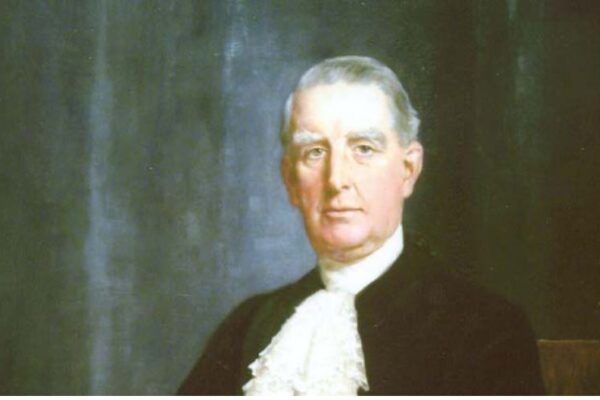
The company, renamed to Messrs H O Serpell & Co., was by now making fancy biscuits and they began to outgrow their Plymouth site. The site was also proving to be less than convenient for trading outside of the west of England. 5 In early 1899 we see reports of the imminent arrival of Messrs Serpell & Co. in Reading. Having considered a move to London, Henry Serpell spotted the opportunity of the Meaby factory sale and purchased the relatively newly refurbished South Street site. Serpell had canvassed all of his employees about wanting to move with the firm to Reading and many did accompany him. 16 By May 1899 the papers were carrying adverts from jobs at the site. 17 Comments in the papers call the company the third oldest in the World and the origin of many great bakeries, such as Peek, Frean and Co. 19 Serpell’s Plymouth site is auctioned in October 1899. 18
In 1901 the business was made in to a Limited Company, meaning it becomes a legal entity in its own right separate from the owners and shareholders. 52 This was to allow Henry’s eldest son Henry William and Mr William Henry Short to be brought into the company’s ownership and management. 61
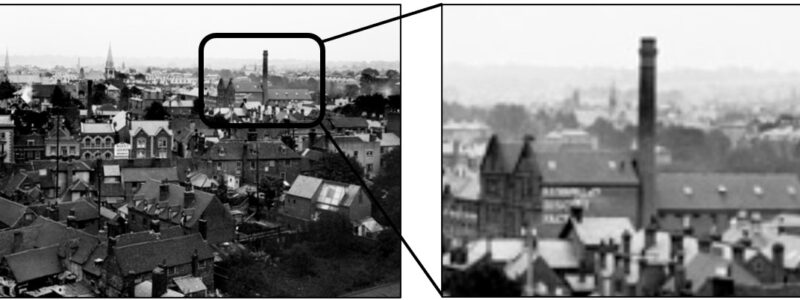
The photographs below show the factory in 1900 looking east across Reading (care of the Museum of English Rural Life). In the insert you can just about make out the large lettering that was painted on the wall saying ‘H. O. Serpell & Cos Biscuit Factory’.
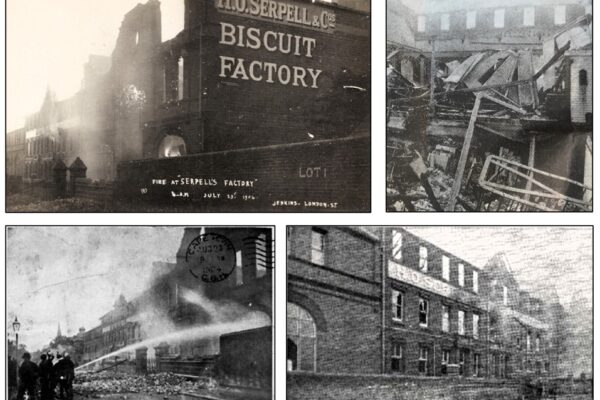
Serpells continued successfully until the night of 23rd July 1904 when there was a serious fire. It started in the early hours of Saturday morning and almost destroyed the factory; the cake factory was saved because it had a fireproof wall. The box factory filled with wood and straw packaging also survived, along with the icing room and the stables. The conflagration was so great that the brick walls of the factory collapsed and damaged the water main in the street, further hindering the fire brigade. It can be assumed that the swimming pools once in the building had been repurposed as the lack of water to quell the flames was one of the findings to come out of the aftermath. The blaze was attended by Reading Fire Brigade and also by Huntley & Palmers’ own Fire Brigade. Estimates of the damage were around £30,000 and nearly all of the employees were made unemployed. Cottages close to the factory and the buildings on the opposite side of the road had minor damage. Mr Serpell was insured and the papers praised him for his generosity in providing the now unemployed workforce with a week’s wages and helping some to replace their own tools which were lost in the conflagration. The Serpell family postponed two impending marriages as a result of the factory’s loss. 20, 21, 22,23 The photographs, taken from various local sources, show the devastation caused to the building’s structure.
It is reported in the Berkshire Chronicle that “Mr Serpell has continued to pay the wages of all married employees and has checked that the single ones were not in distress” after the fire. The Newbury Weekly News describes Mr Serpell’s treatment of his employees as “altogether exceptional”. At the time the employee numbers were estimated at 600-700. 24, 25, 52
At the time of the fire Serpell was living at 20 Redlands Road, a large house designed by local Reading architect Joseph Morris in 1900. 62 Electoral Registers have him living there until around 1910 when he moves to Hyde Park Mansions in London. When in London he still owned properties in Reading such as ‘The Nest’ at 32 Morgan Road, a Victorian semi-detached property just off of Redlands Road. By 1914 he was living in Westcroft Park in Chobham, a large country house and surrounding estate.
By late October 1904 the foundation stone of the new Serpell factory in South Street was being laid by Serpell with pronouncements that the completion of the work was expected within two months. The chosen contractor was Mr R Curtis of Redlands Road and the architect was J H Vincent of Plymouth. A somewhat sarcastic report in the Newbury Weekly News notes that it does not require an intimate knowledge of the building trade to know that the expected completion time of eight weeks will be considerably exceeded. When the foundation stone was laid, a tin box was placed into a cavity underneath it and into it Serpell’s daughter placed local papers from the night after the fire, bills, invoices and price lists from the factory, invitations to the ceremony and the signatures of the company directors written on parchment. Amongst the many thanks given at the ceremony Serpell praised Mr Huntley and Mr Palmer for their telegram of sympathy which was the first he opened after the fire and for their having provided their fire services. He says “No firm could have done more, and he could only say that among the best friends he had had in Reading were those who were generally regarded as their opponents in trade”. He also noted that Peek Frean, the company he had been associated with in his early career, had offered assistance including an offer to set aside of some of their factory to bake Serpell products. 52
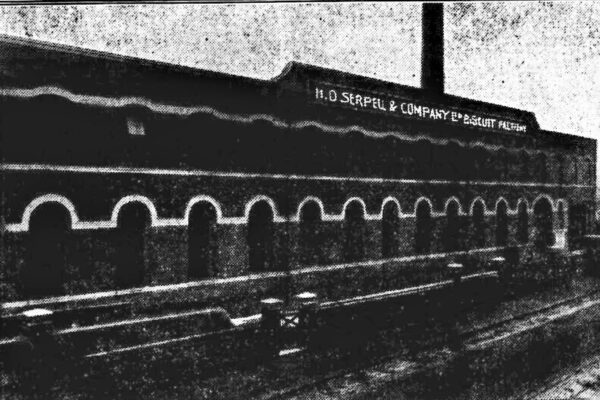
The new factory was built quickly, not in eight weeks but over a seven-month period. 61 The new factory had only two floors whereas the original had four storeys. 7 Below is a rather grainy photograph of the new building that was printed in the Reading Standard on 4th March 1905.
In an incident in 1906, we see the attitude of employers and the establishment to employees at the time. A Serpell employee, Aaron Mearing, had died in February 1906; the first fatality for the company. He fell through a hatch on the top floor of the South Street factory while loading a van and died in the Royal Berkshire hospital a few days later of a broken pelvis and complications. Mearing was forty-one years old, and a widower with two children and he had worked at the Serpell factory for six years. He was holding a rope to lower some items and was pulled down into the hatchway. It was noted that the hatch in the incident had iron bars protecting three sides but not on the side that Mearing had to use for loading. His sister was called by the coroner to confirm that he had no worries at the time so as to eliminate the possibility of his suicide and was also asked to confirm that he was not unwell or suffering from giddiness. The coroner pronounced a verdict of accidental death and no judgement was made against the company for safety issues. 26
April 1919 sees another fire at the South Street site. Fires were quite frequent in bakery and mill environments due to the large amounts of combustible flour and similar substances circulating in the air along with the ovens. Also, a building’s lighting, normally gas, oil or even candles, gave ample opportunity for sparks to set off a conflagration. This time the site was not as badly damaged as in 1904 and the areas destroyed were mainly those that survived the earlier fire. 28
The then Chairman and Managing Director of Messrs H O Serpell, Alderman William Henry Short, dies in June 1936, aged seventy-five. He had been associated with the company since its time in Plymouth, and had also been Mayor of Reading. 29 William had moved to Reading when the company moved from Plymouth, and as we have already seen was made part of the manging organisation in 1901 when it became a Limited Company. His son, Bernard Short, was Works Director at Serpell for many years until his retirement in the late 1930s. 34
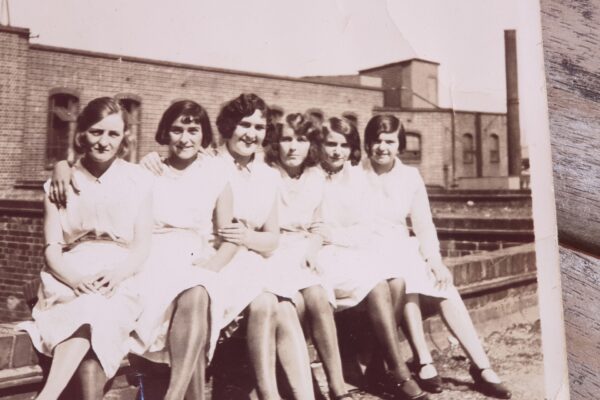
By using the 1921 census we can get an idea of the numbers of staff employed at Serpell – it comes to 141 and of these 83 are women. Conversation with various people who had family working for Serpells have shown that the atmosphere was an enjoyable one, so much so that it was not uncommon for employees from Huntley & Palmers to move across to Serpells when an opportunity arose. Below is a photograph kindly shown to me by Sonia Chapple, whose mother worked for Serpells and is shown here with her colleagues on the roof of the factory in South Street.
The Serpell company expanded in 1923 into transport with the founding of Talbot-Serpell Transport Co. Ltd. It is not as unusual expansion choice as it first seems because the biscuit trade would have needed a fleet of vehicles to supply shops and other outlets. The new company was founded out of the road haulage business of G W Talbot & Sons, who ran a coal merchant operation, with Henry Serpell as the majority shareholder. Ebenezer Talbot was the new company’s Managing Director and was also Mayor of Reading. 53 The company operated out of 64 Caversham Road in Reading.
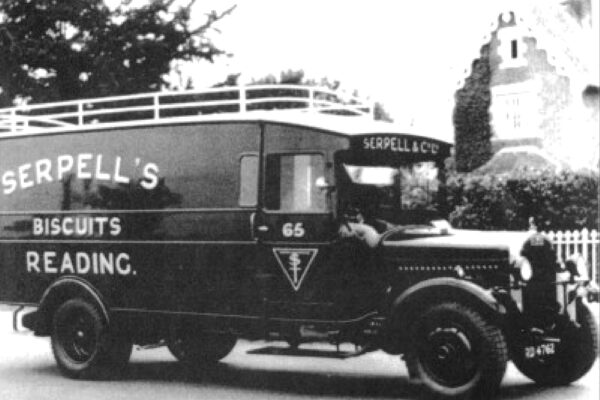
The Reading Mercury of 2nd September 1939 reports on the death of a Talbot-Serpell employee, Arthur Gale. He was crushed between a reversing van and a water tank and died on the way to the Royal Berkshire Hospital. The inquest returned a verdict of ‘death by misadventure’ showing that health and safety at work was still not considered to be an employer’s concern.
In September 1943 Henry Serpell died at his home in Chobham aged ninety-one years old. Henry had made legal history by becoming the first man to secure a divorce from his wife Louisa Jane on the grounds of insanity under the new Matrimonial Act introduced by A P Herbert. At the time of the divorce, Louisa was eighty-four years old and they had been married for sixty-one years. He was awarded a Decree Absolute in July 1938 and within the week had remarried to a distant cousin of his, Fanny Oliver, who was fifty-nine years old at the time. Serpell was eighty-five years old and a Deputy Lieutenant of Surrey and had previously been the High Sheriff of the county in 1924-25. 30, 31, 33 Probate records show that he was worth just over £237,304 when he died, equivalent to around £13.5 million in today’s money.
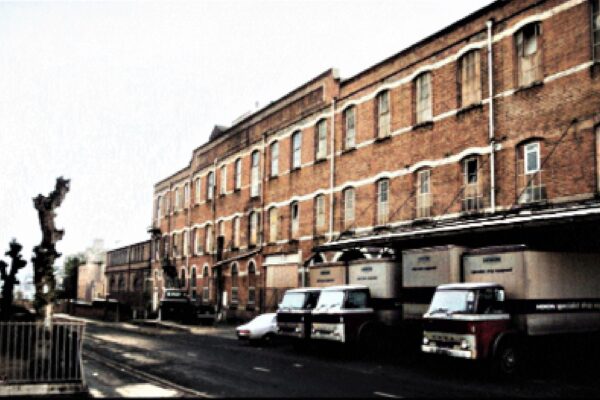
In 1951 Serpells celebrated its 100th year anniversary. The toast at the banquet held to celebrate the landmark was made by Mr R H R Palmer, Chairman of Huntley & Palmers. In his speech Mr Palmer noted that “the two firms had lived together in Reading for some years on the most friendly terms, although competing keenly with one another”. He then commented on the South Street factory saying “in the past it had been supposed that the site would not be suitable for a biscuit factory. Today, if any of you are given the chance to go over the building you will find that it is a most compact modern factory with a wonderful layout”. He added “in business Serpells has always been known as a maker of the finest quality biscuits sold, and as far as price in concerned their goods are well within the reach of the public”. Mr Ben Clark, Chairman of Serpell, announced that all members of staff who had served one year with the firm would be paid an additional week’s wages to mark the centenary. 35 The South Street Site is shown below.
The end of Serpell’s biscuit company came in late 1959, with production ceasing on the 18th December when the company went in to voluntary liquidation. Ben Clark, now Managing Director, told the papers that all employees had been offered other work through the diligence of the Reading’s Employment Exchange. This was lucky because the company paid no compensation to the employees. Being Christmas, many of the 290 workers had been saving into a social club kitty for the festivities and they unanimously decided to give the £630 fund to charity rather than share out the money between themselves. The papers noted that while the workers had chosen to think of people worse off than themselves, when Henry Oberlin Serpell died he left a quarter of a million pounds, all made out of biscuits, to his family and friends. 36, 41, 42
While their biscuit making business in Reading ended, a new company Serpell (1959) Ltd was inaugurated to take over the goodwill, name and trade of the original company. The new company was set up by Wrights Biscuits Ltd of South Shields and they would continue making biscuits there under the Serpell name for some time. 43
In 1960 the South Street site was sold. It was described as 100,000 sq. ft. spread across two and three storey buildings. The new owners planned to offer the site for letting to other businesses. 44 From this time onwards the site was used for a variety of purposes, including the electro-plating works of Reading Metal Finishers Ltd. shown in the photograph below in 1980.
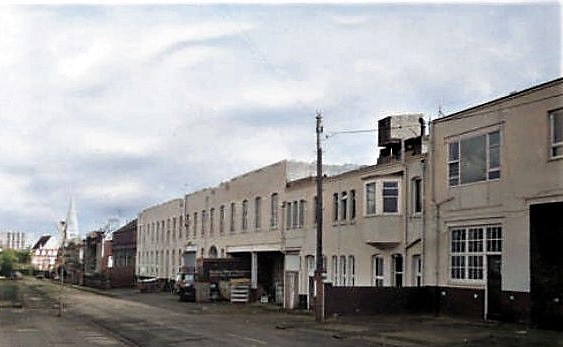
The factory has now been demolished and the site redeveloped. 7
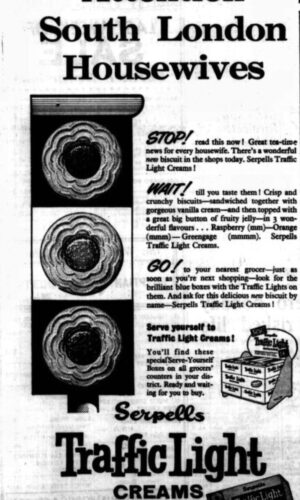
With so many years of operation you would think it would be easy to find examples of the biscuits produced by Serpell, but it isn’t. Only one advert has been found, from the South Western Star of 18th July 1951, which shows their Traffic Light Creams. Although the advert is in black and white it notes the flavours of raspberry, orange and greengage giving the red, yellow and green colours.
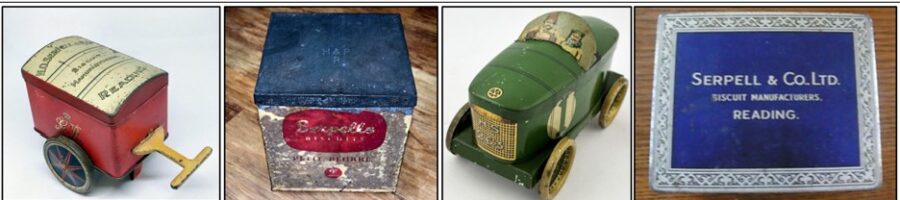
Like their rivals Huntley & Palmers, Serpell had metal biscuit tins in which their biscuits were sold. A selection is shown below. It hasn’t been possible to find out where the tins were made but it is likely that they would have been produced by Huntley, Boorne, Stevens the Reading company that also produced tins for Huntley & Palmers.
References
- Nonconformist and Independent: Obituary Mr R C Serpell (04 Nov 1886)
- West Briton and Cornwall Advertiser: Painful Sudden Death of Mr R C Serpell (28 Oct 1886)
- Express and Echo: Destructive fire at Plymouth (10 May 1869)
- Totnes Weekly Times: Mr Serpell’s Will (02 Apr 1887)
- Faringdon Advertiser and Vale of White Horse Gazette: Removal of a Factory from Plymouth (04 Mar 1899)
- Berkshire Chronicle: Death of a Well-Known Tradesman (20 Nov 1897)
- BIAG News No 33, Winter 2014 – Reading Industries (Part 1) – David Cliffe
- Reading Mercury: Machine-Made Bread (15 Aug 1885)
- Berkshire Chronicle: Steam Bread and Biscuit Works, Queens Road (15 Nov 1862)
- Huntley & Palmer v The Reading Biscuit Company, Limited: High Court of Justice – Chancery Division (12 May 1893)
- Reading Mercury: Meaby (20 Nov 1897)
- Berkshire Chronicle: Queens Road Machine Bakery (18 Dec 1897)
- Reading Observer: Meaby & Co, Ltd, Reading (20 Nov 1897)
- Reading Mercury: Auction (12 Nov 1898)
- Reading Mercury: Freehold Flour Mill (12 Nov 1898)
- Reading Mercury: Removal of Serpell’s Biscuit Factory from Plymouth to reading (04 Mar 1899)
- Reading Mercury: Serpell’s Biscuit Factory (27 May 1899)
- Western Daily Press: Serpell’s Biscuit Factory (07 Oct 1899)
- Western Evening Herald: Migration on an Industry (23 Feb 1899)
- Berkshire Chronicle: Terrible Fire at reading (26 Jul 1904)
- London Daily News: Messrs Serpell, Biscuit Makers, of Reading (12 Oct 1904)
- Long Eaton Advertiser: Reading Biscuit Factory on Fire (29 Jul 1904)
- Oxford Times: Disastrous Fire at Reading (30 Jul 1904)
- Berkshire Chronicle: Messrs H O Serpell’s New Factory (22 Oct 1904)
- Newbury Weekly News and general Advertiser: Serpell (06 Oct 1904)
- Berkshire Chronicle: Fatal Accident at Messrs Serpell’s (10 Feb 1906)
- Reading Mercury: Triticumina Mills (25 Nov 1916)
- Reading Observer: Fire at Serpell’s (05 Apr 1919)
- Western Morning News: Devonian Office Boy to Director (22 Jun 1936)
- Evening Despatch: 85, Married Today (09 Jul 1938)
- Northern Whig: Made Legal History (11 Jul 1938)
- Reading Mercury: Mr H O Serpell’s Birthday (06 May 1939)
- Surrey Advertiser: Death of Mr H O Serpell (18 Sep 1943)
- Reading Standard: Mr Bernard Short (22 Oct 1948)
- Reading Standard: Mr R Palmer’s Tribute to Serpells (20 Apr 1951)
- Reading Standard: Serpells Stop Production Today (18 Dec 1959)
- Huntley, Boorne & Stevens and Tin Box Manufacturing in Berkshire 1832-1985; T A B Corley; Berkshire Archaeological Journal 72 (1983-1985)
- Reading Standard: One Hundred Years of Progress (25 Oct 1930)
- Reading Mercury: Reading Early Closing Association (3 Sep 1887)
- Reading Evening Post: Woodley Firm Cuts 135 Jobs (25 Sep 1998)
- The People: The Christmas Gift (20 Dec 1959)
- Reading Standard: Will of Mr H O Serpell (1 Jan 1944)
- Reading Standard: Serpell Taken Over (01 Jan 1960
- Reading Standard: Serpell Biscuit Factory Premises Sold (04 Mar 1960
- A Village in the Town: F C Padley (1972)
- Reading Standard: H Meaby (17 December 1897)
- Webster’s Reading Directory 1874
- 1871 England and Wales Census
- Kelly’s Directory of Berkshire 1887
- Old Plymouth website [www.oldplymouth.uk]
- Reading Evening Post: Bakers Get a New Pay Offer (06 Dec 1974)
- Reading Standard: Foundation Stone Laying (22 Oct 1904)
- Reading Observer: Inauguration of Talbot-Serpell Transport Co, Ltd. (19 Jan 1923)
- England & Wales, National Probate Calendar (Index of Wills and Administrations) 1858-1995
- Reading Standard: Harry Meaby, The Machine Bakery (01 Dec 1900)
- Reading Standard: Obituary Mr Harry Meaby (26 Sep 1941)
- Reading Standard: Obituary Mr H A Meaby (07 Jan 1944)
- A History of Berkshire part 13: Industries – P H Ditchfield & William Page (1906)
- Reading Mercury: From a Bath to a Bakery (18 mar 1893)
- Reading Observer: Bathing Accommodation in Reading (05 Aug 1893)
- Reading Standard: Messrs H O Serpell & Co’s New Factory (04 Mar 1905)
- Morris of Reading: A Family of Architects 1836-1968. H Godwin Arnold and Sidney M Gold (1989)
- Reading Mercury: To the Editor (25 Jan 1851)