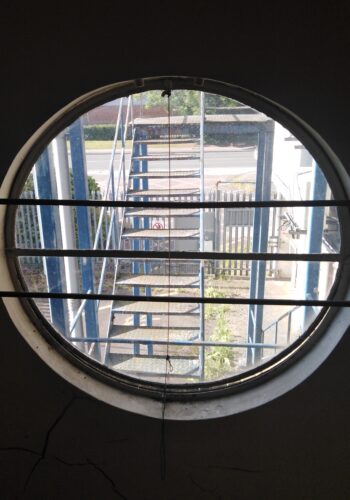
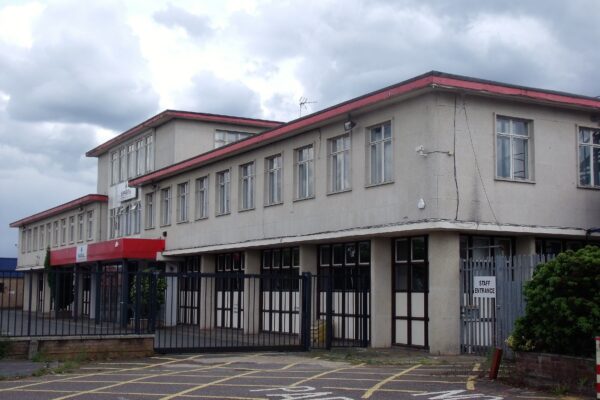
Miles Aircraft Factory, Woodley (Photo: Edwin Trout 2020)
The most important event in the 20th century history of Woodley was the sale in 1929 of a Hundred Acre field to two Reading motor engineers Jack Phillips and Charles Powis, who started an aircraft business. They set up the Phillips and Powis School of Flying which charged 12s 6d for flying lessons. They used second hand aircraft but did not manufacture them.
In 1932 Charles Powis and Frederick George Miles met and agreed “to place at Mr Miles’ disposal a newly equipped Aircraft Workshop”. Phillips left the company in 1932 but the name stayed Phillips and Powis until 1943. F.G. Miles was the major partner in what became known as Miles Aircraft. He was married to Blossom who took a keen interest in the business and was skilled at design. She was born Maxine but preferred to use the name Blossom. Daughter of a famous theatrical family, her first husband was a wealthy aristocrat who paid for her to have flying lessons at Shoreham in 1930. She fell in love with her flying instructor F.G. Miles and divorced her first husband to marry him. From 1934 they lived at Land’s End House in Beggars Hill Road. The house was built for Mr and Mrs Miles. It became a listed building in 1984. Land’s End House, the Falcon Hotel and the Miles HQ and factory were all designed by architect Guy Morgan. The HQ building was opened in 1939.
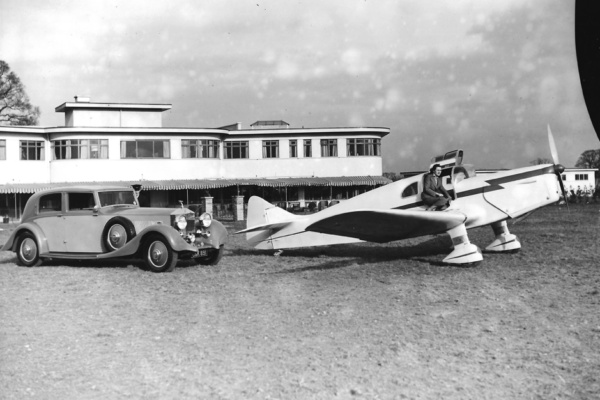
Miles Airplane outside of The Falcon Hotel (Photo courtesy of Reading Borough Libraries)
In September 1932, Reading Aero Club held an At Home to 80 staff members of Reading University. The Berks, Bucks and Oxon Club held an At Home on the same day at the other end of the Aerodrome, which featured an air race to Wokingham Church and back.
In 1935 the King’s Cup race was won by Tommy Rose in a Falcon. The second and third places went to pilots of Hawk aeroplanes. The Falcon and Hawk were both Miles planes. In 1936 Charles Lindbergh visited the Aerodrome. George Miles joined his brother at the company. A year later, Charles Powis left the company.
Miles made many types of wooden aircraft. Their first major success was the monoplane The Hawk, which sold for £395. It was much cheaper than planes made by other companies. Their best-known aeroplane was the Magister, which was used as a training plane for the RAF.
Flying was an expensive hobby in the 1930s and the Falcon Hotel was built in 1937 to accommodate rich visitors. It was at the east end of the Aerodrome, near Eleven Elms Cottage. It replaced the old clubhouse of The Reading Aero Club, which had become surrounded by factory buildings. The Falcon was owned and run by Simonds brewery. It was used by the RAF in the Second World War. The Falcon Hotel was damaged in an arson attack in the 1990s and demolished to make way for the housing development on the airfield site.
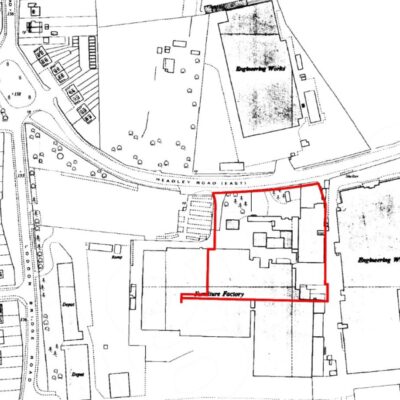
Site of Miles Aircraft Factory - OS Map 1969 (reproduced with permission of the National Library of Scotland)
The noise and pollution from the aircraft factory meant that Woodley no longer had pure country air. St. Luke’s Home for Sick Children in Headley Road closed in 1936 and the children moved to Bexhill. The building became Hawkhurst and was used as a mess and sleeping quarters in the Second World War.
Woodley Aerodrome had grass runways which helped to disguise it from the air in the Second World War. The buildings were camouflaged so well that some pilots had difficulty finding the aerodrome on the way back from exercises. An Elementary Flying Training School for the RAF was set up when war broke out in 1939.
The Aerodrome
In 1939 the aircraft firm Phillips and Powis had 1000 employees. The company name was officially changed to Miles Aircraft in 1943 but local people called it Miles years before then. Employees were recruited to be ARP wardens – Air Raid Precautions -, fire watchers and to join the Home Guard. The Aerodrome Home Guard was commanded by Flight Lt. Tommy Rose, who was the chief test pilot. The trees which gave their name to Eleven Elms Cottage were cut down because they were a landmark which could identify the Aerodrome. Buildings were camouflaged and false hedges disguised the grass runways. There was an underground hospital. Anti-aircraft guns were set up.
Miles was given the contract to build Magisters, the military version of the Hawk trainer, for the RAF. In 1940 Miles was awarded the Spitfire Repair and Service contract. At the peak of wartime production in 1940 there was a 7-day 24-hour working week. Extra buses were laid on by the Thames Valley Traction Company to take workers to the Aerodrome. The company employed 8 blind men, some ex- servicemen in 1942, plus lots of women in technical roles assembling gyroscopes. There was also a factory In Liverpool Road and Basingstoke Road, in Reading and a shadow factory in Swindon. A shadow factory helped to disperse production of vital war supplies like aircraft, in case a bombing raid destroyed a major factory.
They took over the derelict Davis Farm near The Falcon Hotel and built a wind tunnel. The government had refused permission, but Miles secretly built it with the help of local builder Harry Russell. It was in use until 1960, according to an article in the Reading Chronicle of 4 July 1986. The land was also used for the Miles Aeronautical and Technical School 1943-9. By 1942-3 the eastern end of the airfield had an officers’ bath house, accommodation for officers and men, a sergeants’ mess, dining and recreation rooms. Some airmen were in Nissen huts in the grounds of Sandford Manor. The No. 10 Flying Instructors’ School was formed from the former No. 8 Elementary Flying Training School in 1942. Instructors took an 8-week course to qualify. The last recorded flight in their logbook was in 1946.
By 1945 there were 5000 people working at Miles. The government gave assurances that they could keep their jobs for 12 months in peace time. Miles Aircraft turned to making civilian aircraft, then went bankrupt in 1947. The winter fuel crisis in January-March 1947 affected production. There was over-manning and poor financial control. There were also post-war restrictions on fuel for private aircraft. Foreign exchange controls made it hard to collect payments for aircraft ordered from overseas. Only 500 people kept their jobs. Some went to work for Handley Page who took over a year later, and some to the Miles Martin Biro Company. Biro production moved to London and Theale in 1953.
Adwest to Arlington Automotive
The 1939 offices of Phillips and Powis, later Miles Aircraft, were taken over by Western Manufacturing Estate in 1948. Western Manufacturing Estate (on the west side of the aircraft factory) took over the manufacture of aircraft parts. It merged with Adamant Engineering to become Adwest in 1955. The business of Adwest was car engineering, aircraft parts, electric motors, railway signalling equipment and printing machinery. In 1963 it became the Adwest Group.
1950s photo from the Western Apprenticeship Scheme booklet, courtesy of the Elizabeth Simmonds archive in Woodley Library
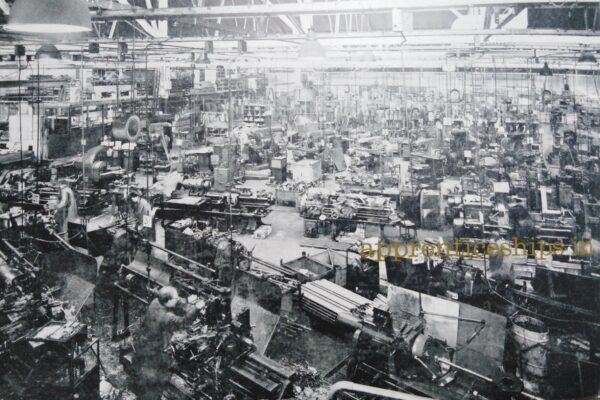
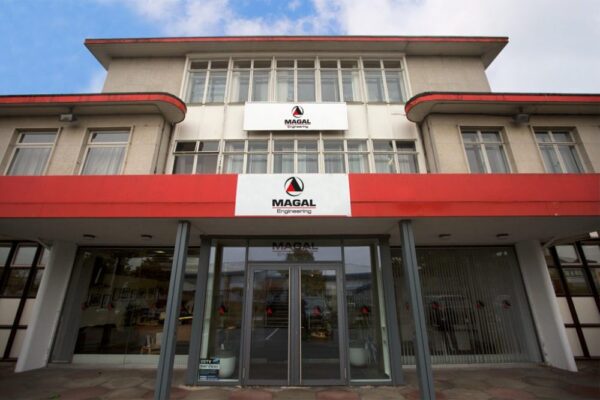
Adwest was taken over by Magal Engineering in 2002 and Magal was absorbed into the Arlington group in 2017. They are still in business in Headley Road East and the name Western Thomson-Magal AWT Ltd was used on their website. In 2022 the company name was Thermal Management Solutions.
Biro
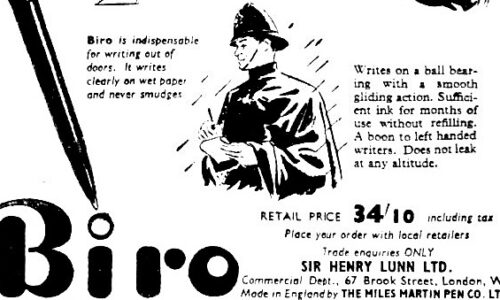
In the late 1940s and early 1950s, a technological wonder was produced in Woodley. The inventor of the ball point pen was a Hungarian, Laszlo Biro in the 1930s. The idea of a pen that could write anywhere had been known since the 19th century. Biro was the first man to produce a working pen, market it and give his name to it. He visited Miles Aircraft several times when he was developing the biro during the Second World War. Airmen often had to write in log books in difficult conditions while flying, and the biro helped to solve this problem. Laszlo Biro convinced Frank Miles to form a new company in 1944: The Miles Martin Pen Company, which had the U.K. rights to the biro. A Mr Martin ran the American company which made biros. Some former aircraft workers worked for the Miles Martin Pen Company, in a factory on the north side of Headley Road East. The first pens produced were very expensive, being advertised for sale at 55s (£2.75- a lot of money in 1945). There were production problems because the biro was new technology, and some materials like ink were not good enough to ensure a reliable pen. Once these problems were overcome, the company became profitable. Later the price of a biro dropped to 34s 10d, according to the advertisement below. The company became Biro Swan Ltd in the early 1950s, then Biro Swan moved production from Woodley to London and Theale in 1953.
Photo courtesy of Woodley Town Council archives
In 2021 an application was received to demolish the building that once housed the Miles Aircraft factory in Headley Road East and replace it with a new commercial development. With so little remaining of the aircraft factory and the wider Woodley Aerodrome a concerted effort was made by local groups to save the building. In June 2022 the planning application was refused. Details of the application and the associated heritage appraisal with photographs can be found here.
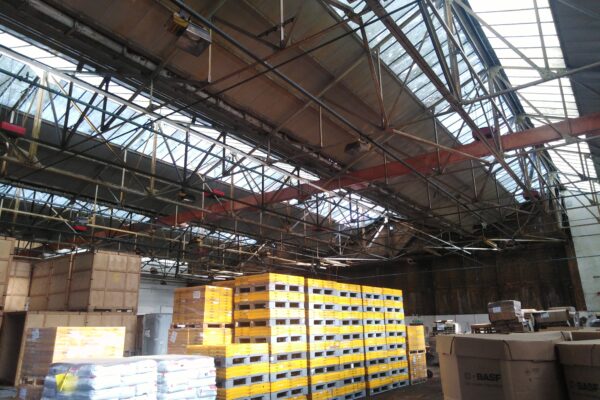
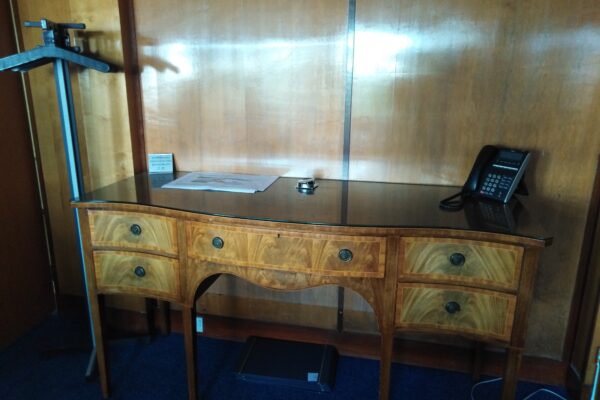
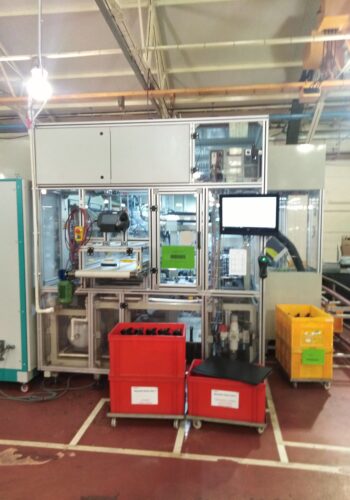
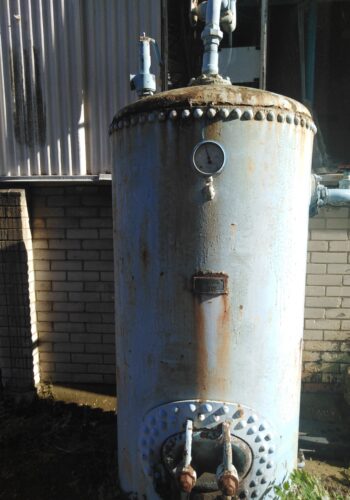
Prior to the final planning decision a small group of interested locals were allowed to visit and photograph the site. Her are some of the photographs taken.
Miles Aircraft Factory, Woodley - now Thermal Management Solutions 2022 (Photo: Ann Smith)
Factory Behind the HQ Building (Photo: Ann Smith)
Boardroom (Photo: Ann Smith)
Machinery in Factory, now owned by Thermal Management Solutions (Photo: Ann Smith)
Boiler (Photo: Ann Smith)
HQ Window (Photo: Ann Smith)