


For our March 2021 event, BIAG were treated to a shining example of expertise in a subject area that is both niche and ubiquitous: the filament lightbulb. Our torch bearer for this talk was John Holden, whose comprehensive and meticulous research took us on a journey into a topic that can truly be seen as transformative for how we are able to live, work and move around. Without lightbulbs, transport would not have been able to develop, manufacturing would have been much less productive and our streets and homes would have been very different – and much less safe – places. It is a story of collaboration triumphing over protectionism, which appeared mainly through patenting developments and processes, although there seems to be some blood on the tracks on the way. For example, General Electric became the subject of anti-trust action by the US government several times due its monopoly control of the industry,
John divided his presentation into three complementary parts: firstly, a gazetteer of early lightbulb technology, followed by a snap shot case study of one of the main manufacturers of lightbulbs in the early twentieth century and finishing with a thoroughly illuminating online exhibition of some of his collection.
John started with a science refresher, reminding the audience of the constituent parts of light and its properties. It was interesting to see how light has gone from something that is rather mysterious in its terminology to something much more scientific and prosaic: what we know as infra-red was dubbed dark heat in the nineteenth century and ultra violet was known as actinism.
The ultimate question of who invented the lightbulb, Edison or Swan, was categorically qualified: neither as it happens, their achievements being the commercially successful apotheosis in the 1880s of almost a century of innovation and at least 20 talented scientists and engineers. The process of producing a filament light, primarily to reduce explosions in mines and reliant on Volta’s recently discovered batteries, started with Humphrey Davy in 1802. Davy demonstrated the capacity for incandescence of a platinum wire using a current from a battery, newly invented by Volta in 1799. Platinum became the go-to metal for filament production as it did not oxidise easily, giving bulbs some longevity and carbon was widely used in early bulbs. Most of these early bulbs were somewhat off looking when compared to the bulb shapes we are most familiar with, and there seemed, from the examples John gave, to be a tendency for scientists to highly-engineer their designs, with many of the early bulbs not being made in any quantity beyond a few prototypes by their designers. The driving force for this may have been the ring-fencing of the technology by Edison and his love of patents protection. Notable examples of these complex, technologically flawed but otherwise workable designs included Bouliguine’s Burner 1876, Konn’s Burner of 1875 and the Reynier bulb 1878, all of which had mechanical as well as electrical parts. The localised innovation and production is demonstrated in a late nineteenth century exposition in Vienna, where no less than 12 exhibitors from different countries showcased their lightbulb technologies.
Advert for Robertson Electric Lamp Co.; image from Graces Guide
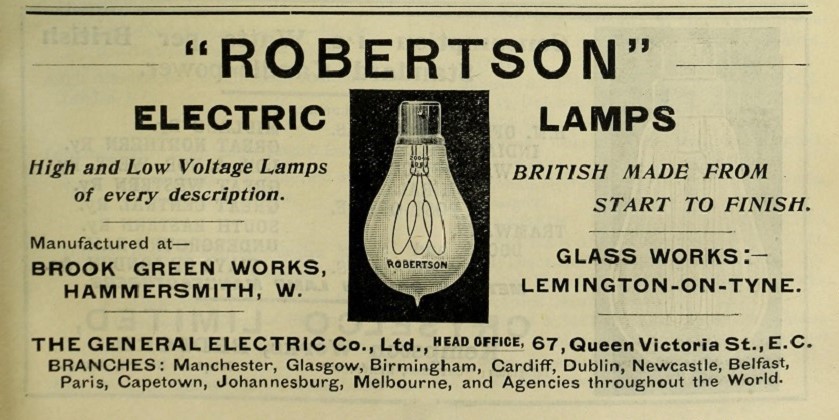
There followed a case study of the Robertson Electric Lamp Co, which gave us a snapshot of the processes of manufacture in 1908. The company was founded in 1893 by the charismatic CJ Robertson, who overcame many initial difficulties to create the basis of a company that was to last well into the twentieth century.
Using the Robertson works as an exemplar, John took us on a fascinating run through the delicate and complex processes involved in making the filament lightbulb, from creating a filament of chemically treated cotton to packaging in the distinctive pink wrapping paper stamped with the maker’s details. The company employed over 500 workers in this most labour-intensive factory process at its Hammersmith site, and there were some charming images of the staff at work and play. Overall, the delicacy of the operation seemed to lend itself to a female-centred workforce and the majority of the images John showed featured a preponderance of women workers. The difference with working conditions and worker safety measures now was striking: the process involved highly toxic chemicals such as benzine and liquid mercury, yet there were few concessions to health and safety – well-lit working conditions being the exception – and PPE was clearly non-existent. The use of benzene was interesting if horrifying from a modern health and safety perspective. It was identified by machine gun maker Hiram Maxim as a means of depositing carbon on the filament to provide an even cover and so better working properties in an elegant process known as flashing.
John went on to show how the glass blowing for the bulbs was all done by hand; this was a highly skilled process as each bulb had to be identical. The company bought the Leamington glass cone in 1908, situated on the banks of the Tyne west of Newcastle city centre.
Leamington Glass Works, Newcastle-Upon-Tyne c.1900
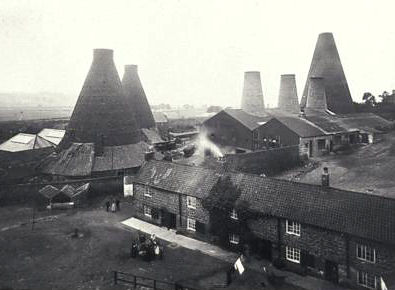
The cone that still exists is the tallest one in the above image (ref: Wikimedia).
The Leamington works produced all the domestically produced glass for the Robertson works. The Robertson factory was later taken over by the UK company General Electric Company, or GEC. However, the pinch point was the glass blowers, where demand for sufficiently skilled workers outstripped supply and some ready-made bulbs were imported from Venice. A particularly interesting slide was the process of sandblasting the inside of the bulbs to create a ‘pearl’ effect light bulb.
The complexity of the process, the hand-made nature of the bulbs and the expense of the raw materials – platinum, hand blown glass – made light bulbs an expensive commodity in the early days. However, as technology was developed production doubled from 2 million units per annum to 4 million in the first decade of the twentieth century. They were also a good example of an early recycling initiative, with bulbs being returned to the factory, or to others, for stripping down and reuse of the platinum parts for example.
There followed a great online exhibition of John’s personal collection, including overly complex ceramic bulbs complete with their own internal heater. These seemed to typify the innovative process around bulb development, with the process being both simple and complicated all at the same time. The level of skill required and the employment of such a level of craft was both impressive and humbling in an object we all now take very much for granted. Our thanks to John for his detailed overview of an invention that has banished the dark and expanded our horizons more than any other.
Meeting review written by Victoria Stevens, BIAG