


The history of this long-standing Reading industry began outside of the county in Southampton, and had maybe not the most auspicious of beginnings born out of financial difficulties.
Thomas Perry is born on 19th February 1777 in Whitechapel in London, the son of Daniel and Elizabeth Perry; Daniel was a Quaker and a baker, who had fifteen children; here we are interested in two of them, Thomas and Joseph. In the early 1800s Thomas Perry works in the Mill Place Foundry in Foundry Lane, Southampton where he is in partnership with Henry Pritchett, another Quaker. Perry has already served an apprenticeship in Robert Ransomes’ foundry in Ipswich; Ransomes’ ironworks was a leader in plough manufacture in this era. In August 1810, the Southampton ironworks becomes insolvent and both partners are accused by their local Quaker Meeting of having ‘absconded and not paid their just debts’. When questioned, Perry accuses Pritchett of having failed to pay in the additional capital he had promised, but is himself charged with having taken a considerable sum out of the business for his own private use. In the circumstances the Quaker Meeting judged both equally culpable and disowned them, an action of the most serious nature for this religious community and not one taken lightly. After these events, Perry left the iron business and went to work as a clerk and accountant in London.
Then in 1818 Thomas Perry, maybe enticed by Reading not having many iron foundries at the time and also because of an already operating link between his former Mill Place Foundry and Reading’s clothing business which they supplied with wire for pin making, moves to Reading. With his younger brother Joseph (born 11th November 1782) he sets up Thomas & Joseph Perry and builds a foundry on the corner of Katesgrove Lane and Horn Street, which we now know as Southampton Street.
1840 Tithe Map of Reading showing location of original iron foundry (map is after foundry had moved)

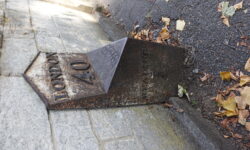
There are few remaining examples of the foundry’s ironwork from this period, but there is a fine example of a metal milestone situated on the Bath Road in Reading just outside of the old waterworks.
Mile Marker – Bath Road Reading, made by T & J Perry (Photo: Jo Alexander-Jones)
Only two years after the foundry was set up Thomas Perry is again in financial difficulties and is declared bankrupt. From this time Joseph Perry takes on running the ironworks business alone. Thomas Perry reverted to the family business of baking, setting up a biscuit bakery at 28 Market Place, Reading and later at 4 Duke Street. His bakery company was commended for its biscuits by the novelist Mary Russell Mitford. In 1839 Thomas retires and henceforth devotes his life to writing on geology until his early death in 1847 in Finsbury, Middlesex.
After Thomas Perry’s departure Joseph Perry spends some time running the company alone, until in 1825 he brings in George Barrett as a partner in the firm. Barrett was a fellmonger (a dealer in hides and skins, especially sheep) born at Alton, Hampshire in 1771, who had previously run a saltworks at Lymington. He was not an engineer, but what he brings to the company is his expertise in commerce and he also contributes much-needed capital; at this point the company name changes to Perry and Barrett. Advertising in early 1825, they describe themselves as ‘Ironfounders and Plough Manufacturers’. The foundry had begun to manufacture lighter weight ploughs to meet a growing demand from the farmers of Berkshire for better, locally-made ploughs. Previous to this, local foundries would only make minor adaptations to plough designs and this had led to farmers purchasing lighter, non-wooden ploughs from outside of the county.
Mill extension over River Pang

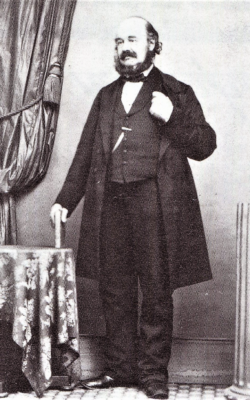
Barrett, who had no children of his own, brings into the business his nephew, George Allam Barrett, and his nephew by marriage, William Exall. He also appoints Charles James Andrewes, the son of a Hounslow businessman and not a relative, to a clerical post in the firm’s office. William Exall’s parents had emigrated to Richmond, Virginia in the US when he was young and he had since been working in his family’s agricultural machinery business. He brings the business acumen he had gained in America to the Katesgrove foundry and focusses on improving their agricultural machinery products. Exall proved to be a very inventive man, amongst his early innovations was a tyring pit for making wooden wheels with iron hoop tyres. To cool the iron on the wheel he devised a platform that was then dropped as a whole into a tank of water.
William Exall (From Reading Iron Works by Jonathan Brown)
While the foundry is producing a large variety of agricultural ironwork they also, like many industries of the time, diversify. In the 1830s they are seen to be providing gas furnaces for horticulture and other large buildings, acting as domestic gas fitters, selling domestic products such as metal stoves and acting as agents for sales of anti-corrosion paints, oil and brushes. They also lease on a mill on the banks of the Kennet and Avon canal, presumably on their premises, which had previously been used in the zinc trade but could be adapted for the corn or paper trade by new management.
Joseph Perry dies on 5th May 1831, having spent two months in the Radcliffe Asylum in Headington, Oxfordshire, suffering from ‘a mental malady’. In his Will he leaves his part of the foundry business to his wife Martha, William Exall and John Brown, a coal merchant in Maidenhead.
After Perry’s death the company continues to operate as Perry and Barrett until April 1825 when George Barrett retires. Barrett places a notice in the Berkshire Chronicle of 25th April announcing his retirement and informing the public that his nephews George Allam Barrett and William Exall will take on the company’s management and the company will be known as Perry, Barrett and Exall.
In 1836 the foundry moves to larger premises in Katesgrove Lane and this brought them closer to the river Kennet thus making it more convenient for raw material deliveries, such as coal from Somerset. It also brought them close to other industries in Katesgrove including sail making and brick making.
1860 - The ironworks on the east bank of the Kennet & Avon canal (from ‘The official Illustrated Guide to the GWR’ by George Measom)

During the construction of the Great Western Railway, William Exall meets with Isambard Brunel in 1838 and managed to secure a loan from the railway for £1,500 to support their supply of iron products to the building work; the loan was to be repaid in 1840 when London to Reading line completed. As the railway work reduced the company moves back to more to general and agricultural engineering. Exall continues to invent and patents a number of ideas including a safety cylindrical horse gear which became a standard mechanism in Europe and America, but mostly he didn’t follow up on his patents letting others make them into commercial successes. He is reputed to be the first person to use portable steam engines in agriculture.
In 1841 the Company places an advert in the Reading Mercury appealing to the agricultural community and offering various types of plough, especially the Light One-Horse plough which is described as the lightest plough in the field and the winner of a recent prize at the Royal Agricultural Society show. The company is also offering machines to thresh, winnow and sow seeds as well as hay-making and turnip-cutting implements. In addition to the agricultural products, they are selling iron fencing, kitchen ranges, fenders, pumps and brewing machines. As well as selling pure products they are also erecting conservatories, balconies and verandahs, which while not explicitly stated are presumably made in iron at the foundry.
Charles Andrewes (From Reading Iron Works by Jonathan Brown)
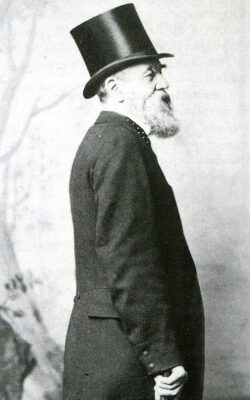
Charles Andrewes is made a partner in the company in 1842, and a notice is placed in the Berkshire Chronicle of 1st January noting that the partnership of Martha Perry, George Allam Barrett and William Exall is dissolved and going forward the company will be known as Barrett, Exall and Andrewes as of 31st December 1841. At the same time they go on to outline their leading agricultural machinery:
- Hand Threshing machine – this can also be operated by horse
- Double Action Turnip Cutter – this machine has a reverse option avoiding the need for two machines. It also designed to allow dirt and stones to fall through the mechanism to avoid damaging the knives
- Gorse or Furze Crushing Machine – when the crushing rollers are disengaged the machine acts as a Chaff Engine. Machines for crushing gorse and furze were important because the uncrushed foliage is too hard for most farm animals to process
- Light Double Furrow Plough – operates with two horses
- Light Double One Horse Plough – won 1st prize in the 1841 Royal Agricultural Society Show and of the lightest draft
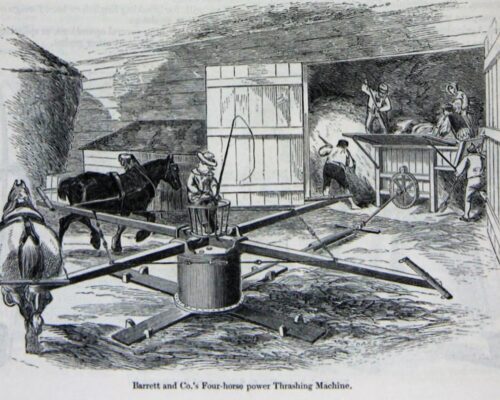
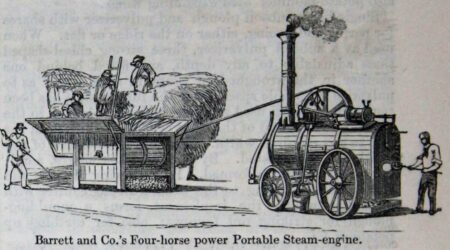
1851 – Barrett and Company 4-horse powered Threshing Machine (Graces Guide)
While emphasising their agricultural goods, the company does also list many other products including railings, stoves, horticultural fittings and castings in brass and iron. They note that they also take old metal in exchange for goods.
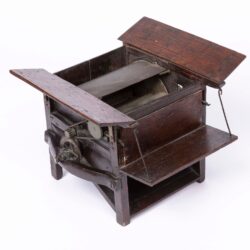
Around 1840 the firm had begun to make threshing machines and winnowing machines, the design was first exhibited at the Royal Agricultural Show in 1843. Going forward, these machines become a major part of the company’s production. Threshing is the process of separating the grains from the crop stalks after they have been reaped. For many years this was a manual process, but the introduction of machines made it easier, faster and cheaper, although it did reduce work opportunities for farm labourers. The introduction of mechanisation such as this had been the driver for the Swing Riots of the 1830s where agricultural labourers protested against the changes and the impact on their livelihoods. Being involved in the manufacture of agriculture wares meant that the company needed to keep good relations with the farming communities. In 1841 a letter is published in the Berkshire Chronicle from the company directors trying to dispel claims that their employees were expelled from the Town Hall following an altercation on the new Corn Laws. The letter claims to have spoken to all of the workers and found that only half a dozen had attended and none had been evicted. An interesting finding from the letter is the statement that the company’s employees work to a very late hour in the evening (used as a means of explaining how they could not have been involved) and also that the number of employees at the time was close to 200. The company also maintained good relationships with the community by giving ploughs as prizes for local agricultural shows.
1847 – Barrett, Exall and Andrewes Threshing Machine (Museum of English Rural Life)
William Exall stood for the Town Council in 1845, later he was chosen as an Alderman in 1854 and then elected Mayor in the same year. He remained an Alderman for the rest of his life and also from 1864 he was also a Justice of the Peace, making his last appearing in June 1881. In 1850 he was elected an Associate of the Institute of Civil Engineering.
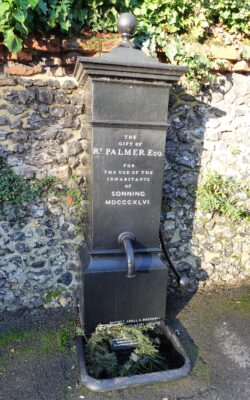
1845 saw the company make the village pump at Sonning, which was a gift to the Berkshire village from Robert Palmer. The pump bears the inscription at the bottom of ‘Barrett Exall & Andrewes Engineers Reading’.
Sonning Pump (Photo: Jo Alexander-Jones)
At the 1851 Great Exhibition held at London’s Crystal Palace, Barrett, Exall & Andrewes had one of the largest displays of threshing machinery, horse gears and agriculturally-related implements. At this time they are considered an important world supplier and as such are sited alongside Ransome & May of Ipswich, who were the acknowledged world leaders in agricultural engineering and its largest employer at 900 men. Barrett, Exall and Andrewes are also allotted four illustrated pages in the exhibition catalogue, which was more than most other companies had.
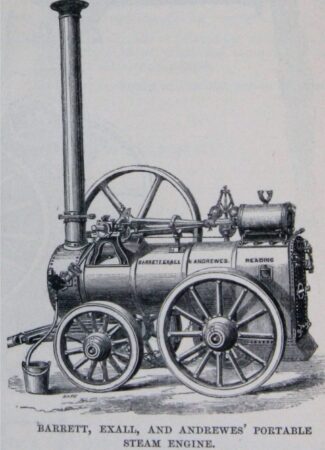
One of the machines exhibited at the Crystal Palace was the company’s Portable Steam Engine. Steam engines were a major part of the company’s product range at this time and it is estimated that they made around 1700 types throughout their existence. Their first portable engine designs began around 1848, but were considered not robust enough. The design was improved and for the Great Exhibition they showed the Ceres, a 4 ½ horse-power engine with a wooden-clad engine and firebox. Exall continued to innovate making the chimney taller, enlarging the cylinder and adding iron wheels. Initially the new design was not considered good enough in comparison to competitors to sell well, but by 1860s it has established a good reputation with the larger boiler giving good steam-raising capacity without the additional size and complexity of its competitors.
Early Barrett and Co Portable Steam Engine (Graces Guide)
1862 – Barrett, Exall and Andrewes Portable Steam Engine (Graces Guide)
By the mid-19th century, Barrett, Exall & Andrewes are now the largest employer in Reading, having 250 male workers in 1851, and they remained in this position until Huntley & Palmers took over from them.
In August 1857 a vicious storm swept across England, damaging many areas. The Katesgrove foundry was struck by lightening causing damage of around £2000 (around £¼ million in today’s money). While this would have had a major impact on the business the reports allow us to see some of the layout as the ensuing fire consumed the engine house, timber shed, ironmongery warehouse, saw mill and deal shed.
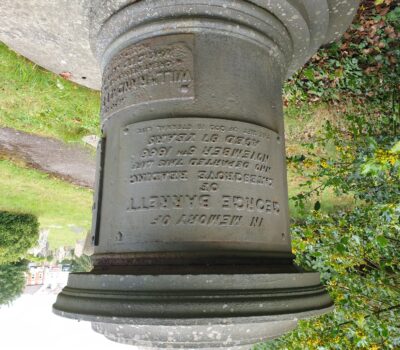
On 5th November 1858 George Barrett dies aged eighty-seven, over twenty-five years after his retirement from the company. Through most of his later life he has lived in Katesgrove Lane, beside his foundry. He is buried in Reading Cemetery in the non-conformist area and fittingly the foundry made him a cast iron memorial, which is now Grade II listed (list entry 1156154). In his Will, proved on 17th August 1859, he leaves effects of around £7,000 (close to £1m today). His wife, Sarah, also appears on the memorial; she died in 1852.
George Barrett’s memorial, Reading Old Cemetery (Photo: Jo Alexander-Jones)
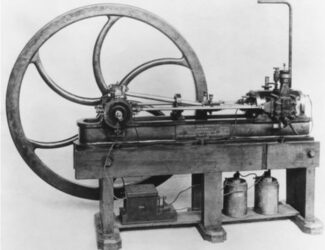
In 1860 the company obtain the manufacturing rights for the Lenoir patented internal combustion (gas) engines in all European countries except France. One of the first to purchase was the Science Museum in London. This engine to becomes a key product for them during the early 1860s with up to 100 being produced. However, the design had many inefficiencies and by the end of the decade it does not appear in their sales catalogue.
1860 - Lenoir engine from Science Museum
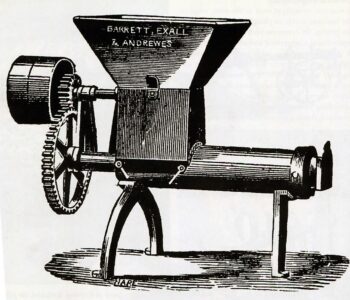
They are also carrying out a significant amount of work for Huntley & Palmers biscuit factory, including a steam-driven biscuit machine. This relationship with Huntley & Palmers had begun before the King’s Road biscuit factory opened as George Palmer was greatly interested in mechanising the business and relied heavily on William Exall’s innovative skills to design novel machinery. The Illustrated London News described one of the powered biscuit machines when shown at the Great Exhibition; it features a small Brunel Steam Engine which operates a rotating shaft in a kneading trough to mix the baking ingredients, once prepared the dough is passed through ha set of rollers that can be adjusted to the depth needed for the particular biscuit and passed to a hand-press to cut the shapes. The company didn’t restrict themselves to Huntley & Palmers and in 1860 we find adverts for a patent bread manufacturing machines operated in conjunction with Peek Frean, another well-known biscuit manufacturer.
1873 - Reading Ironworks - Biscuit Mixing Machine (From Reading Iron Works by Jonathan Brown)
The Exall – Palmer relationship is cemented in a more personal manner when in 1877 William Exall’s daughter Alice Maria marries George Palmer’s son Alfred.
The ironworks are also providing steam engines to the Huntley, Boorne and Stevens factory in Crown Street Katesgrove; Huntley, Boorne and Stevens produced the biscuit tins for Huntley & Palmers.
While the partners are managing the business, the workers are getting involved in supporting their fellows. The Berkshire Chronicle has an article on how he employees of Katesgrove Ironworks have collected £9, 10 shillings and 7 pence through subscriptions to support distressed worker in Lancashire. They plan to continue the subscription for the following six months to alleviate the situation.
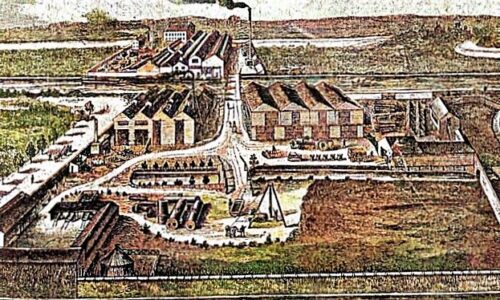
In 1862 the company expands by acquiring a 90-year lease on ten acres of meadow land on the west side of river Kennet, opposite their current site, at annual rent of £70. This site will be used for a timber store, a boiler maker shop and a large showroom of 2,750 square yards. The 1876 OS map shown below details many of the site’s features. On the east side of the river are the foundry, stores, smithy, turning and planning shop, fitting shop and the offices. To the west side of the canal are the stables, cart shed, boiler making shops, a plate furnace, a timber yard and storage sheds, a paint shop, a show room and a urinal. By this time there is also a bridge across the river joining the two sides of the ironworks, known as Foundry Bridge.
OS Maps 1876 (reproduced with permission of the National Library of Scotland)

By 1864 the expansion of the business needs a matching increase in the financial capital of the Katesgrove foundry. The situation was precipitated by needing to pay back the £3,300 that George Barrett had left in the firm on his retirement; the company did not have enough liquid assets to pay out and rather than accept the offer of Peter Spokes, a local chemist, to purchase the whole company they chose to move the firm from a Partnership to a Limited Company. In the process the company is renamed becoming the Reading Ironworks Co. At the time of this change the company is employing around 600 workers. This number of workers is smaller than some of the larger ironworks in the country and would place them in the second-division of the industry; for the company this marks the pinnacle of their employment figures. The change in status also brings new management expertise in the form of Henry Adolphus Simonds, a former mayor of Reading and a partner in his family’s brewing company, as the chairman. John Simonds of J & C Simonds Bank and Peter Spokes join the Board. Charles Andrewes remains as managing director responsible for commercial matters and William Exall stays in charge of engineering; both become executive directors. Unfortunately for the Reading Ironworks Henry Simonds proves to be the least dynamic of the Simonds family and he, along with the other Board members, seem to take little interest in the actual management of the company. At the time of the change the company assets are valued at £50,000 (between £6-7 million today) with an additional £20,000 for goodwill. The new commercial concern is set with a capital of £200,000 in £20 shares. The land was sold to the new company for £9,000 and after the George Barrett’s monies had been paid out the senior partners all received £2,400 cash. They also received 500 shares with a nominal value of £10,000 excepting Alfred Barrett who having paid in less only received £5,000.
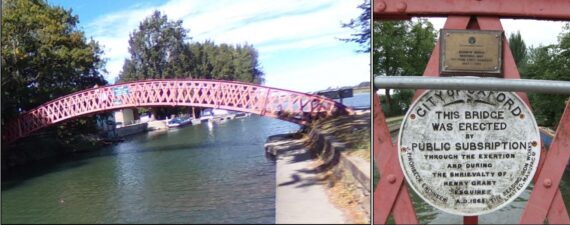
Away from commercial changes, manufacturing continues. In 1865 they produce the Rainbow Bridge which crosses the river Isis to the east of Oxford. This bridge still remains in place and has a commemorative plaque citing ‘J Pinchbeck Engineer – The Reading Iron Works Limited Manufacturers’. John Pinchbeck was chief engineer and will feature more in the history of the company.
Rainbow Bridge, Oxford
The 1860s and 1870s sees the market for agricultural implements and machinery changing, and the company starts to move more into steam and general engineering. They are reputed to have made the first set of steam ploughing equipment on the ‘roundabout’ principle in 1849, although do not appear to have continue with this line of business. The roundabout ploughing method used hemp or wire rope strung around the outer edges of a filed with moveable anchors at the corners. The portable steam engine was then belted to a double windlass located at the edge of the field with each end of the rope attached to one of the windlasses. The plough was then hooked onto the ropes at the corner opposite the engine and pulled back and forth across the field. The process was fairly labour intensive with the need to continually move the equipment and the reop would also frequently break. The roundabout process was not widely applied and hence the need for the associated steam engines were few.
The move to a limited company did not solve the company’s financial and management problems and in 1867, John Pinchbeck, their former senior engineer and manager of the company already mentioned above, wrote an open letter alleging that poor management was leading to declining profits and impacting the technical expertise. Pinchbeck had been appointed as the company’s manager in 1854 when finances were not great. The low ebb may have been as a result of Exall and Andrewes both being heavily involved in public service at this time. According to Pinchbeck he then spent ten years slowly focussing on management efficiencies and correct pricing, and in this period, turnover did increase and employment numbers went from 250 to 400. He also seems to have focussed on local people with 30% of the staff in 1861 being from Reading and two-thirds being from Berkshire and surrounding counties. While turnover and even profits were reasonable the owners preferred to draw the profits to support their lifestyle rather than invest in research and marketing. In 1866 no dividend was paid, with the start of 1867 giving a small profit of £600. The chairman attributes the poor results to large increases in the cost meaning that many sales make no profit at all.
1872 – Company Portable Engine and crew – Alfred Barrett is third right (From Reading Iron Works by Jonathan Brown)
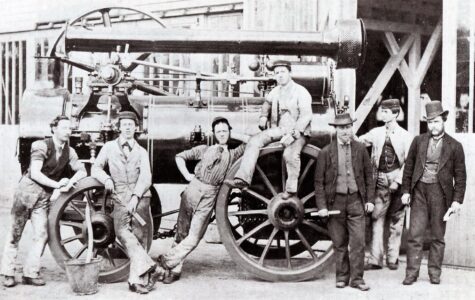
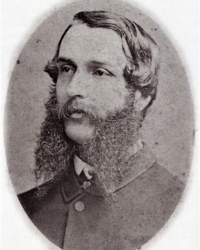
The company continues to exhibit at agricultural shows, but by employees are down to around 360 people working on the 12-acre plot. William Exall is continuing to innovate and take out patents, and to help him he has the support of Alfred Barrett, the son of George Allam Barrett, sadly Alfred dies in 1872 at only 37 years old. Exall’s son, William Henry Exall, is apprenticed at a Runcorn chemical firm and he was expected to join the company and work with his father on product development. Sadly, William is killed in 1868 by falling into a heated copper vat. [10] After these sad events Exall’s inventiveness reduces. All of these circumstances combine with increasing tension between William Exall and Charles Andrewes over money for research and the effective management of the company declines. Like many companies of this era the expectation was for the next generation to take over the reins and they had only the option of Charles Henry Andrewes, who was given charge of the London office, but his health was poor and he then dies in 1883 at only 38 years old.
Alfred Barrett (From Reading Iron Works by Jonathan Brown)
The directors were reluctant to bring in management from outside of the company and dilute their control, but they do appoint the 22-year-old George W Brown as chief engineer in 1877. However, the products are not securing market share as their competition are matching their designs, and while Brown is a competent manager, he is not an innovator.
By the 1880s the declining profits have moved to losses and a significant level of capital is written-off. John Simonds had died in 1876 and not long afterwards Peter Spokes moved to London, it is also rumoured that Henry Simonds passes his chairmanship to Spokes despite him no longer being in Reading. William Exall is in to his seventies, and in 1881 he dies, leaving Charles Andrewes as the only one of the management team with any long-term continuity. However, Andrewes was known for his inflexible management style and was nicknamed ‘Major Pomposity’ by the workers.
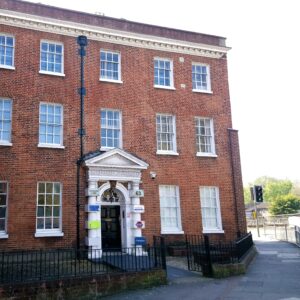
William Exall had been unwell for quite a while before his death and had become housebound. He died at his home, Holy Brook House in Castle Street, Reading, on 14th July 1881. He is buried in Reading Cemetery, but unlike his colleague Barrett he does not have a cast iron memorial. In 1888 his house is sold, and it still exists although now it is next to Readings’ Inner Distribution Road whereas in Exall’s time it is described as a centrally located mansion set in around 3 acres crossing the Holybrook stream.
2019 - Holy Brook house, Castle Street, Reading (Photo: Jo Alexander-Jones)
By now George Brown is chief engineer and works manager, and his time is focussed on manufacture and sales leaving little time for innovation. No dividends are being paid and they are just managing to service their debenture interest. One of their main products now is the Universal wrought-iron pulley. While they are still attending exhibitions the products displayed are either older styles or minor items such as horse-rakes and milk can cleaning machines.
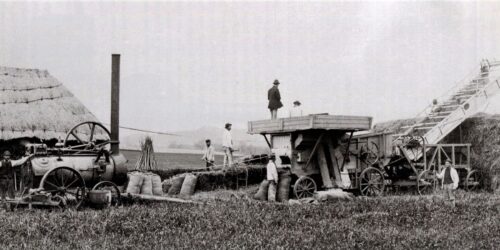
1880 – Company Portable Engine and Threshing Machine working in Farnham (From Reading Iron Works by Jonathan Brown)
In March 1887 Peter Spokes formally requests that the Board pay the company’s £18 debenture (roughly £2,500 in today’s money), but the directors could not find the money required and in April the company is voluntarily wound-up. It was hoped that the company could be sold as a going concern, but by October their equipment is being auctioned off. In June 1888 the company’s premises across both sides of the river Kennett, which are still joined by a timber and iron bridge, and reached as far as the Holy Brook, are offered for lease and freehold. December 1890 sees the final winding up meeting.
1887 – Reading Ironworks seen from west side, from sales brochure
The Black Barn was built about 250 years ago on the River Pang, near Bucklebury. The barn had a small mill attached to it. This was one on a number of small mills on the Pang built to grind corn for animal feedstuff.
In August 1888 the Reading Mercury has an announcement “The Universal Patent Pulley Company Limited, engineers, iron and brass founders, Reading. This company having purchased this patent are now the sole patentees and makers of the product. The manufacture is carried on upon a portion of the works lately occupied by The Reading Ironworks Limited…Thomas James, Managing Director.” Thomas James had been the Company Secretary of the Reading Ironworks. The new company was located in Lower Brook Street on the opposite side of the River Kennet to Katesgrove Lane; this company closes in 1895.
On 24th August 1889 the Berkshire Chronicle has a notice of the sale of the freehold portion of the original Reading Ironworks site. It is described as having a long frontage to the river Kennet and having the option for barge transport with London, Oxford and Bristol. The notice notes that the leasehold portion of the site had already been sold, which is most likely to have been to the Universal Patent Pulley Company Limited.
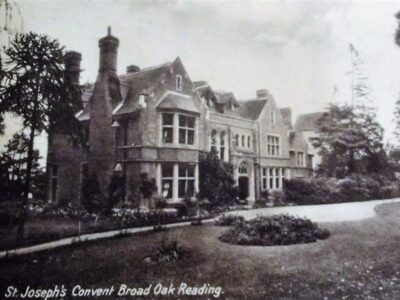
On 9th November 1895 Charles Andrewes dies, close to his eightieth birthday, and he is given a nearly full-page obituary in the Reading Observer and the Reading Mercury. He was taken ill while travelling on a Reading Omnibus in Southampton Street, Reading and once the seriousness was realised the bus took him to his residence, Broad Oak in Upper Redlands Road (which he had had built). Sadly, he died before he reached home. Even at his age, he had been on the way to a Reading council meeting where he was to propose his friend Owen Ridley for a second term as Reading Mayor. His obituary lists his many public roles, including his mayoralty in 1858, being on the committee for pauper lunatics in the Borough, chairman of the Sanitary Committee, trustee for the Reading and Kendricks school and treasurer of the British School. St Lawrence church’s bell was tolled for an hour during the funeral ceremony. In July 1899 a memorial window was placed in Trinity Congregational Church in Queen’s Road Reading to commemorate Charles Andrewes. He is not commemorated on the Andrewes cast-iron memorial in Reading Cemetery, which holds his mother and father.
Charles Andrewes home – Broad Oak, now St Joseph’s Convent Upper Redlands Road
By looking at the 1898 and 1909 Ordnance Survey maps the area of the Reading Ironworks goes from showing the foundry site to becoming the Central Coley Railway Depot on the west side of the river Kennet and housing on the east side alongside some of the original site buildings – the foundry, smithy, stores and workshops, but now used for other businesses.
OS Maps 1898 and 1909 (reproduced with permission of the National Library of Scotland)

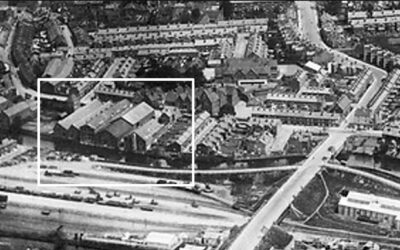
The original buildings on the east side of the ironworks site remain until Reading’s Inner Distribution Road is built. They can be seen in the aerial photograph of the area taken in 1920 (Britain from the Air). The area is rather derelict in the 1990s as the plans for development are reducing companies using the warehousing. The photograph below was taken by a member of BIAG in October 1995 in Katesgrove Lane and shows some of the old foundry buildings.
1851 – Barrett and Company 4-horse powered Threshing Machine (Graces Guide)
1851 – Barrett and Company 4-horse powered Threshing Machine (Graces Guide)

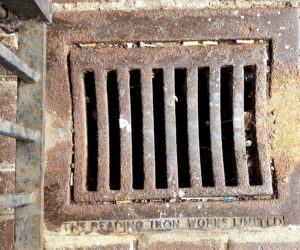
There are not many of the products of the Katesgrove ironworks that have survived. Some have been shown earlier in this article, more are below:
2019 – Reading Ironworks lamp post, Caversham
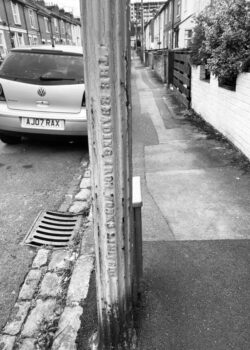
2019 – Reading Ironworks drain grate, London Street, Reading (Photo: Jo Alexander-Jones)
Bibliography and Sources:
- Grace’s Guide to British Industrial History – Barrett, Exall and Andrewes
- Some notes on the Reading Iron Works Ltd (Barrett, Exall & Andrewes) 1818-87 by T.A.B. Corley. MERL Pamphlet-5342-BOX 1/13
- Putting the iron in big business (by Leslie North. Reading Mercury) MERL pamphlet-5342-BOX 2/08
- A letter to the proprietors of the Reading Iron Works Limited by John Pinchbeck. MERL Pamphlet-5342-BOX 1/14
- Men of iron. MERL-5342-ME
- On this day – 9 November 1895 by Evelyn Williams published in The Whitley Pump (9 Nov 2018)
- Barrett, Exall & Andrewes’ Iron Works at Reading: the partnership era 1818-64. T A B Corley. Berkshire Archaeological Journal Vol 67 1964
- Reading Mercury (1 July 1899) p7 Memorial Window Unveiled at Reading
- Hampshire Record Office Deeds – 4M 49/40 (Mar 1802) and 4M 49/41 (Jan 1832)
- Barrett, Exall & Andrewes, the Reading Iron Works: The Firm and its Products by Jonathan Brown (research by Roy Green) 2010. MERL Pamphlet-5342-BRO. Published by Road Locomotive Society
- Stirring the bones
- Will of Joseph Perry, proved 11 November 1831
- University of Reading Archive and Museum Database
- Illustrated London News – Bread Manufacture (17 Mar 1860)
- Obituary, William Exall 1808-1881 Minutes of the Proceedings of the Institution of Civil Engineers vol 67 1882 pp 405-407
- Hampshire Record Office Deeds – 4M 49/40 (Mar 1802) and 4M 49/41 (Jan 1832)
- Barrett, Exall & Andrewes, the Reading Iron Works: The Firm and its Products by Jonathan Brown (research by Roy Green) 2010. MERL Pamphlet-5342-BRO. Published by Road Locomotive Society
- Stirring the bones
- Will of Joseph Perry, proved 11 November 1831
- University of Reading Archive and Museum Database
- Illustrated London News – Bread Manufacture (17 Mar 1860)
- Obituary, William Exall 1808-1881 Minutes of the Proceedings of the Institution of Civil Engineers vol 67 1882 pp 405-407
- The Victoria History of Berkshire Volume 1, ed: P H Ditchfield and William Page (1972)
- Reading Mercury – The Reading Ironworks. Winding Up Order (30 April 1887)
- Reading Mercury – Business Announcement (18 August 1888)
- Berkshire Chronicle – To be Sold. The Reading Ironworks (24 August 1889)
- Quaker records: Monthly Meeting of Devonshire House, Houndsditch, London
- Salisbury and Winchester Journal – Mill Place Foundry (3 Sep 1810)
- Reading Mercury – Perry, Barrett and Exall (28 Aug 1841)
- Reading Mercury – Thomas Perry Biscuit Baker and Confectioner (15 Jun 1835)
- Berkshire Chronicle – Deaths (23 Jan 1847)
- Berkshire Chronicle – Agriculture (26 Mar 1825)
- Reading Mercury – Witty’s Patent Furnace (31 Oct 1831)
- Berkshire Chronicle – Gas Consumers (21 Jan 1837)
- Reading Mercury – Dr Arnott’s Stoves (17 Nov 1838)
- Berkshire Chronicle – Messrs Barsham and Lonsdale (16 Jun 1838)
- Berkshire Chronicle – To Be Let on Lease (10 Mar 1838)
- Berkshire Chronicle – Mr George Barrett (25 Apr 1835)
- Berkshire Chronicle – Notice (1 Jan 1842)
- Reading Observer – Death of Mr Alderman Andrewes JP at Reading (16 Nov 1895)
- Reading Mercury – Death of Mr Alderman Andrewes JP at Reading (16 Nov 1895)
- Reading Evening Post – Trafalgar was won in Katesgrove Lane (19 Apr 1968)
- Illustrated London News – Agricultural Machines and implements (17 May 1851)
- Berkshire Chronicle – Corn Law Demonstration (12 Jun 1841)
- Reading Mercury – Wokingham Agricultural Show (28 Sep 1839)
- London Illustrated News – Great Storm (22 Aug 1857)
- Berkshire Chronicle – Death of Alderman Exall (16 Jul 1881)
- Reading Mercury – Funeral of Mr Alderman Exall (23 Jul 1881)
- Reading Mercury – Holy Brook House (29 Sep 1888)
- Berkshire Chronicle – The Distress in Lancashire (1 Nov 1862)