


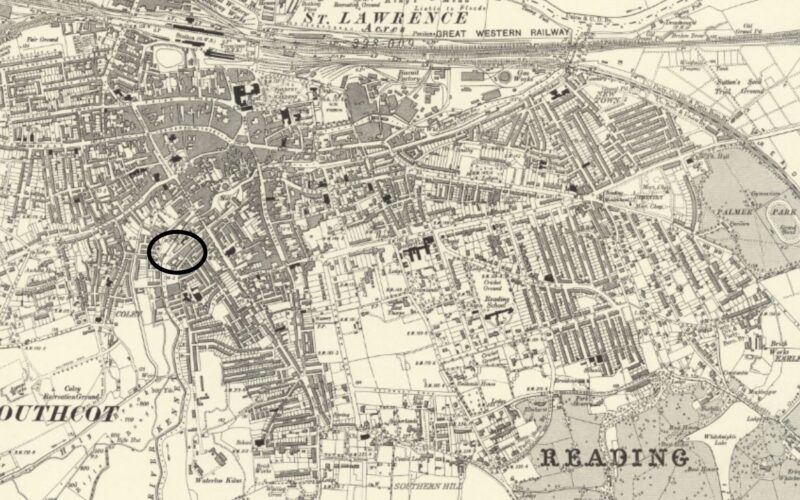
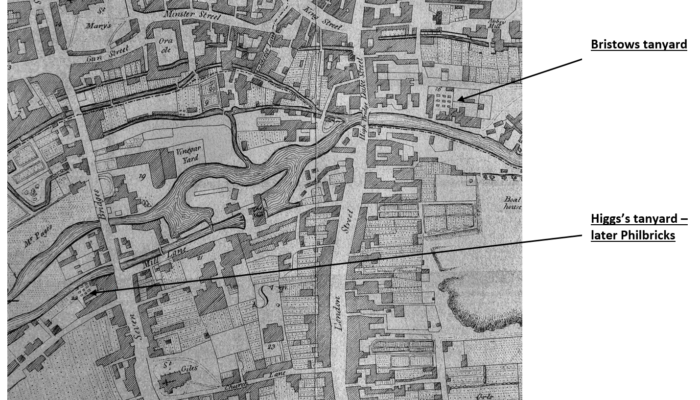
The original version of this article by Evelyn Williams appeared in Berkshire Old and New, the Journal of the Berkshire Local History Association, No 34 2017. Additional maps have been added to show the location of the tannery in Reading in 1898 and on Charles Tomkins Plan of Reading 1802. Corrections have been made to the names and locations of Charles and George Philbrick’s homes on Southcote and Bath Roads.
Philbrick’s Tannery on the south bank of the Kennet in Katesgrove Lane operated for over a hundred years from the 1830s to the 1930s and was run by four generations of the Philbrick family. During this period the area of Katesgrove along the Kennet developed as an industrial area of Reading with housing built to meet the needs of an expanding local population. This history of the tannery and its industrial operations will also describe the participation of the family in the civic and social life of the town.
1898 OS Map showing Philbrick Tannery in Katesgrove - reproduced with permission of the National Library of Scotland
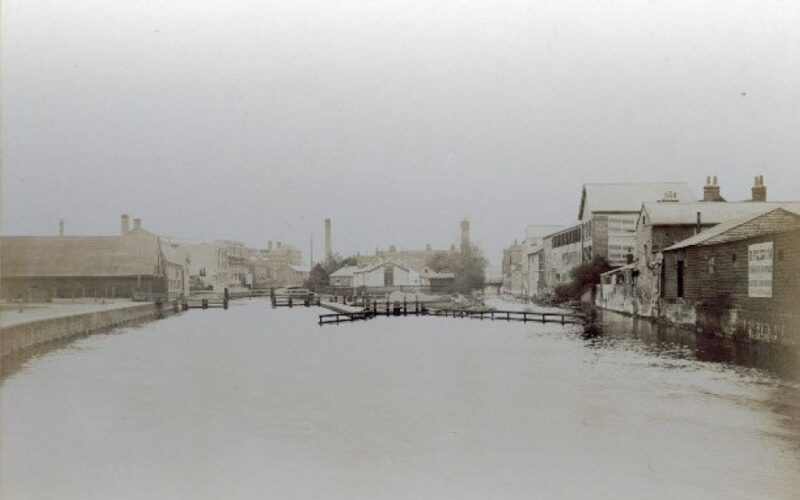
The Kennet and County Lock, Philbrick’s Tannery on the right with louvred windows, c. 1895. Image courtesy of Reading Borough Libraries
Tanning in Reading in the Nineteenth and Twentieth Centuries
New business opportunities for the leather trade opened up with legislative changes 1830.¹ These made it possible for the trades of tanner and currier to combine. Before this a tanner was responsible for tanning the leather after which the currier stretched and finished it for use. The Act also repealed taxes and duties on leather.
Reading may not have had an important tannery when Mavor carried out his survey of the agriculture of Berkshire at the beginning of the nineteenth century. In Wantage, he highlighted that Sylvester’s tannery was ‘the largest tanyard in the kingdom’. For Reading, malting, brewing and light fabrics were important industries and he then went on to say that sailcloth and sacking were more important and employed 500 people.² Alongside eloquent descriptions of selected Reading businesses in 1861, the iron foundry, brewery and biscuit factory, Measom mentions the trade in timber and oak bark, the latter being an essential input to the tanning process at that time.³
Apart from Philbrick’s tanyard on Katesgrove Lane there were other tanneries east along the Kennet in the mid-nineteenth century but from the 1870s onwards C. & G. Philbrick were the only tannery operating in Reading.
Philbrick’s Tanyard
Unfortunately, business records have not survived. Directories, census records, notices in the local press and news reports of events give context and in some cases evidence of the operation of the business during its life.
The Business
The first mention of a tannery in Katesgrove discovered so far is in a 1716 counterpart lease between Edward Plumer and Samuel Bellchamber. This mentions a messuage and dwelling house in ‘Kattsgrove Lane’ and also ‘Tannyard, Tannpitts, Barnes, Stables and all manner of outhouses….’⁴ On dates either side of this there are other deeds that mention tanners in the same area. Possibly the same Samuel Bellchamber, described as a tanner, and his wife leased land and buildings in ‘Cattlesgrove or Cattesgrove’ in 1700.⁵ By 1722 the tanner on ‘Katsgrove Lane’ was Samuel Wheat the older who leased land from Mr Thomas Terrell, gentleman, for 11 years.⁶
The Victoria County History says that Philbrick’s tanyard was purchased from Mr George Higgs who carried on the business there before 1832.⁷ A ‘Mr Higgs of Reading’ purchased the tanning equipment of Whitfield Tanyard at Wantage, sometime after 1825.⁸ George Higgs also leased 61 St Mary’s Butts, which was used in the leather trade, and leased property in Katesgrove Lane.⁹
Annotated extract from Charles Tomkins map of Reading, from Coates History and Antiquities of Reading 1802
Possibly the first mention of Philbricks as curriers in Reading is in a ‘DOG LOST’ notice in the Berkshire Chronicle on 5 November 1825. Anyone who found the terrier going by the name of ‘Flora’ was asked to ‘bring the dog to the Town Crier or Messrs Philbrick’s curriers and leather cutters, London Street, Reading’. A reward of half a guinea (55p) was offered for its return.
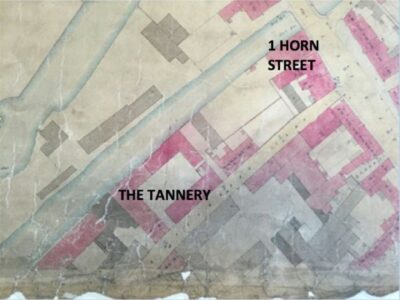
Although Reading had several curriers and leather sellers in 1827, including Samuel and Thomas Philbrook (sic) at 4 & 5 London Street, no tanners are listed.¹⁰ A few years later in 1837 J(ohn) & T(homas) Philbrick appear listed as tanners at 1 Horn Street (now Southampton Street).¹¹ In the 1850s John Philbrick is listed as a tanner in Katesgrove¹² and, as the Katesgrove area developed, the business address entries on Katesgrove Lane become more specific. The distance from 1 Horn Street to the tanyard on Katesgrove Lane was insignificant and the properties were probably connected.
Annotated extract from 1853 Board of Health Map Ref R/AS2/4/15. Image courtesy of Berkshire Record Office
Brothers Samuel and Thomas Philbrick, the eldest sons of Samuel Philbrick, came to Reading from Dunmow, Essex. Samuel Philbrick junior died in Reading in 1830 and Thomas was joined by another brother, John. At some point after that they were joined by Charles, a third brother, but the partnership as tanners and curriers between the three brothers was dissolved by mutual consent on 24 June 1847, with John taking on the business.¹³ Charles Philbrick moved to Nottingham but Thomas continued to live in Reading at Katesgrove House until his death in 1854.
The Premises
Some of the earliest descriptions of the premises are in press reports of the two devastating fires suffered by the tanyard in the nineteenth century. The first was on the night of 16 October 1839 and was particularly noteworthy because it was dark and the fire could be seen as far as Woolhampton about 10 miles west along the Kennet. ‘The oldest inhabitant of the borough never witnessed so extensive a conflagration here, the reflection of which was seen at Newbury, and was distinctly visible at Woolhampton and other places at a distance.’¹⁴ The premises are described in the press report as ‘Messrs Philbrick, extensive curriers’. Three fire engines were called into action from the Protector and the County insurance companies and St Giles’ parish. Fighting the fire proved difficult as the yard was too far away from the source of water on the western side of the premises. Chaotic scenes are described as efforts were made to save the stock and records of the business. ‘Most respectable and well-dressed individuals were to be seen covered in grease from the undressed skins, and dyed with tan from head to foot – often falling into the tan pits, some of which were six feet deep – the avoidance of which, in the confusion which prevailed, being a matter of no slight difficulty: the books, papers and accounts &c, were removed from the counting house and deposited in a place of safety.’ Eventually the fire engines were brought into use by knocking down a wall but burning materials fell into a back stream of the Kennet and were carried down to St Giles’ Mill. The conflagration was brought under control about 4am. Buildings around the tannery were put at risk of the fire spreading. Mud was put on the roofs of houses in Katesgrove Lane to stop them burning and Perry and Barrett, which later became Barrett, Exall and Andrewes, was saved by pulling down communicating roofs and walls. The value of property destroyed was estimated at £5,000, almost £470,000 in 2015 money, although the business was only partially insured.¹⁵ The damage and destruction of buildings and stock mentioned were: curriers’ shops, store rooms, granaries, ware-rooms for bark, leather and hides.¹⁶ This fire seems to have been started by boys playing with a turnip lantern. The three boys, Isaac Low, William Benham and Edmund Egg, were brought before the magistrates but as charges were not pressed, they were admonished and discharged.¹⁷ Despite the damage, trade continued. T., J. and C. Philbrick placed a notice in the local press thanking the ‘Gentlemen, Inhabitants of Reading, who so kindly assisted at the late Calamitous Fire’. The notice goes on to say that as a result, they were ‘enabled without delay to resume our business in all its branches.’¹⁸
The fire in 1851 took place on a Sunday during the day and, although not such a great visual spectacle, may have done more damage than the earlier fire. ‘In an incredible short space of time, the whole of the warehouses and shops, containing an immense quantity of leather, finished and in various stages of manufacture, were completely gutted, the fire being confined chiefly to the bark barn which contained between 500 to 600 tons of bark, a great proportion of which was “hatched” or prepared for the mill, and consequently, very expensive.’¹⁹ The alarm was raised around 7.15 am on Sunday 3 August and by 12 noon the fire was thought to be under control, only to revive in the late evening. Four fire engines attended the blaze, from the County Fire office, the Phoenix insurance company and two Borough fire engines. The four engines continued to pour water from the Kennet on the site until Tuesday morning. Both Borough fire engines remained until Wednesday evening after which only one remained. Buildings mentioned within the report are: currying shops, bark barn, engine house, shed, leather warehouses and stable. Attempts were made to save the manufactured and unmanufactured stock of hides and leather. Bark, oil and tallow were also stored on the premises. As in 1839, local homes and other businesses were endangered by the fire. Nearby residents feared that their cottages would be burnt down and some had put their furniture in the street away from the fire. There was a danger that the fire would spread to Barrett, Exall and Andrewes’ yard next door, which was averted by their own fire engine and a human chain of buckets of water from the Kennet organised by the Mayor. Simonds’ timber yard on the opposite bank of the Kennet was briefly on fire too. The damage was estimated as between £8,000 and £10,000 (approximately £1 – £1.25 million in 2015 money) about twice the value of damage in the 1839 fire.²⁰ Philbrick’s were insured by Norwich Union Fire Office, but the Chronicle commented that it ‘would not nearly cover their loss’. After this fire the tanyard was completely rebuilt.²¹
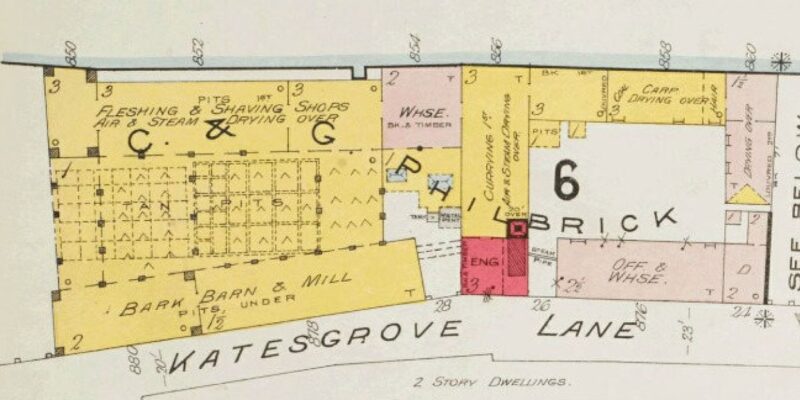
The layout of the tannery in 1895 is known from Goad insurance maps.²² The plan shows: fleshing and shaving shops with drying over, tan pits, bark barn and mill with pits under, a warehouse for bark and timber, a building for currying on the first floor and air and steam drying above, a building marked ‘carp’, with a coal and hair store with drying over, a drying room, an office and warehouse and an engine room.
Extract from Fire Insurance Plans - Charles E Goad (1875): Reading Sheet 2-2 - The British Library
1879 OS Map showing Tannery and Bark Store - reproduced with permission of the National Library of Scotland
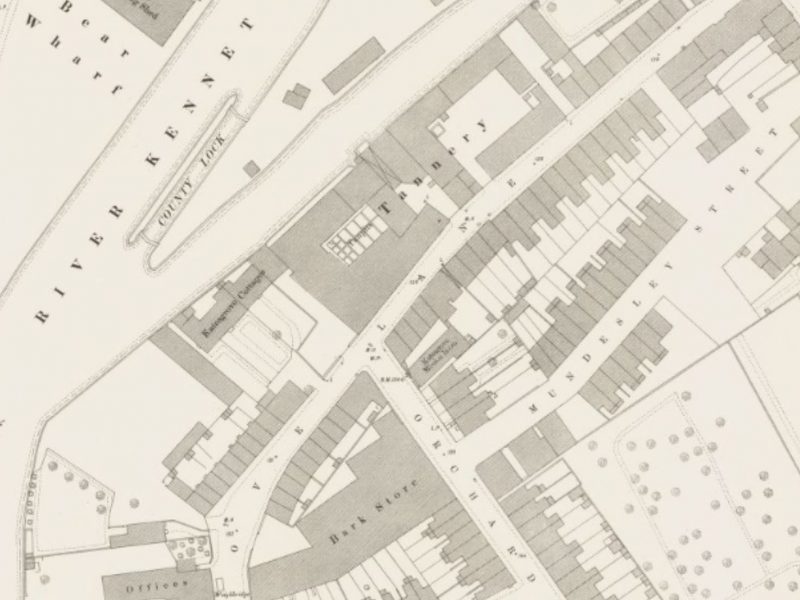
By this time there was a separate bark store on Orchard Street. Although the insurance maps do not cover this area, it is marked in the 1879 OS map. The bark store is last mentioned in directories in 1935.²³ In 1936 these premises were occupied by the Dock & General Transport Co Ltd.²⁴ It is likely that the extent of the tannery reduced over time, although the numbering of properties might not be an accurate guide to the size of the premises, because of renumbering and other development in the street. With this in mind, in 1939, the last year that C. & G. Philbrick is mentioned, it occupied only 26 Katesgrove Lane. In 1895, the same year as the Goad map, it occupied nos. 18, 20, 22 and 24 Katesgrove Lane²⁵ and in 1897 26-28 Katesgrove Lane.²⁶
After Philbrick’s departure part of the site may have been used by Lewis H. Hobday Ltd, paper stock merchants. By 1949, 26 Katesgrove Lane was occupied by Converters (Reading) Ltd textiles and Lewis H. Hobday was a neighbour. ⁷ The tannery site is now under the Inner Distribution Road, next to County Lock.
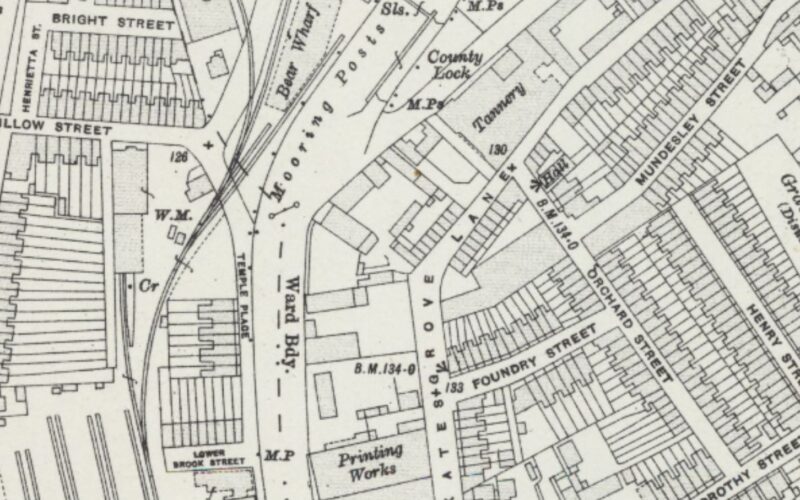
Extract from 1931 OS map showing the Tannery on Katesgrove Lane
Work at the Tannery
In 1860, William Nelson²⁸, the nephew of John Philbrick, worked at the tannery for a couple of months.²⁹ A description of his time working there survives in his diary entries:
1860
- 1 January. Chapel morning and evening. Went to tea at Katesgrove with Mont.
- 2 January. Tan yard. Tea’d at Katesgrove. Doing odd things all day. Mont went to work at Buckersbury first.
- 3 January. Carrying. Ragging skins all day.
- 4 January. Carrying. Finishing welts and ragging.
- 5 January. Carrying. Finishing welts. Ragging horse hides. Writing in the evening.
- 7 January. Carrying legs all day. Making bacon toaster. Later: Cleaned clock at night. Oiled clock
- February. Greasing and hanging up kipps. Stuffing and scouring horse hides. Slicking off and bruising legs.
Family and trade connections facilitated this experience for William Nelson as his mother Sarah Philbrick was John Philbrick’s sister. In 1830 she married George Nelson who later founded Nelson’s Gelatine of Warwick, a trade which has some similarities to that of a tanner.³⁰
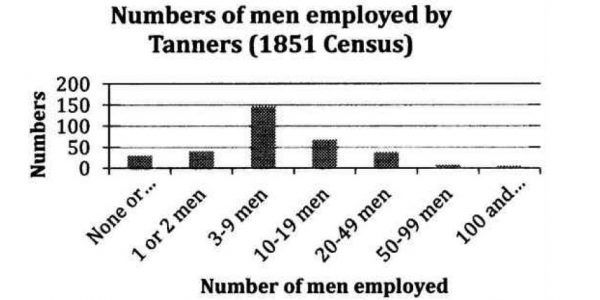
Around this time, the census gives some information about Britain’s industrial workforce. Nationally, an analysis of the 1851 census showed that 328,776 people worked in the leather trades. The largest group among them were 274,000 shoemakers. There were 25,276 men and women employed as tanners.³¹ Of 7,331 employers (masters) making returns, 339, just under 5 per cent, were tanners. Among these, 31 either had no employees or did not state the number, and 5 employed over 100.³²
Source: Peter Mathias, The First Industrial Nation. The Economic History of Britain, 1969
Unfortunately, the census record for John Philbrick does not show how many employees there were in the tannery in 1851 or 1861. By the time of the 1871 census John had died and two of his sons, Charles and George Philbrick, had taken over the business and it was known as C. & G. Philbrick. Both lived at Katesgrove House and were described as ‘Tanners and Brickmakers’. George was the head of the household and employed 43 hands, which would have been in brickmaking as well as the tannery.
By 1881, Katesgrove House had been sold and the brothers lived in separate households with their wives and families. At this time Charles Philbrick was a tanner and currier employing 22 men and a boy. The census entry for George is less clear and appears to describe him as a Farmer and ?(smudge or deletion).
Around the turn of the nineteenth century, the tannery employed about thirty people and was an oak bark tannery producing dressing hides and calf skins.³³ Later censuses do not give information about the numbers of employees, but George and Charles continued to describe themselves as tanners. In 1911, the last census for which full information has been published, Charles was a retired tanner but George was still working as a tanner. Charles A. Philbrick, George Philbrick’s son, who was a ‘tanners assistant’ in 1891, continued the family trade as a tanner and fellmonger. It has not been possible to establish when or whether there was a handover of the business from father to son.
In 1916, during the First World War, 27 employees were in the forces. The tannery claimed exemption for A. C. S. Warrell, as a man engaged in a certified occupation; the application was deferred.³⁴
C. & G. Philbrick still existed until around 1939, the date at which it disappears from local directories. Charles A. Philbrick died in 1932 and his son Leslie Philbrick was listed in directories as a Reading resident until 1939. At the time of the census in 1939 he was in Esher and was described as manager of a tannery. It may be safe to conclude that he managed the Reading tannery until its closure, the fourth generation to do so.
The Wokingham Tannery
John Philbrick leased a tannery in Wokingham from James Twycross in April 1858³⁵ and adapted it for fellmongering.³⁶ A fellmonger is a sheepskin dealer who separates the wool from pelts. In a notice in the Mercury, James Twycross announced the transfer and that he would no longer be purchasing ‘English Bark and English Hides’. In the 1851 census Mr Twycross was a tanner and woolstapler master and employed 43 people. He had operated at the Tanhouse on Barkham Lane for about thirty years. John Philbrick’s eldest son John moved to Wokingham and ran the business. Census information for the number of employees at these premises is more continuous than for Reading. In 1861 there was at least one employee, in 1871, 6 men and one boy, and in 1881, 2 fellmongers and 5 general labourers.
There were strong links between the Reading and Wokingham businesses. In 1866 Charles Philbrick was fined 6s 6d (32p) for transporting sheepskins from Reading to Wokingham, which contravened the Cattle Plague Regulations.³⁷ In 1883 John Philbrick junior died and after this it is unclear who managed the tannery on a day-to-day basis although it was probably George Philbrick.³⁸ An employees’ dinner to celebrate the silver wedding of George Philbrick and his wife was held in 1894. A newspaper report of the event mentions that an illuminated address was presented on behalf of the employees of the Wokingham Yard and Mr H. Lovelock presented a marble clock on behalf of Reading employees. Over fifty people attended the dinner which was held next door to the tannery at Pilgrim’s furniture store.³⁹
In 1899 there was another dinner for employees. This time it was to celebrate the marriage of George Philbrick’s daughter, Harriet, to Rev C. G. Stokoe which took place at the George Hotel. Again Mr H. Lovelock made the presentation of a silver salver from the workmen at Katesgrove. Wokingham employees also attended and there were about 50 at the dinner.⁴⁰
George Philbrick moved from Reading to Wokingham during 1911 and this became the family home. His wife Catherine died at Embrook (or Emmbrook) House in 1915.
The Wokingham tannery closed around 1920.
The Tanning Process
The process of tanning is one by which the hides of dead beasts are transformed in a malodourous and noxious underworld into leather. Traditional tanning is a process that takes place over many months as hides are moved from tank to tank.⁴¹ Unfortunately there are no records of production at the tanyard or accounting records which might provide some concrete data on costs, quantities and profitability. Only one original record remains, and that is in relation to one season’s bark purchase which survives in the records of the Wellington Estate.⁴² Some isolated and detailed information is also available from newspaper reports.
Inputs to the Tanning Process:
Hides
Hides were the primary input to the process. As no records survive it is impossible to know the value of the unprocessed commodity and how many were processed.
Bark
Clarkson states that between 1680 and 1830 around 90 per cent of leather was tanned with oak bark and that between 4lb (1.8kg) and 5lb (2.3kg) of bark was needed for each 1lb (0.45kg) of leather.⁴³ Tanners held large stocks of this material: 500–600 tons, a great proportion of which was ‘hatched’, had been destroyed in the fire at Philbrick’s tanyard in 1851.
There is some information about bark purchased by the business. A set of six letters survive, sent from C. & G. Philbrick, the Tanyard, Reading to G. F. North, the Wellington estate agent, during 1905. The letters concerned bark supplies from Stratfield Saye and Wolverton.⁴⁴ The first letter sent in May 1905 offered £9 a load ‘hatched’ and £3 per ton ‘in the rough’ less 2½ per cent for cash on delivery. The next letter, dated 10 May 1905, appears to be in reply to a letter from the estate asking for £10 a load. £10 was regarded as too expensive – it was the price of bark going up to London, including carriage. Philbricks compared this to equivalent bark bought from R. Mulford & Sons from the Wellington estate, saying that they would pay the same. The final four letters were sent later in the year, when bark had begun to arrive at the tanyard. On 28 July they wrote complaining about the poor quality, ‘we can only describe it as chopped rough’. The letter on 13 September complained that the quality from Stratfield Saye is still poor, but that from Wolverton was acceptable, and suggested a 10 shilling (50p) allowance per ton. It would appear that an allowance of 5 shillings (25p) a ton was proposed by the estate manager in a letter which does not survive. Philbrick’s made a counter offer of £9 per load from Wolverton and £8 for Stratfield Saye. The final letter of 28 September 1905 set out the account of £128 19 shillings (£128.95) and closed with the comments, ‘May we suggest that another season should you be felling any very old dead lopped trees it would be better not to have them stripped.’
If the prices agreed were £9 a load and £8 a load as set out in the letter of 18 September, then the quantity purchased would have been about 6 loads from Wolverton and 9 loads from Stratfield Saye of hatched bark. Using these statistics to inform an estimate of leather production from the tannery is not possible. Philbrick’s, as the above correspondence states, purchased from more than one bark supplier; the quality of bark affected the amount required; the stocks of bark held at the yard from year to year are unknown; and the validity of Clarkson’s estimates of bark required in the process up to 1830 may not hold for the early twentieth century. For the period about which Clarkson was writing, the quantity of bark in a load varied regionally and over time. A load of bark was a variable measure of the volume of bark in yards. By the late eighteenth century, he says that a load of 50 yards of bark had been standardised at 45 cwt or 2.5 tons (2.3 metric tonnes). Applying this to the 15 loads of bark purchased from the Wellington estates equates to 675 cwt or 33.75 tons (34 metric tonnes). If 4.5lb of bark was required for each lb of leather, the bark purchased was enough to tan 1,120 lbs (508 kilos) of leather.
Lime
Lime is needed to soak the hides to remove the hair from them. Parrott quotes the quantity required as 2 per cent of the weight of the hide, an average of 1lb (0.45 kg) per hide.⁴⁵
Water
Tanneries need water at all stages of processing. The River Kennet and its channels were also used to dispose of waste from the process, and pollution of the local water supply was a nuisance.
Pollution and Nuisance
Operations at a tannery produce waste products which can cause a local nuisance. The problem on the Kennet and onwards to the Thames took many years to resolve. Unlike some other tanneries in Reading, Philbrick’s tanyard was situated upstream of the Mill Lane pumping station. The pumping station supplied Reading’s domestic water supply until 1852 when the Bath Road reservoir came into operation taking water from Southcote Mill. Action was taken or attempted under the available legislation. In 1843 the Water Works Company charged Mr Philbrick with fouling the water but because of a difference of opinion about the Act of Parliament the case was deferred.⁴⁶ In February and March 1847 a court of enquiry was held into the Reading Improvement Bill. On Monday 15 February James Burgess, a servant employed by Mr Exall, was asked by Mr Warren, counsel against the bill, and cross examined by Mr Rogers, counsel for the bill, and Mr Keating, about waste from the tannery, as well as privies and the ironworks, which passed down the Kennet to the waterworks at Mill Lane.⁴⁷
- Q: Have you seen Messrs Filbrick’s (sic) tan-pits flowing into it?
- A: I have seen it in the yard.
- Q: From the lime-works?
- A: From the tan-yards.
- Q: Messrs Filbrick’s are tanners are they not?
- A: Yes.
- Q: In a large way?
- A: Yes.
- Q: Where are their tan-yards?
- A: Down Catsgrove-lane.
- Q: How far is that from the waterworks?
- A: I do not know, about 200 yards.
The proposals in the bill were not implemented but it had created divisions on the Town Council.⁴⁸ In 1865 Commissioners were appointed to study the state of the Thames and were in Reading from Tuesday 14 November after which they moved on to Windsor. On Thursday 16 November they examined Mr H. A. Simonds and he is quoted in the Mercury as saying: ‘Our brewery is situated on the River Kennet. We use Thames Springs situated in the very centre of our yard. There is a great deal of sewage passed into the river below us, and above us lime is passed from a tannery, and it is a common thing to see the water white for more than an hour together. That lime killed the delicate fish.’⁴⁹ The impact on fish is contradicted in the Berkshire Chronicle report which quotes: ‘The pollution of the Kennet has never been sufficient to interfere with the fish, with one exception. There is a deposit of gas tar in the river, arising from the way in which the Gas Company used to conduct their operations, which prevents the fish coming up here. But there are more fish now than there were.’⁵⁰
Philbrick’s gave evidence too about how the Kennet was affected by waste from the tanning process, and was reported in the Reading Mercury as saying: ‘The materials used were lime and bark. Lime was used to separate the hair from the hides, and the hair was sold; none of it went into the river. It was washed in the river to free it from lime. He estimated that 200 gallons of water a week would be required for this purpose. There would be no difficulty of doing this in a tank, but the tank must be emptied somewhere ultimately. The lime water – certainly not more than 100 gallons a week – was discharged into the river, but all sediment was allowed to settle first, as it was sold to the farmers. The water so discharged was, in his opinion, nearly pure, all the scrapings were preserved, and sold for making sise. He had frequently seen tar water in the river, which he believed came from the Iron Works.’⁵¹
The Berkshire Chronicle report, in which Charles Philbrick is named as the representative of the tannery, states that about 700 gallons of water were used a week.⁵²
The Borough of Reading’s ‘Byelaws as to Offensive Trades’ of 1887 set out what is expected from blood boilers, blood driers, bone boilers, fellmongers, tanners, leather dressers, soap boilers, tallow melters, fat melters or fat extractors, trip boilers, glue makers, size makers and gut scrapers under the Public Health Act 1875. The byelaws were still in force in 1910. Waste including hair, fleshings and refuse fragments which were not being processed further were to be removed from the premises, as was waste lime.
Output
The principal output from the process was leather but other by-products and waste products, as suggested in the evidence given to the 1865 enquiry, were also valuable.
Leather
The theft of leather from the Katesgrove Lane tannery in 1857 ran as a story in the local press for six months, as those who had stolen the leather and the receivers of leather were charged and brought to trial. The receivers of stolen goods were shoemakers and one of those charged with the theft had previously worked at the tanyard. Through the newspaper reports it is possible to learn the prices of some leather products at this time.
A Coley Street shoemaker, Edward Collier, was charged with receiving stolen leather and appeared before the Borough Magistrates on 11 November 1857. The theft of three butts of leather, two foreign and one English, had been noticed by John Philbrick junior.⁵³ A butt was valued at about £3 10 shillings (£3.50).⁵⁴ Although he knew that some of the leather that had been found at the suspect’s house was Philbrick’s he was unable to say if it was the stolen leather. Mr Collier said that he had bought £5 of leather from Mr Gilligan, although Mr Gilligan denied this. Also mentioned in the case was leather from Mr May of Hungerford. This case continued into the next year. George Smith, a shoemaker from Castle Street, gave evidence that Collier had offered him six soles for a shilling (5p) a pair, 6 shillings (30p) in total. He had paid 5s 6d (27p) for them. When the police sergeant came to his house, he had handed them over. Edward Lovegrove, an employee at the tannery, said that the soles should have been worth about 11 shillings (55p). The jury found the prisoner guilty of receiving stolen goods and he was imprisoned in Reading Gaol for a year with hard labour.⁵⁵ Two men, Brown and Appleton, were suspected of carrying out the theft by crossing the Kennet in a punt. Appleton had in the past worked at the tanyard. Brown was acquitted in April 1858. The Deputy Recorder told the jury that they needed to take into account whether the evidence of Collier who had received stolen leather, was sufficient. After the not guilty verdict he said: ‘It was solely owing to the fact that the evidence of the accomplice was not corroborated that he (the prisoner) had not met with the punishment he so richly deserved.’⁵⁶ Appleton had left the area and was working in Shepton Mallet when he was taken into custody. Appleton was convicted in May 1858, and sentenced to two years imprisonment, but because of a previous conviction, this was converted to two years penal servitude.⁵⁷
Spent Tan Bark
The sale of spent tan bark for ‘horticultural and stable purposes’ was advertised in 1865. The price was 2s (10p) per cart load, 5s (25p) per wagon load in the yard; 3s (15p) per cart load, 7s 6d (38p) per wagon load delivered within a mile.⁵⁸
Hair
In evidence to the Thames enquiry in 1865 Charles Philbrick said that hair was sold. Gilligan’s tannery advertised it as ‘plasterers’ hair’, but the sale price was not quoted.⁵⁹
Lime
As a witness to the Thames enquiry in 1865 Charles Philbrick said that lime which had been used to separate the hair from skins was sold to farmers, but the price was not given.
The Philbrick Family in Civic Life
Local Politics
Thomas Philbrick stood in the municipal election in Church Ward in 1847. The election was caused by the elevation of Councillor Allaway to an alderman. As it is described in the Berkshire Chronicle, the nomination of a ‘Tory’ candidate appeared very last minute and unexpected. The candidacy had first been offered to his brother John and then transferred to him. In the event Thomas Harris won the Ward by 170 to 150 votes. The report described Thomas Philbrick as ‘… a gentleman unable to attend to public business from a debilitated state of health.’⁶⁰
In 1886 George Philbrick was elected as councillor for Church Ward.⁶¹ In 1887 as a result of the extension of Reading’s boundaries the number of councillors increased from 18 to 30 and the number of wards from 3 to 10 and George Philbrick was allocated to Katesgrove ward by the Commissioner appointed under the Reading Corporation Act.⁶² In 1895 he was challenged in the municipal elections by a ‘Socialist’ candidate G. H. Wilson who received 144 of the 601 votes cast.⁶³
In 1899 he was the most senior councillor who had not yet served as Mayor, but he declined and William Poulton was selected for nomination.⁶⁴ He was made alderman in 1904 and he retired from the council in 1919. By this time his son Charles A. Philbrick was following in his father’s footsteps he had been seconded onto the council. In his speech looking back over his term the outgoing Mayor, Leonard Goodhart Sutton, mentioned three new councillors including ‘Mr C. A. Philbrick, who establishes I believe an altogether new precedent in the council of a father and son sitting at the same time. I congratulate our friend Mr Alderman Philbrick most heartily in seeing his son commence to take up the good work he has himself done for so many years.’⁶⁵
Charles A. Philbrick pictured as a candidate in the 1920 municipal elections from the Reading Observer, 24 October 1820

In the 1920 municipal elections, Charles A Philbrick stood in West Ward. He placed a notice in the local press in advance of the forthcoming elections. He quotes his record on the council since being co-opted in 1916: ‘During my four years’ service my efforts have been chiefly devoted to the health of the borough, and in 1917 I was elected Vice-Chairman of the Health Committee, and while the Mayor was busy with war work was acting Chairman for nearly two years. I have been Chairman of the Maternity and Child Welfare Committee since its inception in 1918, and have also served on the following Committees: Medical Services; Tuberculosis Advisory; Waterworks, Sewage Disposal and Farm; Public Libraries, Governor of Reading School.’⁶⁶
Charles A. Philbrick’s wife, Ethel, was also active in local politics and served as the President of Reading Women’s Conservative and Unionist Association for 13 years until 1919.⁶⁷
Charities and Public Service
In 1839 John Philbrick was elected as one of the five members of the Board of Guardians for St Giles’s parish.
In 1877 the subscription promised for C. & G. Philbrick to the erection of the new Town Hall, library, reading room and museum was £100. Fellow tanner, George Gilligan and Son promised £250. The town’s MP Sir Francis Goldsmid gave £5,000 as did Huntley & Palmers. The Reading Dispensary celebrated its centenary in 1902. Donations to the Centenary Fund were recorded on a board in the Museum of Reading Collection. Those giving over 10 guineas (£10.50) towards the total of £811 1 shilling (£811.05) are recorded individually. Among the distinguished donors are C. & G. Philbrick who gave 10 guineas; George May gave £100, as did Reading’s MP G. W. Palmer.
Social Standing
If social standing can be measured in column inches, the 1899 marriage of George Philbrick’s eldest daughter Harriet Louise to Rev. Cecil George Stokoe, son of the former headmaster of Reading School, was a prestigious and important local event. The ceremony took place at St Mary’s parish church. The report of the wedding, including a list of guests and wedding presents, occupied a full column of the newspaper.⁶⁸ Miss Abrams and Mr Pendon lent their house, Ascham House, now Yeomanry House, on Castle Hill for the reception for 200 guests. At the end of 1899 it made the ‘Weddings of the Year’ article in the Mercury. Among other weddings of the year was the marriage of another tanner’s daughter, Beatrice Gilligan, daughter of George Gilligan, to P. Hedworth Foulkes a couple of weeks earlier at the same church. Members of the Philbrick family attended the reception.
Tragically, George Philbrick’s daughter died in India, where Rev. Stokoe was a chaplain in Calcutta, and the news reached Reading on 25 September 1900.⁶⁹
Philbrick family
Although this is a history of the tannery in Reading, it was a family business and consequently some biographical information about the members of family is relevant to the story.
Four generations of the family ran the business in Reading.
The First Generation
The eldest sons of Samuel Philbrick, a currier of Dunmow, Essex, Samuel (junior) and Thomas, came to Reading and worked as curriers. Samuel died in Reading in 1830 and Thomas was joined by his brother John and briefly later a younger brother Charles. Thomas married Judith Collis, the daughter of a brewer from Great Dunmow in 1833. He retired from the business in 1847 and lived at Katesgrove House until he died in 1854.
John also married in 1833 Eliza Hooper of Reading. Three of their sons, John, Charles and George, continued the family trade in Reading (C. & G Philbrick) and Wokingham. John lived at 1 Horn Street and later at Katesgrove House until his death in 1865. John and Eliza Philbrick are buried in London Road cemetery.
The Second Generation
John Philbrick junior moved to Wokingham to run the fellmongering business. In 1862 he married Rhoda Frederica Crewe, daughter of a Wokingham draper. In Reading the third and fourth sons Charles and George ran the business. Charles Philbrick was the third son of John Philbrick. He married Euphemia Webster in 1877. Charles Philbrick lived at ‘Summerfield’ on the corner of Tilehurst Road and Southcote Road with his family from around 1890 until his death in 1921. The house, originally 22 but now 24 Southcote Road, is still there. His widow continued to live there until her death in 1942. His eldest son Arthur Philbrick was discharged from the Royal Fusiliers in 1916 on medical grounds and died in 1918. None of Charles’ sons continued in the business. ⁷⁰
George Philbrick was the fourth son. He married Catherine Louisa Welch in 1869. His eldest son, George Hooper Philbrick, became headmaster at a school in Beckenham, Kent, and his second son Charles A. Philbrick continued the tanning business. George Philbrick’s many homes included Parkhurst Lodge, Bath Road where he was living in 1891. He purchased the land from the trustees of Captain Liebenrood at a price of £1,700. ⁷¹ The architects were Newman & Newman of 31 Tooley Street, London. He later moved to 21-23 Coley Hill in Reading and then Embrook or Emmbrook House in Wokingham.
In 1920 he moved to 1 Charnham Close in Newbury. Intriguingly, this was part of a former tannery operated by Gilligan and Son that had closed by 1886.⁷² Although the Gilligans and Philbricks knew one another, it has not been possible to find any other links that might explain the move. George Philbrick died in 1922.
John and Eliza Philbrick’s second son Henry went to Australia in 1857. He appears to have spent eight years digging for gold north west of Melbourne before establishing a tannery at Broadford in 1865. The tannery was put up for auction in 1871 and, at that time, the property comprised 27 tan pits, a drying shed and a bark mill shed as well as two and a half acres of land and cottages.⁷³ In 1872 the Broadford Tannery was run by David McKenzie and the Lloyd brothers. They expanded it considerably and new opportunities opened up with the coming of the railway. In 1914 the tannery, by then owned by Lloyd Bros and McGinnis, was destroyed by fire. The damage was estimated as £17,000. At the time it employed about 60 men.⁷⁴ It closed in 1915 and operations were transferred to Melbourne.⁷⁵
Whether by accident or design, in 1888 Henry Philbrick was running a tannery in Rosedale, Victoria, which had been established by Paul Cansick also from a family of Reading tanners.⁷⁶ The business was described as tanning 60 to 70 hides a week, employing four hands as well as himself and his son.⁷⁷ Paul Cansick was an early settler in Rosedale and the tannery was its first major industry. He had arrived in Rosedale in 1858 and established a tannery there.⁷⁸ In 1870 he devised an apparently novel cage, called the Aquarium, to soak hides in the Latrobe River which was reported in the local press.⁷⁹ In 1887 he was still living in Rosedale and applied to be discharged from bankruptcy.⁸⁰ He and his wife are both buried in Rosedale cemetery. At the end of the nineteenth century Henry Philbrick managed a tannery in Melbourne. He died in 1909 and was buried in Coburg cemetery.⁸¹
The Third and Fourth Generations
Charles A. Philbrick married Ethel Bazett in 1900. He died in 1932. Their son Leslie continued the business until it closed around 1939.
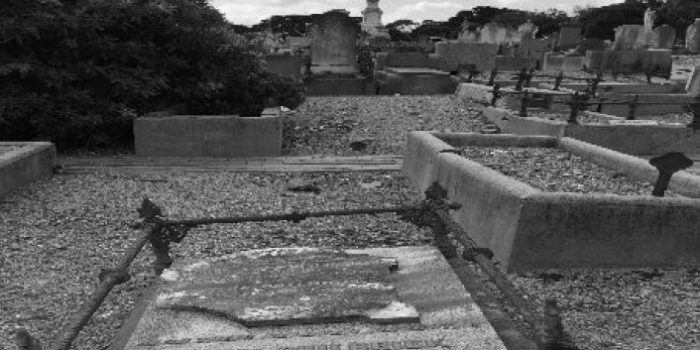
The grave of Henry and Mary Philbrick and their daughter Mary, Coburg Cemetery, Melbourne
Bibliography and Sources:
- An Act to repeal the Duties of Excise and Drawbacks on Leather, and the Laws relating thereto, 1830
- William Mavor, General View of the Agriculture of Berkshire, 1813
- George Measom, The Official Illustrated Guide to the Great Western Railway, 2nd edition 1861, p. 83
- Berkshire Record Office R/D32/1/5
- Berkshire Record Office R/D32/1/4
- Berkshire Record Office R/D32/1/6
- Victoria County History, Berkshire, v. 1 p. 399
- John Parrott, The Largest Tanyard in the Kingdom, 2009, p. 78. A George Higgs was the leaseholder for 61 St Mary’s Butts and a property sale on his death included, in addition to this lease, properties in Katesgrove Lane. Reading Mercury 28 March 1868
- Reading Mercury, 25 April 1868
- Horniman’s Reading Directory 1827
- Ingall’s Reading Directory 1837
- Macaulay’s Directory 1859
- Berkshire Chronicle 31 July 1847
- Reading Mercury 19 October 1839
- Bank of England Inflation Calculator
- Reading Mercury 19 October 1839
- Reading Mercury 26 October 1839
- Berkshire Chronicle 19 October 1839
- Berkshire Chronicle 9 August 1851
- Bank of England Inflation Calculator
- Victoria County History, Berkshire, v. 1 p. 399
- Fire Insurance Maps
- Kelly’s Directory 1935
- Kelly’s Directory 1936
- Smith’s Directory 1895
- Smith’s Directory 1897
- Kelly’s Directory 1949
- Evelyn Williams, ‘On the road again. Hunting for Katesgrove’s William Nelson’.
- L. Paterson, William Nelson of Tomoana
- Anthony Leahy, Rediscovering Nelson’s Gelatine Factory (accessed 29.7.2016)
- Peter Mathias, The First Industrial Nation. The Economic History of Britain, 2nd edition, 1983, p. 239
- ibid p. 240
- Victoria County History, Berkshire, v. 1 p. 399
- Reading Mercury 4 March 1916
- Reading Mercury 1 April 1858
- Victoria County History, Berkshire, v. 1 p. 399
- Reading Mercury 27 October 1866
- He lived at Emmbrook House in Wokingham for a time
- Reading Mercury 13 January 1894
- Reading Mercury 6 May 1899
- Britain’s Remaining Traditional Tannery, J. & F. J. Baker & Co Ltd. BBC video (accessed 29.7.2016)
- Museum of English Rural Life (MERL), Wellington 440/1-6
- A. Clarkson, ‘The English Bark Trade, 1660-1830’, Agricultural History Review, 1974
- MERL, Wellington 440/1-6
- John Parrott, The Largest Tanyard in the Kingdom, 2009, p. 50
- Reading Mercury 5 August 1843
- Reading Mercury 20 February 1847, continuing in 27 February 1847
- See Alan Alexander, Borough Government and Politics, Reading 1835-1985, pp. 23-30 for a full discussion of the issues and parties involved
- Reading Mercury 18 November 1865
- Berkshire Chronicle 18 November 1865
- Reading Mercury 18 November 1865
- Berkshire Chronicle 18 November 1865
- A butt is the large, thick piece of leather from the back of an animal
- Reading Mercury 14 November 1857
- Reading Mercury 9 January 1858
- Reading Mercury 3 April 1858
- Reading Mercury 29 May 1858
- Reading Mercury 26 August 1865
- Reading Mercury 27 March 1875
- Berkshire Chronicle 20 August 1847
- Berkshire Chronicle 30 November 1886
- The first elections in Katesgrove ward in 1887. Whitley Pump (accessed 30.7.2016)
- Reading Mercury 2 November 1895
- Reading Mercury 7 October 1899
- Reading Mercury 11 November 1916
- Reading Standard 23 October 1920
- Berkshire Chronicle 20 June 1919
- Reading Mercury 29 April 1899
- Berkshire Chronicle 29 September 1900
- No trace of any participation was found and this is confirmed by the Horton-Pallister family tree (accessed 28.7.2016)
- Estate Papers of Captain John Liebenrood. Berkshire Record Office, R/D154/61/1-23
- Hungerford Virtual Museum, page for 1 Charnham Close (accessed 28.7.2016)
- Kilmore Free Press 15 June 1871
- Kilmore Free Press Thursday 30 April 1914
- Seymour Express and Goulburn Valley, Avenel, Graytown, Nagambie, Tallarook and Yea Advertiser 19 February 1915
- A notice in the Taunton Courier and Western Advertiser 26 September 1855 for his marriage to Margaret Salter at St Paul’s Melbourne described him as the youngest son of Paul Cansick of Reading.
- Victoria and its Metropolis, 1888
- Rosedale & District Historical Society (accessed 28.7.2016)
- Gippsland Times 8 November 1870
- Victorian Government Gazette
- I am grateful to Rosedale Historical Society for their assistance in tracing Henry Philbrick
- Alan Alexander, Borough Government and Politics. Reading 1835-1905, 1985
- Broadford & District Historical Society
- A. Clarkson, ‘The Leathercrafts in Tudor and Stuart England’, Agricultural History Review, v. 14, 1965, pp. 25-39
- A. Clarkson, ‘The English Bark Trade, 1660-1830’, Agricultural History Review, v. 22, 1974, pp. 136-52
- Glenys Crocker (ed), ‘Surrey’s Industrial Past’. Surrey Industrial History Group. Online edition 1999
- H. Ditchfield and William Page (eds), Victoria County History, Berkshire, Volume 1, 1972
- Drummond, ‘The “Art and Mysterie” of the Currier’, Family Tree magazine, September 1995 (on-line version)
- Find My past Census, birth marriage and death records, newspaper archive, military service records
- Sidney Gold, A Biographical Dictionary of Architects in Reading, 1999
- Hungerford Virtual Museum
- Anthony Leahy, Rediscovering Nelson’s Gelatine Factory. A treasure trove of all things related to the gelatine factory that ultimately became part of Davis Gelatine
- Peter Mathias, The First Industrial Nation. The Economic History of Britain 1700-1914, 2nd edition 1983
- William Mavor, General View of the Agriculture of Berkshire, 1813
- George Measom, The Official Illustrated Guide to the Great Western Railway, 2nd edition, 1861
- William Page, (ed). Victoria County History of Berkshire Volume 1. 1901. (online edition)
- J. Paterson, William Nelson of Tomoana, His Legacy to Hawke’s Bay Private publication c 2001
- John Parrott, The Largest Tanyard in the Kingdom. Three Centuries of the Tanning Industry in Wantage, 2009
- Daphne Phillips, The Story of Reading, 1980
- Rosedale & District Historical Society
- James Smart (ed), London Street Described. London Street Research Group, 2007
- Board of Health Map 1853
- Ordnance Survey map 1879, extract showing the tannery – reproduced with permission of the National Library of Scotland
- Goad insurance maps 1895, British Library Board
- Ordnance Survey map 1910, extract showing tannery and bark store – reproduced with permission of the National Library of Scotland
- Ordnance Survey map 1931, extract showing the tannery – reproduced with permission of the National Library of Scotland