


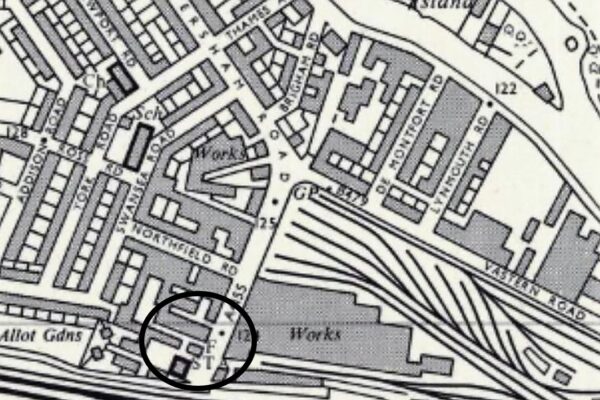
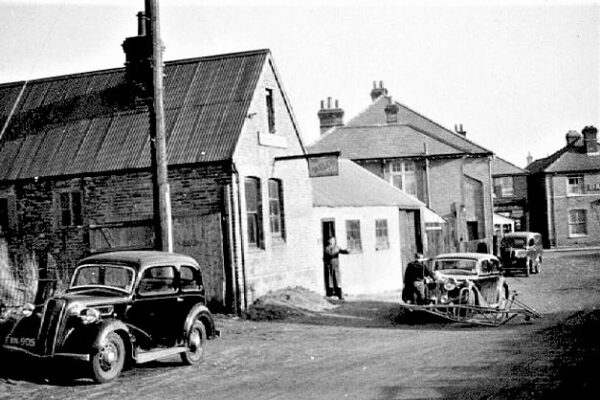
On 25th June 2022 BIAG was pleased to be asked to send a representative to the unveiling of a plaque commemorating the location where Buckler cars operated, organised by David Montgomery, Registrar and post 1972 Archivist from the Buckler Car Register. The site located at 67 Caversham Road, Reading was latterly Dawsons Music shop and is now vacant awaiting re-use. Until the late 1980s, it was one of two semi-detached properties, with an access road opening into a large yard surrounded by warehousing and small buildings.
Buckler Cars site at 67 Caversham Road in 1962 (Courtesy of Buckler Car Register)

1962 – Location of Reading Site (OS Map – reproduced with permission of the National Library of Scotland
The Buckler Car Company was founded by Derek Buckler (Chadwick Derek Frank Buckler 1910 – 1964). It was known for its high-quality cars that were supplied either fully built to order with a works body or optionally, and more frequently, in component form for home completion. The cars were designed to accept a range of mechanical components which enabled buyers to create a lightweight sports car suitable for road use and also for rallying and racing.
Derek Buckler started work at fourteen years old in his father’s motor engineering company, Frank Buckler Ltd, before going on to train as a solicitor. However, by 1932 he has returned to the engineering business becoming the transport and sales director of another of the family firms, Watford Dairies. In 1938 he became the sales organiser for the company, and it is in this year that his father dies and, along with his brother Murray, he inherits Johnson Roberts Ltd, engineers to the motor trade along with other family businesses.
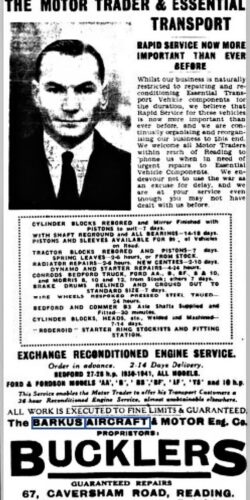
The next few years saw the company’s work devoted to supporting the war effort, and it was during this time that the brothers purchased another service company called Barkus Aircraft and Motor Manufacturing Company located in Reading. After the war, the brothers go their separate ways with Murray managing Johnson Roberts Ltd, while Derek takes over Barkus and another company that they owned called Welco Farm Implements in Hill Heath Road South, Crowthorne. Welco were makers of agricultural implements and hammer mills.
Advert for Barkus Aircraft & Motor Eng. Co from Reading Standard of 24 Dec 1941
According to Les Brown in his book ‘Special Obsessions: A History of British Specials 1947-62’, Derek Buckler began to take an interest in car chassis design in 1946, when he saw an unfinished racing car that a friend had recently bought. From 1947, Buckler was designing chassis to take the engines of production cars, and fitting light-weight aluminium and fibreglass bodies to make them go faster.
The company name changed from Barkus Aircraft & Motor Eng. Co. to Buckler Cars and they began specialising in sports and racing cars. They operated out of the site in Caversham Road, Reading and the Welco Works site in Crowthorne; the Crowthorne site stopping its agricultural machinery manufacture when the Caversham Road site ran out of space to focus on the manufacture of the spaceframe chassis.
Welco Works, Crowthorne (courtesy of Buckler Car Register)
1961 – Location of Crowthorne Site (OS Map – reproduced with permission of the National Library of Scotland)

Buckler had the aim of producing cars with excellent handling characteristics, good acceleration and also with good fuel economy. The cars all had multi-tube chassis and Buckler was a pioneer of the spaceframe, an approach established in the aircraft industry. The company’s designs used light narrow-gauge tubing to form a three-dimensional skeletal frame to which the engine, suspension and bodywork were attached.
1947 - DDP 201 chassis (courtesy of Buckler Car Register)

The first car they produced had the registration of DDP 201. It was designer Derek Buckler who then tested it on the roads around Berkshire where the bare chassis not only turned heads but also occasionally caught the attention of the police. At the plaque opening ceremony David Montgomery, the company’s archivist, told us that the fire brigade, who were and still are in the building next to 67 Caversham Road, used to help with building the prototype machines and providing water and space for the suspension to be tested.
The picture below shows this first car in January 1950 on the Thames-side promenade near to Caversham Bridge. Standing on the right is Derek Buckler and to the left is Mark Cook, who later became the company secretary. At the wheel is Bob Drew, the works manager.
1950 - DDP 201 in Reading (courtesy of Buckler Car Register)
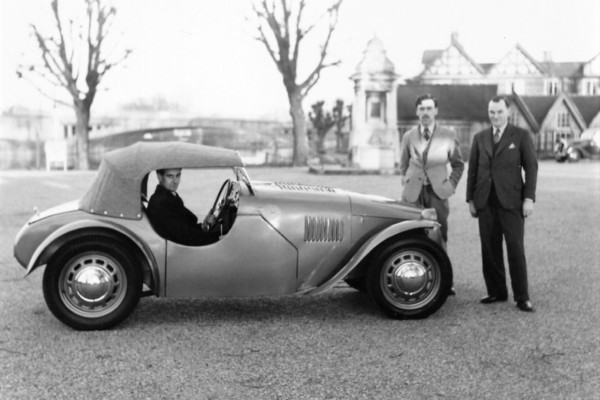
Following the war, the demand for private motor cars grew, but rationing and high taxation put new cars out of the reach of most people. Added to this, the supply of steel for car production was conditional on manufacturers selling most of their output overseas to provide foreign currency to boost the British economy. Buckler’s solution was to use pre-existing engines and parts, attached to a lightweight frame, clad in a simple aluminium, latterly a fibreglass body, to develop a car for both leisure and sport. In doing this, he pioneered two motoring trends; firstly, the self-build ‘Specials’ and kit-car movement, and secondly, the spaceframe chassis. The DDP 201 used an engine one from a 1939 side-valve Ford Ten.
1949 – First production car leaves Caversham Road site (courtesy of Buckler Car Register)

Buckler supplied all the components of the car, except the body. This was because home-built cars (or ‘specials’ as they became known) were exempt from purchase tax, which at this time, could have added around 50% to the cost of the car. Customers had to make their own arrangements to obtain body panels and often used C F Taylor Ltd, a company conveniently located at the rear of the Buckler’s Crowthorne factory. As a result of this approach to manufacture, Buckler cars appeared in many forms and were not always immediately identifiable, particularly as owners sometimes did not receive a Buckler badge until they had sent a photograph of their finished car to the office at Caversham Road.
C F Taylor Ltd, the company who made the body panels for Buckler cars went on to become a worldwide business itself, involved in aircraft and marine engineering, packaging and plastics. The plastics division is said to have made props for the 20th Century Fox film Cleopatra, including eight golden crocodiles, twenty-four griffins and six swans for Cleopatra’s bath.
On the sporting front, between 1947 and 1956, Buckler won over two hundred awards in trials, hill-climbs, rallies and circuit races. In the summer of 1953, he took a car to the Cheltenham Motor Car Club’s fuel economy rally, staged over a route of 578 miles. Averaging 30 mph, Derek Buckler won the ‘Specials’ section, with an overall fuel consumption figure of 91.023 mpg.
1956 – Buckler Mark X (courtesy of Buckler Car Register)
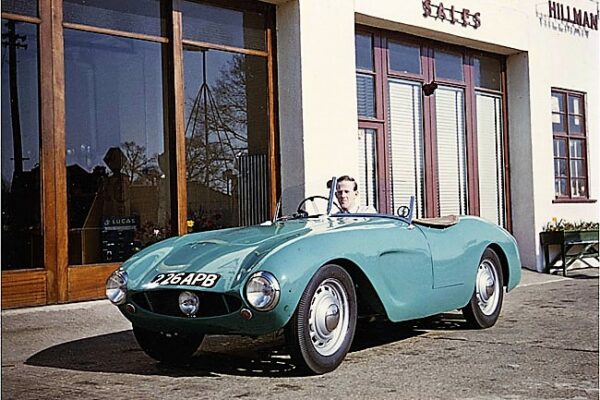
Over the next fifteen years, Buckler developed a range of lightweight sports car designs. The first was the Buckler Mk V, said to have been named to suggest that it was not the company’s first car, followed by the longer Mark VI (based on the Ford Prefect), and then the Mark X, with a full-width body.
In 1954, the company split into Buckler Engineering, based in Reading, and Buckler Cars, in Crowthorne. The Reading site manufactured a wide range of products for both the specialist builder and other manufacturers and undertook individual orders for engine, suspension, and gearbox modifications. The Crowthorne site continued to manufacture the spaceframes and built cars for customers.
1970 – Buckler BB100 racing prototype (1959) in Woodcote Way, Reading (courtesy of Buckler Car Register)
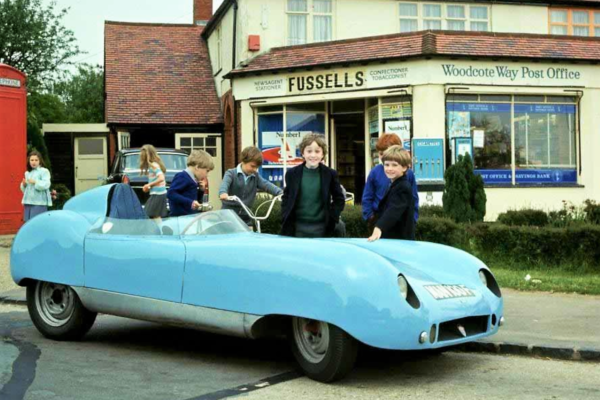
After success in the early and mid-1950s, Buckler’s popularity waned as other manufacturers came on the scene and the kit-car market began to lessen. In 1956, Derek Buckler withdrew from motorsport after suffering a heart attack, and in 1958, Peter Hilton was appointed to run the Crowthorne factory and in the same year Buckler produced his final design, known as the BB100, said to be the first true Backbone space frame. It had an aluminium body and retained the Ford 100E side-valve engine. Its overall weight was just 7¼ cwt (less than 370 kg).
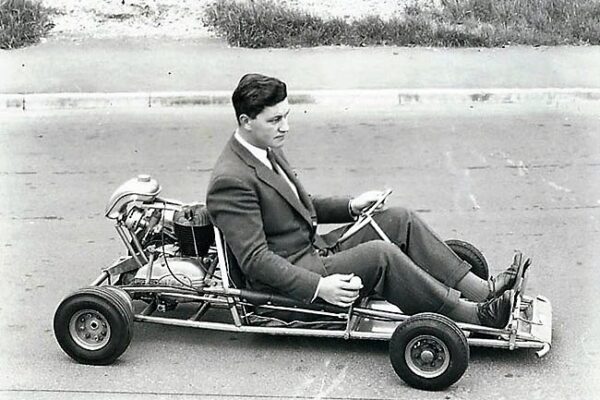
Also, in 1958 the company built their first kart. Karting as a hobby was in its infancy, but Buckler saw the opportunity and with their expertise in lightweight machine developments were in a good position to start design and manufacture. Buckler had considerable success entering the new go kart market in the 1960s, led by Jack Barlow.
1950s – Peter Hilton driving a Buckler Kart (courtesy of Buckler Car Register)
In 1961, Derek Buckler sold the Crowthorne factory to Mike Luff and Frank Fletcher. Car and kart production continued but with Buckler’s departure it lost momentum, despite him being retained as a consultant, and in 1965 the company went into liquidation.
Derek Buckler died in 1964 at the age of 53. The Reading firm continued to operate for four more years, but the loss of its founder, and the decline of the ‘Specials’ market led to the company’s closure in 1964. The site then became Dennis Hands motor dealership. In 1982, it was occupied by the Berkshire Motor Co., then Lords of Reading, and finally, Carvell Car Hire in 1987. After this, there were no more motor-related businesses on the site.
Between 1947 and 1962 Buckler produced around four hundred cars. They were also famous for their tuning accessories and manufactured close ratio gear sets that were fitted to most early Lotus cars, TVRs and many Ford Specials of the 1950s.
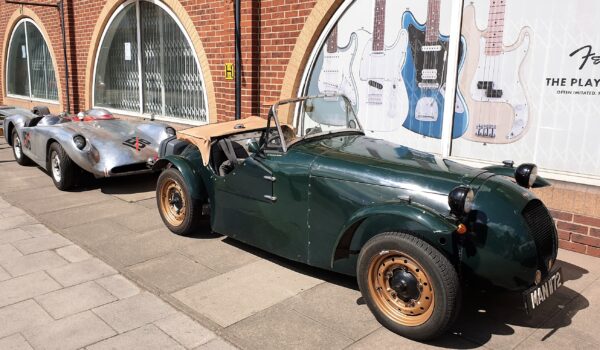
On 25th June 2022 a plaque to commemorate the site of Buckler Cars in Caversham Road, Reading was unveiled by Keith Ambrose, Derek Buckler’s son-in-law, accompanied by Malcolm Buckler, Derek Buckler’s son and Simon Ambrose, Keith’s son. The Buckler family kindly brought a number of their cars and lined them up outside of the building that now occupies the site of the former factory.
2022 – Plaque Unveiling (photo: Jo Alexander-Jones)

2022 – Buckler Plaque (photo: Jo Alexander-Jones)

2022 – Buckler car outside former Buckler Site (photo: Jo Alexander-Jones)
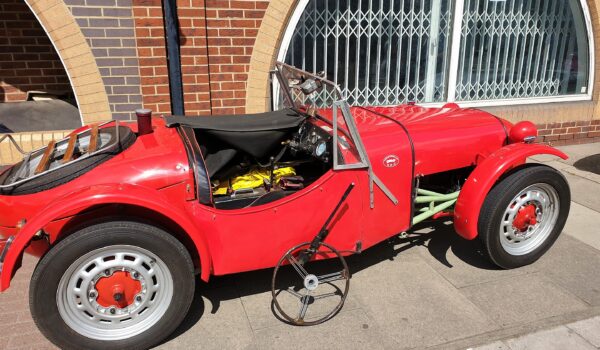
2022 – Buckler cars outside former Buckler Site (photo: Jo Alexander-Jones)
In 2007 a similar plaque had been placed on the site of the Buckler factory in Hill Heath Road South, Crowthorne, to commemorate this important Berkshire company.

Bibliography and Sources:
- Graces Guide – Buckler Cars
- Motor Sport Magazine – Buckler pp 961 – 965 (Sep 1985)
- Reading Industries (Part 2) – BIAG News No 34 (Spring 2015)
- Buckler Cars and Karts
- Britain By Car
- Special Obsessions: A History of British Specials 1947-62 by Les Brown (2017)
- Fast Lane to success (Reading Evening Post 15 Aug 1997)