


Brickmaking in Berkshire
Bricks and tiles have been made in Reading since the medieval period using the clay around the river Kennet which is of good quality and easily manipulated. In the 14th century brickmaking was established in Berkshire, with Reading being the chief centre. Even earlier there is evidence of brick and tile making in central Reading, such as the medieval tile kilns in Silver Street.
The Reading and East Berkshire area has no extensive local deposits of building stone, so the development of bricks was imperative to avoid having to ship in stone at great expense.
Berkshire Geology (taken from Berkshire by H W Monckton)
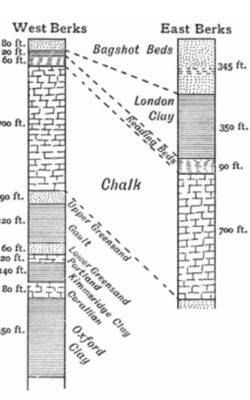
Reading sits on the Reading Beds which give a distinctive red brick. With the addition of various amounts of chalk, a yellow or silver-grey brick can be produced. The need for chalk to both prevent shrinkage and adjust colour explains why the areas of brick manufacture often have associated chalk pits.
Further east of the county the base material is London Clay which also produces red brick, with the Bracknell and Wokingham area in particular exporting yellow bricks to London.
There were at least 51 tile and brick manufacturers in Berkshire and most likely many smaller local kilns.
The Romans were the first brick makers in the area, some workings having been found near Abingdon. Typically, their bricks were 9 inches square and 2 inches thick (so more like tiles). After the Romans left Britain, brickmaking all but died out and buildings made in the Dark Ages used bricks robbed from older buildings. Reading does have a medieval tile works in Silver Street.
Brickmaking was re-started in the 15th and 16th centuries. Typical Elizabethan bricks were smaller than modern ones and expensive items, so they were only used for important buildings, such as Hampton Court. Simpler houses were timber framed, with wattle and daub infill, or occasionally with some brick infill. These bricks would usually be made on an individual basis, for a specific building, and this practice continued until the 19th century.
In the late 1700s brickfields and kilns begin to appear around Katesgrove, later the centre of the industry would move to Tilehurst and Calcot. The name Tilehurst is derived from ‘a wooded hill where tiles were made’. None of these brickworks survive, the Prospect Park Kiln at Honey End Lane was the last to operate.
Brickworks in the Reading Area
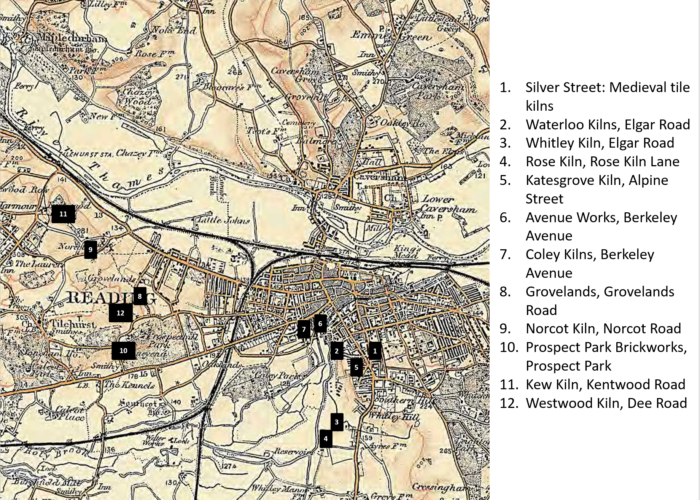
By the 19th century brick and tile making was a major industry and employer in the Reading and Bracknell areas.
The Brickmaking Process
Brickmaking is a very labour-intensive industry and even after the industrial revolution much of the activity remains manual, although over time the operations tended to change from mostly manual working to large, steam-based machinery being used whenever possible. It is the industry that gives us the term ‘hard graft’ – graft (groftr) is the Norse term for how much earth a man can dig and throw in one movement.
Bursledon Brickworks (from the Brickworks Museum)
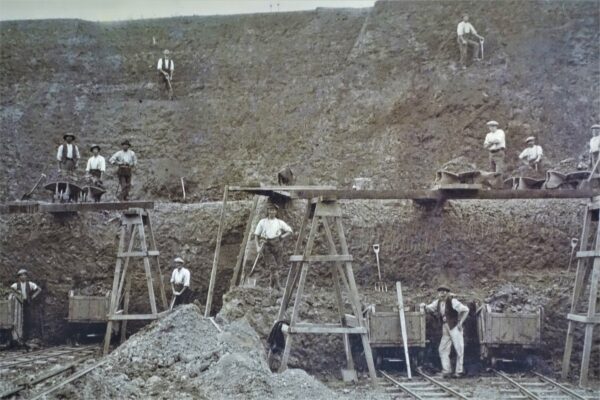
The basic steps in making bricks are outlined below:
- Dig out the clay
- Wash the clay to remove stones, normally in the Wash Pit
- Pile up the washed clay for a few months to weather
- Mix the clay with water, and other often ingredients to change the quality or colour, in a pug-mill. The mill squeezes the clay making it into a soft malleable form
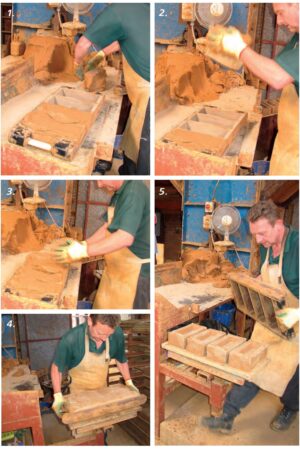
- A ‘clot’ or ‘warp’ of clay which is roughly brick-shaped is prepared [1 in photographs]
- The ‘clot’ is It is thrown into a sanded mould box and any excess is removed with a wooden ‘strike’ or wire ‘harp’ [2 & 3 in photographs]
- Palette board is placed over the mould, which is then flipped over [4 in photographs]
- Mould box is lifted clear, leaving bricks on the palette board [5 in photographs]
- Stack the ‘green’ bricks in long, low drying sheds allowing wind and air to dry them (if the clay is too wet steam can build up inside and they will then explode)
- Fire the bricks; the earliest firings were done by heaping the bricks and fuel together and covering them with turf, but simple kilns followed – a single ‘clamp’ of a brick arch covered with turf being one of the earliest, followed by round brick kilns. Over time these developed in to more sophisticated kiln types using fires made of wood, charcoal and coal
- It takes about 5-6 days with the kiln being fired day and night for 3 days, then allowed to cool
Bricks were moulded during the summer – an Act of Parliament only allowed this to occur from March to October, as the quality of bricks made in winter was poor as the clay needs to dry before being used.
The moulder, who would be in charge of a small group of men, could make around 1000 bricks per hour by hand.
From Earth, Brick and Terracotta - Historic England
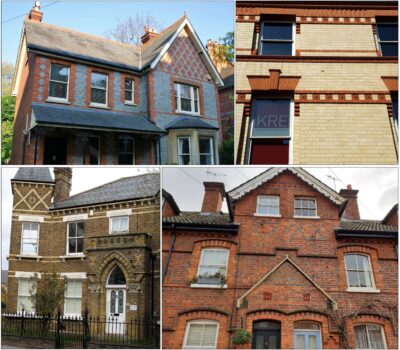
One thing that is very notable in the brickwork of Reading is the wide range of colours. Colours can be the result of the base clay, but it can also be introduced through the firing process. Often a hotter and longer firing will produce a deeper colour. Some of the most common causes of the widely seen colours are described below:
- Red – iron impurities
- Yellow, cream or white – high lime impurities, often chalk was added
- Blue – very hot firing gives a bluish tint. Often glass was added which gave the bricks a vitreous appearance
Many local architects used locally sourced decorative bricks in their buildings. Alfred Waterhouse is said to have used bricks from these kilns in his buildings in Reading and wider.
Brick colours in Reading (from top left – 9 Craven Road, Cross Street, The Mount, School Terrace
Katesgrove and Waterloo Kilns
Katesgrove Kiln was located in south-west Reading where Alpine Street is now, and Waterloo Kiln was further south on what is now Elgar Road. This area was and is still now known as Katesgrove.
OS Maps 1875 and 1889 (reproduced with permission of the National Library of Scotland)

Until the mid-18th century this area of Katesgrove, beside the river Kennet, was a rural landscape mainly used for market gardens. Below we can see the area in a picture drawn in 1734 by J Ryland; it is in the foreground looking north towards Reading’s centre. Even by 1798 John Man’s map is showing the area as mainly gardens.

The earliest ownership of the Katesgrove Kiln to be found to date is John Chapman. When he took on operation is not known. We know this because he is mentioned in the newspaper article concerning his successor, John Waugh.
The Reading Mercury of 3rd June 1771 sees John Waugh selling a house in Sun Lane and he is described as a stationer and bookseller in Fisher Row of Reading who has taken over the brick kiln of John Chapman at Katesgrove. It notes that he will still continue to act as a bookseller and stationer. However, by April of 1773 John Waugh has pulled out of the stationery business and his business is taken over by one of his apprentices, John Samman, who then opens a shop in Duke Street. Also, in 1773 John Waugh places a notice in the Reading Mercury on 8th March describing the location of his Katesgrove kiln as the brick kiln in the parish of St Giles in Reading. He states that since taking over he has had time to prepare a large stock of all kinds of kiln ware and will be able to supply lime, bricks, tiles, foot and nine-inch pavements and similar to anywhere in England. He also notes that as he is an agent for the Royal Exchange Insurance Office he can insure houses, buildings and goods for damage by fire.
On Tomkins map of Reading 1802 there is a brick kiln, which is labelled as Mr Waugh’s Brick Kiln in Katesgrove. Shown below is the Tomkins map and the corresponding 1875 Ordnance Survey map which shows the kiln site and the location of a geographical feature called Bob’s Mount that sits beside the brickworks (Bob’s Mount can also be seen on the 1798 John Man map above).

The Tomkins map is the last information that dates John Waugh’s tenure of the Katesgrove kiln. Sometime between 1802 and 1828 John Waugh departs Katesgrove Kilns as in an article in the Berkshire Chronicle in 1828 we see a court case that mentions events relating to the ‘brick-works of Mr Fortnum of Katesgrove’. There may well have been owners / leasers between Mr Waugh and Mr Fortnum.
On 6th July 1829 there is an advert in the Reading Mercury announcing that the Katesgrove Brick and Lime Kilns in Katesgrove Lane is available on a 7-year lease. The site is described as an old-established business, adjoining the navigable river Kennet. The property comprised a good dwelling house, offices, coach house, stable, excellent garden with well-stocked fruit trees, shrubs and vegetables. It also has numerous buildings for carrying out kiln business and several pieces of pasture and meadow land with the total site measuring eighteen acres. The notice also includes in the lease four cottages and gardens in Katesgrove Lane. It goes on to say that ‘the almost inexhaustible mine from which the clay and chalk are dug is very advantageously situated on an eminence a short distance from the kilns, and clay continually falls down so that the expense of digging is very trifling. The goods may be carried on a level from the kilns to the town or put in barges in the river Kennet which is only a few yards from the kiln. The goods and wares made at these kilns are universally allowed to be the best in the neighbourhood’. A similar advert in the Reading Mercury of 16th March 1829 directs those interested in the lease to inquire of Mr Fortnum, the same as was mentioned as the owner a year previous.
We don’t know who leased the kiln in 1829, but by the time of the 1840 Tithe Map of St Giles Parish [1] the Katesgrove Kiln is owned by Richard Billing, who also has the meadow and rough pasture that surround the kiln and most importantly abut the river Kennett. On the Tithe map there is an inlet on the river leading into Billing’s land, by no. 29 on the map, and this would provide a landing and loading point for raw materials and brick products. The large house and gardens to the north of the kiln was the home of Thomas Philbrick who was part of the Philbrick tannery who operation in Katesgrove. It is possible that Billing took over the kiln lease in 1829 and went on to buy the property, but we do not have firm evidence of this.
The same tithe map shows that Richard Billing also owns part of Waterloo Kiln; the other part was owned by Sir William Milman, a local landowner, but it was occupied (leased) by George Shackel. George Shackel was a large tenant farmer in the area so it is most likely that the kiln was being operated by Richard Billing alone.
Billing is also occupying a brickfield, pasture and cottages that is owned by Sir George Rose; it is the site that was later known as Rose Kiln brickworks. Billing’s Tithe Apportionment for this site includes an ‘occupied road’ which is the forerunner of Rose Kiln Lane and at this time leads all of the way to the Basingstoke Road. The brickfield site is described as ‘waste’ implying that it is not operational when the tithe survey is undertaken. The Rose Kiln operated until 1911.
1840 Tithe Map of Reading (Reading Library)

In a reference to a local cricket match in August 1841 one side is described as the employees of ‘The Tweeddale Patent Tile and Brick Company’ works at Waterloo Kiln. This may well be the name that Richard Billing used for his brick and tile works as he was still the owner at this time or this may be an additional company that operated on the site. The Tweeddale patent was for a mechanical tile drain making machine. There is also another name associated with the Waterloo kiln at this time, which is Mr Howard. In 1843 he appears on an advert for a tile maker, in 1845 in a sales offer for Waterloo kiln and also in 1845 in a coroner’s inquest where he is described as Mr Howard, the foreman at Waterloo kiln. It looks as though he was running the brickworks for Richard Billing. With respect to the sales notice in 1845, it would appear that the sale did not happen as ownership did not change from Richard Billing, but it may have been an early indication of the financial difficulties that would later cause Billing to sell the site. In line with the laxer advertising rules of the time, the sales notice describes the brickworks as having ‘an abundant supply of the finest brick and pottery earth in the kingdom.
Pigot & Co’s Directory of Berkshire in 1844 includes Richard Billing & Son, who are brickmakers with the address of Bridge Street, Reading. Bridge Street is most likely their home and/or offices as the actual kiln site doesn’t have any obvious living premises and would not have been within easy reach of many local residents. In the same directory Billing & Son are also described as slate merchants, slater and timber merchants.
The 1848 Kelly’s Berkshire Directory describe Richard Billing & Son as brickmakers and coal merchants in Katesgrove. It also has Richard Billing, junior, as a brickmaker at 8 Southampton Street. Then in April 1849 Richard Billing has a tender accepted for the ‘erection of the East Wing of the Royal Berkshire Hospital for £1390; it isn’t clear if this is Richard Billing Senior, the builder, or Richard Billing Junior, the brickmaker, but it is most likely that both would be involved in such a large building enterprise.
Despite winning such a prestigious project as the extension to the Royal Berkshire Hospital, or maybe because of it, in January 1852 both Richard Billings are declared bankrupts. The Berkshire Chronicle of 3rd January [19] has notice of three of Messrs R Billing & Son’s lots for auction:
- Freehold brickyard at Katesgrove of 12 acres with an inexhaustible quantity of good brick earth and every accommodation for carrying on trade in brick and tile making and lime burning. Large brick kilns, drying sheds, counting-house, cottage, stabling, granary, cart sheds, pug mill and other trade fixtures
- Freehold land of 1 acre alongside the river Kennet at Rose Kiln, adjoining property of Sir George Rose, with large brick kiln, sheds which has for many years been used as a brick yard and well suited for carrying on an extensive brickmaking business in connection to the adjoining property
- 5 Southampton Place, held under lease from the Corporation of Reading with 62-years unexpired lease. 2 parlours, drawing room, 4 bedrooms, servant’s bedroom, kitchen, scullery, wine, beer and coal cellars, WC, walled garden, currently occupied by Mrs Richards
In a letter to the editor of the Reading Mercury in June 1859 Richard Billing described himself as a brickmaker of sixteen years who subsequently became an estate agent after his bankruptcy.
On 28th February 1852 an announcement in the Berkshire Chronicle states that E Salter & Co have purchased Katesgrove Kiln from Messrs Billing & Son. We know from the report of a robbery at Katesgrove Kiln in 1853 that the E Salter is Ebenezer Salter. [22] Kelly’s 1848 Directory has Ebenezer Salter as a grocer, bacon factor, ales store seller and also an agent for Sweetman’s Dublin porter and for the Argus Life Assurance Company. He is operating at 15 and 16 Castle Street.[17] Earlier in 1844 Pigot & Co’s Directory of Berkshire has him as a grocer and tea dealer at 16 Castle Street. The move into brickmaking is quite a change for Ebenezer Salter, as it had been for John Waugh in earlier times.
In September 1854 John Leach is described in the cricket report in the Reading Mercury as the owner of Caversham and Waterloo Kilns. In 1843 he had taken ownership of Caversham Brick Kiln in Emmer Green from Henry Berry and John Dormer. In October 1867, John Leach places a notice in the Berkshire Chronicle announcing his retirement and that his business ‘Waterloo, Reading and Caversham Brick, Tile & Drain Pipe Works’ be taken over by Wilson & Ward as of 15th October. The business had its offices and a wharf at 39 Kings Road.
While Waterloo kiln is an operational brickworks, as with many operations at this time, the land is not solely dedicated to brick and tile making. In the 1840 Tithe details the area of the kiln includes pasture, meadows and Withey Eyot where willows were grown and used for basket making (osier). There was also a cricket field. In 1865 Waterloo kiln is advertising for a farm steward who understands the management of pasture and arable land and livestock. The advert also suggests that if the steward was married his wife could look after dairy or poultry stock. This usage continues and in to the late 1880s the kiln had pigs as six of them contracted swine flu. Parts of the land was also used for public needs. In 1866 John Leach allows Reading’s Health Board to have parts of the land for the deposit of ‘night soil’ (human excrement). While the land was leased for free Mr Leach did benefit from the Corporation repairing the road that led to the kiln.
At roughly the same time, in April 1866, the Reading Mercury has a notice stating that John Poulton has taken over the Katesgrove Kiln from the previous owners E Salter & Co. Ebenezer Salter places a notice announcing that it is as a result of the death of Samuel Collier that his company’s business at the Katesgrove Kiln will be discontinued. Ebenezer Salter dies in 1870.
John Poulton was born on 5th November 1811 in Marylebone, London. He first appears in Reading in the 1861 census with his wife Isabella and their seven children. The eldest child is William and he will later be involved in the brickmaking concern. He has three younger sons, John, George and Frederick (Alfred Frederick) – the younger two work in Poulton’s china and glass merchants and John is involved in brickmaking, but not obviously with the two kilns featured here. On this census and in all of the census he features in he is described as a ‘China and Glass Merchant’ in Broad Street rather than a brick maker.
In August 1870 the Berkshire Chronicle reports that the ‘Inspector of Nuisances’ is to be authorised to take proceedings against John Poulton to stop the issues he has been causing from burning bricks in his kiln at Katesgrove. The report implies that the issue is due to the installation of a new kiln, but no details are given nor has the actual report been found. In describing burning it is most likely that the issue is the brick firing process.
A year later the marriage report section of the Reading Mercury in December 1871 notes the wedding of Isabella Poulton and James Berkshire and more importantly for this article it is the first reference to John Poulton as ‘of Katesgrove and Waterloo Kilns’. The actual timing of his taking over the management of Waterloo Kiln from John Leach is not known. From later information in 1875 a report on Reading Corporation works refers to Waterloo kiln which describes the brick kiln as being occupied by John Poulton and son, it also notes that the land belongs to Richard Attenborough, a large local landowner. So Poulton was at this time, at least, leasing the brickworks rather than owning them.
By 1874, there is an indication that John Poulton is building houses in Reading in that he is offering for ‘cottages for sale (freehold and leasehold)’. The enquiries are directed to the either the Glass & China Warehouses at 105 Broad Street or to the office at Katesgrove Kiln. While it doesn’t specify that Poulton is the builder of the properties it would make sense for a brick maker to move into property development.
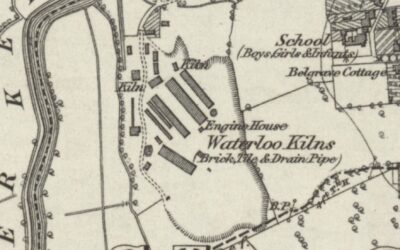
The 1875 Ordnance Survey map of the Katesgrove area shows the kilns, described as Brick, Tile and Drain Pipes. From Bob’s Mount we can see the land sloping down and across heath and rough grassland, and potentially marshy land, to the clay pits. To the west side, by the river Kennet, is an inlet most likely to be a wharf surrounded by buildings; these and others around the site are likely to be drying areas and kilns. Running vertically across the site is a tram road which would have been used to transport the clay and other goods on the site and out of the kiln area.
1875 Ordnance Survey Map of Reading (reproduced with permission of the National Library of Scotland)

A slightly later map, from 1879, gives details of where the three kilns sat on the site, the clay mill or pug-mill (leftmost circle), the barge building shed (oval) and a tram road (oblong). There isn’t a full description of the site but the long oblong buildings would most likely be the brick drying sheds and we know that somewhere on site there are offices. The tram road would be a wat to transport the bricks and the raw materials as needed.
1879 OS Large-scale Town Plan (reproduced with permission of the National Library of Scotland)

At almost the same time Waterloo Kiln is outlined in the 1877 ordnance survey map. The format is very similar to the Katesgrove kiln site, here with two kilns and a set of rectangular brick drying sheds.
1877 Ordnance Survey Map of Reading (reproduced with permission of the National Library of Scotland)
An advert placed in the Reading Observer in early of 1st January 1881 shows that, whilst he is the owner of both Katesgrove and Waterloo kilns, John Poulton is still running Poulton’s Reading China Bazaar at 103 and 104 Broad Street. In the paper he is advertising the sale of Coalport China and ‘begs respectfully to intimate to his extensive connection of nobility, and clergy of the town, Royal County, and surrounding neighbourhood, that he has now on show various choice specimens of the above china’. He also notes that has been appointed the sole agent in the district for this product.
In 1882 John Poulton takes his retirement and in the Reading Observer of early January there are a number of notices placed which detail the changes to his empire. The notices announce the following:
- The partnership between John and William Poulton of Katesgrove Kiln, known as John Poulton & Sons, is dissolved by mutual consent. The notice informs the reader that William Poulton has had the practical management of the works for several years previous
- William Poulton, John’s eldest son, purchases the whole of the Katesgrove Estate, which he describes as containing ‘one of the finest and strongest banks of clay this side of London. It has been found that bricks manufactured from these clays will not absorb half so much as milder clays and that they will stand twice the pressure’
- George and Frederick Poulton, John’s youngest sons, take over The Reading China Bazaar, having been managers in the firm for several years
With respect to the Katesgrove kiln, going forward it will be known as Poulton & Son – The Adamantine Steam Brick Works, Reading’. Adamantine means “unable to be broken”.
Poulton brick from the Brickworks Museum in Bursledon, Hampshire
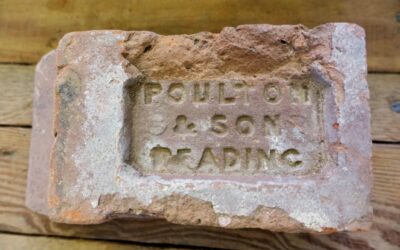
Poulton ‘special’ brick from the Brickworks Museum in Bursledon, Hampshire
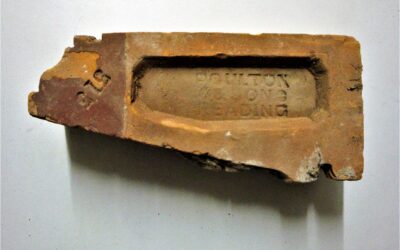
The above bricks are from the Brickworks Museum at Bursledon, Hampshire, and many thanks to the team there for bringing them out of their archives to be photographed.
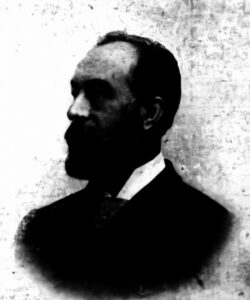
William Poulton was born in London in 1844 and moves with the family to Reading, where in the 1871 census he is shown as an assistant in his father’s china and glass store in Broad Street. By the next census, in 1881, he is married to Eliza Wright and living at 2 Milman Road in Katesgrove where he is cited as a brick manufacturer. He has one son, Francis, who is born in 1880.
William Poulton
There are few pictures of Katesgrove or Waterloo kilns, but a picture featured in the Illustrated London News of 8th July 1882 shows the view from South Hill looking north towards central Reading and it shows clay workings, of most likely Katesgrove kiln, in the foreground. There are men are digging at the hillside and loading a cart. The scene looks rather rural. Reading’s churches are in the background and the Katesgrove ironworks can be seen in on the left-hand side.
Reading from the south over Katesgrove (1882)

William Poulton focussed on the brick making operation and throughout the 1880s there are adverts and reports of the products being made. While he was supplying much of the brick work for new buildings in Reading and the neighbourhood, they also supplied to a much wider audience.
A report in the Reading Observer of 4th July 1885 notes that ‘Messrs Poulton & Son, of the Adamantine Steam Brickworks, had supplied the whole of the red rubbing bricks (bricks that are soft and can be rubbed in to shapes), red facing bricks and purpose-made bricks for rustic joints of the, then new, Blackfriars Bridge station in London that was being built for the Chatham and Dover railway’. The article also notes that the company has been supplying brick enrichments and purpose-made bricks for several private and public buildings in various areas of the country, but doesn’t give any specific names.
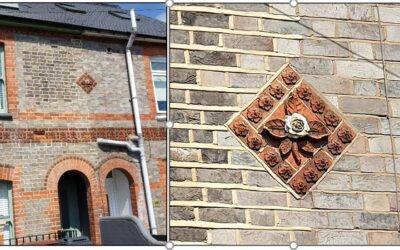
In April of the following year Poulton and Son has a stand at the Building Trades’ Exhibition in Islington. A report in the Reading Mercury of 24th April 1886 describes the display comprising red and silver-grey moulded and enriched bricks. The report describes their cornice brick ornamented with a vine, bunches of grapes and a gently curving vine stem and calls it something quite out of the ordinary. The article also describes how Alfred Waterhouse, the architect, used Poulton bricks (silver-grey and red) for most of the buildings he had built in Reading and the surrounding district, and he had pronounced them to be ‘excellent’. The exhibition display also included a new design of a diamond with a hand-modelled rose spray in bold relief with the flower being of a lighter colour than the surround. There is an example of this or a very similar design in Addington Road, Reading.
Poulton & Sons Terracotta Rose Design – Addington Road, Reading (Photo: Jo Alexander-Jones)
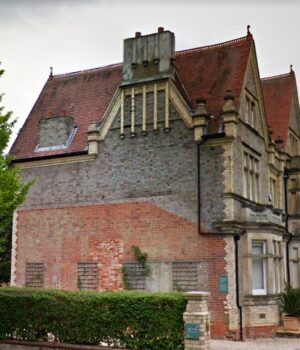
Poulton & Son produced much of Reading’s silver-grey bricks, which were more expensive than red bricks and tended to be used in house frontages. A example of how the different bricks were used can be seen on 16 Bath Road, Reading where the more expensive silver-grey bricks are fronting the house and are on the side wall which would have been exposed on this corner property. The part which would have been behind and single-storey area that has now been removed is built in the cheaper red brick.
Brick usage – 16 Bath Road, Reading (Photo: Jo Alexander-Jones)
On 23rd July 1885 John Poulton dies at his home in Theale. He was seventy-three years old. There is little written of him or his life in the newspapers as unlike his son, William, he led a private life. William, in contrast, is elected to the town council in 1887 when Katesgrove was first included under Reading borough, he later becomes an alderman and finally Mayor of Reading in 1899.
In mid-1886 the Whitley Grove Estate, which beside Elgar Road, is sold; it was previously the home of Richard Attenborough. As we saw from the 1840 Tithe map Mr Attenborough owned Waterloo kiln and it is included in the estate sale along with an included residence. While the house is sold elsewhere, it is highly likely that William Poulton bought Waterloo kiln at this time, but there is no direct evidence.
By 1888 we see adverts for the Adamantine Steam Brickworks appearing in newspapers around the country. These adverts are offering silver-grey bricks, red moulded bricks, ornamental bricks and brick enhancements. They also state that bricks can be made to an architect’s design all year round, produced within one month and that the mould would be kept in stock for later use.
While the brickworks operation was producing beautiful products, there were also a number of accidents occurring in the works. In early 1888 John Sopp was killed at Waterloo kiln; while digging the clay it fell, burying him and he was dead before he could be dug out. At the inquest his wife commented that he had suffered a similar, but non-fatal accident two years before. The process for digging out the clay bank was for a man to dig in to the clay wall creating an overhang, others then worked above the clay wall to cause it to fall or to be thrown down to the lower level. In the case of this accident the top-level clay fell faster than expected and encased the deceased. William Poulton, giving evidence, commented that the process used was perfectly safe and while the deceased was up to his work, he was rather slow in his movements. So, he thought it likely that when the warning was given instead of running away, he looked up the bank and so lost time. The coroner returned a verdict of accidentally killed by the fall of clay and no blame whatsoever was to eb attached to Messrs Poulton. While this was one of the more serious accidents, there were a number of incidents involving injury to workers.
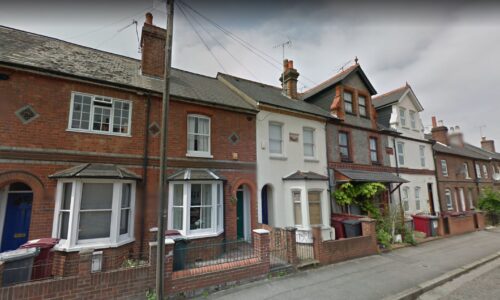
In the spring of 1888 Poulton & Son’s Adamantine Brickworks advertises land for sale. It is offered as freehold and described as having a 250-foot frontage to the river Kennet, 220-foot frontage to Elgar Road and is 125-foot deep. It is offered as suitable for a contractor’s yard, warehouses or for cottages. Looking at the 1900 Ordnance Survey map there are houses built on the area described (red oblong), which still exist now on the west side of Elgar Road.
1900 Ordnance Survey Map of Reading (reproduced with permission of the National Library of Scotland)

Elgar Road, Reading (Photo: Jo Alexander-Jones)
By this time the Poulton brickworks was well established and, as we saw above, the land that had been Katesgrove Kiln is being sold off for housing and the workings are focussed on Waterloo Kilns. To support the growing business Poulton had built an office at 185 Elgar Road – the location is the red circle in the 1900 Ordnance Survey map. The photograph below shows the office in 1900 with the workers arranged outside.
1900 - Katesgrove Kiln & Waterloo Kiln - Elgar Road Office (Reading Library)

The office and the houses built on Elgar Road were adorned with an astonishing array of brick and terracotta moulding for what is a typical “working class” road. The location acted as a living showroom for the company’s products allowing customers to see the brick and tiling in situ.
2021 – Decorative Brick and Tile work in Elgar Road (Photo: Jo Alexander-Jones)
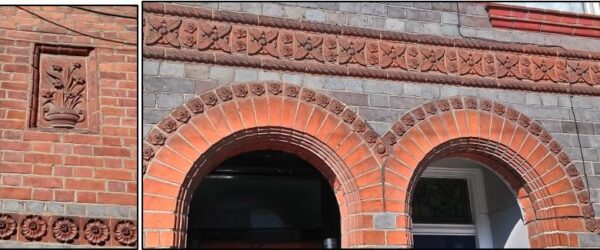
In 1896/7 the land that had belonged to Highgrove House sitting on the corner of Kendrick Road and Christchurch Road was developed by William Poulton. Using his own company products he built:
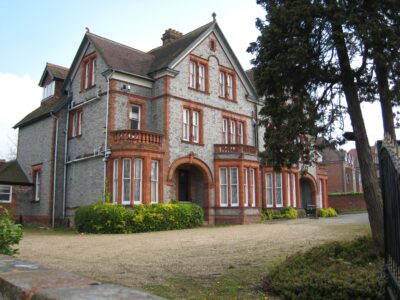
- 2 semi-detached houses at the top of Kendrick Road called Kendrick Rise and Dryburgh (now nos. 117 and 119 and part of the Sure Hotel complex)
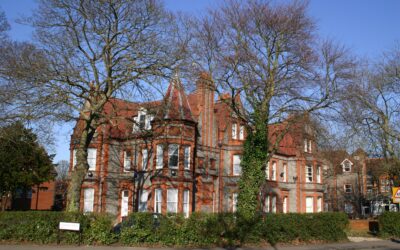
- 2 semi-detached houses on Christchurch Road called Kirkland and Bergheim (now nos. 35 and 37)
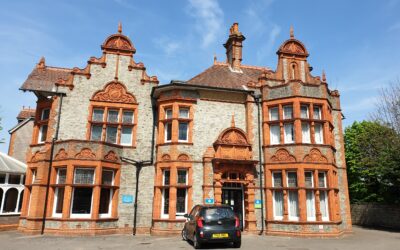
- 1 large detached house on Christchurch Road called Hillingdon (now no. 39 – Hillingdon Prince Hotel)
All of these properties still exist and are fine examples of Reading’s brick heritage using both the silver-grey and the red brick colouring and adorned with many terracotta decorations.
William moved into no. 39 Hillingdon and in the 1901 census has William living in ‘Hillingdon’ with an occupation of terracotta and brick manufacturer. He has with him his wife Mary, his son Francis and two servants. Francis is also a terracotta and brick manufacturer, having become part of his father’s business. By the 1911 census Francis has moved next door into no. 41 Mullingar which had been the western gate lodge of a large property called Sutherlands.
2022 – Kendrick Rise and Dryburgh, Kendrick Road (Photo: Jo Alexander-Jones)
2022 – Kirkland and Bergheim, Christchurch Road (Photo: Jo Alexander-Jones)
2022 – No 39 Hillingdon, Christchurch Road (Photo: Jo Alexander-Jones)
Poulton’s continued to sell of the land that had comprised Katesgrove Kiln and with this developed the housing in Elgar Road. The east side of the road had been built, once again showcasing Poulton brickwork, and Waterloo Road was now named. The Poulton office sat on the north corner of Waterloo Road with the end-of-terrace house on the south corner being built in 1904. The house still exists with its terracotta dated roundel and terracotta decorative panels.
2022 – No 183 Elgar Road (Photo: Jo Alexander-Jones)
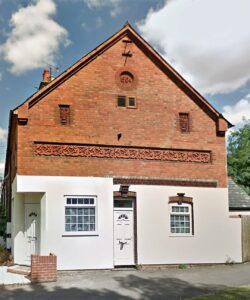
The 1901 OS map shows the completed terrace and the office sitting alone on the south side of Waterloo Road.
1910 Ordnance Survey Map of Reading (reproduced with permission of the National Library of Scotland)

With the exception of the single photograph of the offices and Ordnance Survey maps there is little description of the brickwork sites. There is one report from May 1905 which covered the celebrations for the employees held at the Adamantine Brickworks for the wedding and return from honeymoon of Mr and Mrs Francis Poulton. It tells us that there were over two hundred persons present, and while this did include the wives of the married men, it indicates a large workforce. The only description of the site is that a ‘large shed called Pretoria, was transformed into a dining hall’. This would most likely have been a drying shed or one used for storage, but it would have been significant to house over two hundred people. A later article from 1999 that was looking at Katesgrove claimed that the brickworks site reached 46 acres in total.
1905 was to be a big year for the brickworks on 9th August that year S & E Collier Ltd acquired the business of Messrs Poulton & Son of the Adamantine Brickworks. Collier was the largest brickworks in Reading at the time and with this acquisition, of what was most likely the second biggest brickworks, they cornered the local market and employed 350 workers. The price paid was £22,000 (about £2.8m in 2022). The land purchased was 21 acres comprising frontage on Elgar Road of 1500 feet, on Waterloo Road of 610 feet and on Hagley Road of 395 feet. It included the right of way and perpetual use of Wharf and Draw Dock on the river Kennet. When the Poulton brickworks is taken over by Collier William Poulton joins their Board of Directors.
The acquisition notices explain that Poulton & Sons, Patentees and Manufacturers will continue to be operated as a separate concern run by William and Francis Poulton. From this time adverts appear for Poulton & son, Boiler Setting Engineers and in the 1911 census this is the occupation description given by William. By the 1914 Kellys’ Directory William is living in Mullingar with his son Francis, and by 1920 he has moved to ‘The Elms’ in Christchurch Gardens. By this time he has retired and the company is being run solely by Francis. It is at ‘The Elms’ that William Poulton dies on 9th February 1920, he had continued his public engagements until three weeks before his death and his last appearance had been at the conferment of the freedom of Borough upon Lord Reading. His obituary in the newspapers he is described as the Chairman of Katesgrove Ward of the Reading Liberal Association and a prominent Congregationalist and Chair of the Executive Committee of the Reading Temperance Association. His probate sees him leaving £10, 412 (around £1.4m in today’s money) and ownership of all of the houses he built in Kendrick and Christchurch Roads. His son Francis sold all of the houses excepting Mullingar which he retained as his home.
S & E Collier continued to operate the Waterloo Kiln as a brickworks. In 1950, the whole property that comprised Waterloo Kiln was sold and converted into an area of light industrial buildings, garages and houses.
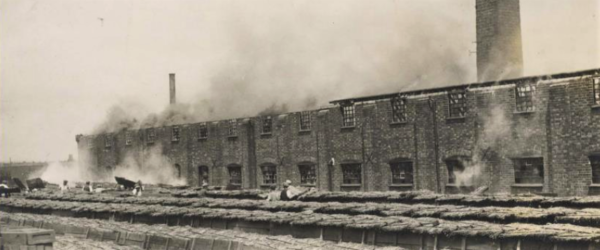
There was a fire at the Waterloo Kiln drying shed in 1928, which destroyed much of the old building.
Waterloo Kiln Drying Shed Fire – 1928 (Reading Library)
Below is an aerial photograph taken of the location of Katesgrove Kiln in 1920 (Britain from Above) and the same location as of 2022 (Google Earth).
1920 (top – Britain from Above) and 2022 (bottom – Google Earth) Katesgrove Kiln Area

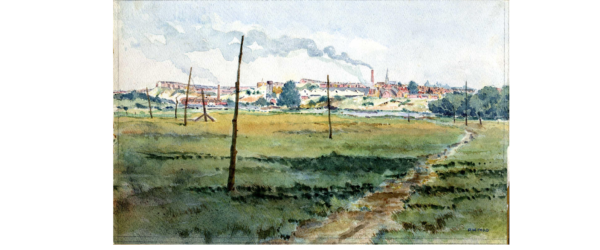
A watercolour by R W Ford from 1940 shows the view toward Reading across Fobney Meadows and captures the smoking chimneys of Waterloo Kiln in the background.
1940 View Across Fobney Meadow toward Reading (R W Ford)
Bibliography and Sources:
- Tithe Map of St Giles, Reading (1840)
- Berkshire – Cambridge County Geographies by H W Monckton
- Excavations at the Silver Street Site – Thames Valley Archaeological Services (2019)
- Building Material of Berkshire – Berkshire Geoconservation Group (2019)
- An Historical Atlas of Berkshire – Joan Dils & Margaret Yates (2012)
- Brickmaking: Resource Pack – Historic England
- Earth, Brick and Terracotta – Historic England
- 18th century: print, with the title “The South View of Reading, Berks., ” drawn and engraved by J. Ryland. (Reading Library)
- Map of Reading by John Man (1789)
- Reading Mercury – To Be Let (3 Jun 1771)
- Reading Mercury – John Samman – Late Apprentice to Mr John Waugh (5 Apr 1773)
- Reading Mercury – To All Gentlemen, Builders and Others (8 Mar 1773)
- Reading Mercury – To Kiln Masters, Builders and Others (6 Jul 1829)
- Reading Mercury – Brick Kiln to Let (16 Mar 1829)
- Berkshire Chronicle – Parental Affection (23 Aug 1828)
- Pigot & Co’s Directory of Berkshire (1844)
- Kelly’s Berkshire Directory (1848)
- Berkshire Chronicle – Royal Berks Hospital (21 Apr 1849)
- Berkshire Chronicle – Freehold and Leasehold Estates, Katesgrove (3 Jan 1852)
- Reading Mercury – To the Editor (4 Jun 1859
- Berkshire Chronicle – Katesgrove Kiln (28 Feb 1852)
- Berkshire Chronicle – Borough Police (18 Jun 1853)
- Reading Mercury – Cricket (2 Sep 1854)
- Reading Mercury – Caversham Brick Kiln (4 Mar 1843)
- Berkshire Chronicle – Public Notices (19 Oct 1867)
- Reading Mercury – E Salter (7 Apr 1866)
- Views from the Hill: The Story of Whitley and Memories of Whitley Life in Past Times – Dennis Wood (2017)
- Reading Mercury – Ebenezer Salter (16 Jul 1870)
- Berkshire Chronicle – Nuisance from Burning Bricks at Katesgrove (13 Aug 1870)
- Reading Mercury – Marriages (30 Dec 1871)
- Reading Mercury – Cottages for Sale (13 Jun 1874)
- Reading Observer – John Poulton (1 Jan 1881)
- Reading Observer – Notice (4 Feb 1882)
- Illustrated London News – View from Katesgrove (8 Jul 1882)
- Reading Observer – Adamantine Steam Brick Works (4 Jul 1885)
- Reading Mercury – Messrs Poulton and Sons Stand (24 Apr 1886)
- Bricks and Brickwork in Reading: Patterns & Polychromy – Adam Sowan (2020)
- Leamington Spa Courier – The Adamantine Steam Brick Works, Reading (14 Jan 1888)
- Reading Mercury – Freehold Building Land for Sale (19 May 1888)
- Reading Standard – Mr Wm Poulton (25 Jan 1902)
- Reading Standard – The Adamantine Brickworks, Reading: Employees Entertained (27 May 1905)
- Reading Evening Post – The Clay we were in the Good Old Days (15 Apr 1999)
- Reading observer – The Adamantine Brick, Tile and Terracotta Works, Reading (26 Aug 1905)
- Reading Standard – Messrs S and E Collier Ltd (30 Sep 1905)
- Grace Guide – Litholine, Poulton & Sons (1906)
- Kelly’s Reading Street Directory (1914)
- Reading Standard – Death of Mr William Poulton (14 Feb 1920)
- BIAG Newsletter 33 (Winter 2014)
- Bricks and Brickmaking – Martin Hammond (1981)
- Brick: A Social History – Carolyn Haynes (2019)
- Reading Standard – 100 Years of Brick Making (1 Feb 1952)
- Brickmaking in Sussex – M Beswick (1993)
- Reading Mercury – Cricket (14 Aug 1841)
- Berkshire Chronicle – Mr Pusey on Drainage (10 Dec 1842)
- Reading Mercury – A Plain Tile Maker Wanted (29 Aug 1843)
- Berkshire Chronicle – To Brick, Tile and Pottery Makers (19 Jul 1845)
- Reading Mercury – Inquest Before the Reading Coroner (22 Apr 1854)
- Reading Mercury – Wanted (16 Sep 1865)
- Reading Mercury – Sanitary Committee (20 Mar 1886)
- Reading Mercury – Night Soil (22 Sep 1866)
- Berkshire Chronicle – Works at Creek abutting upon Waterloo Kiln (6 Mar 1875)
- Reading Observer – The Whitley Grove Estate (29 May 1886)
- Reading Observer – Fatal Accident in a Clay Pit at Reading (17 Mar 1888)
- The Brickworks Museum at Bursledon: A History and Guide (2007)
- Waterloo Sunrise: Discovering the past, the life and the wildlife of Katesgrove – Katesgrove Community Book Project (1999)
- Brickworks Museum at Bursledon